

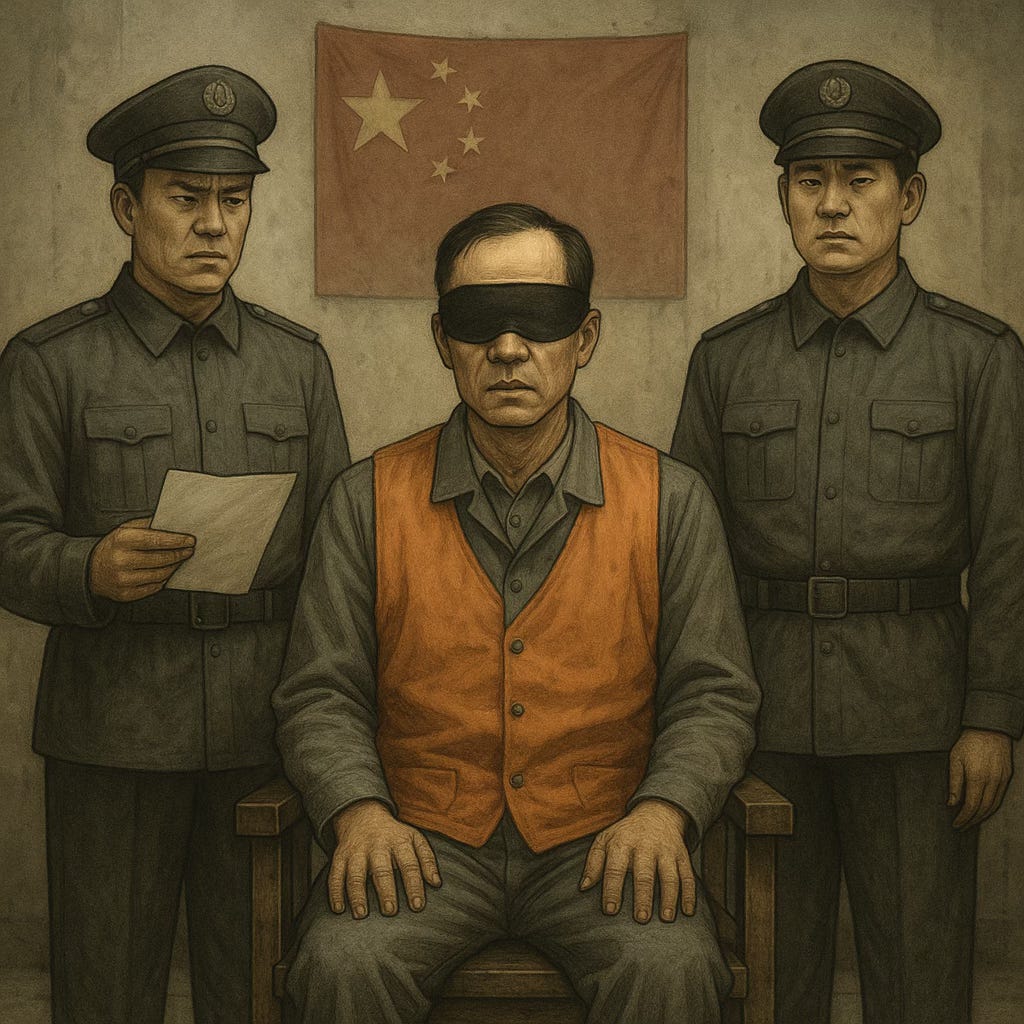
China’s government executed four Canadians earlier this year. It’s never killed so many foreigners in recent memory. Why do this? Why now? And what does it mean?
In a new #longread article in The Walrus I take you on a deep, dark dive into these questions. They matter because the CCP’s callousness in cases like these illustrates why it’s a threat to global norms that protect all of us, and also ultimately undermines its own propaganda.
Ending executions and arbitrary detention and protecting citizens requires a deeper understanding of the Party-state’s bureaucratic-authoritarian logic.
Key takeaway: Domestically, the point is to intimidate Chinese citizens by showing remorseless power and authority. For foreigners, the message is: Demonstrate subservience and we’ll stop doing harmful things.

In the past decade the PRC has executed at least seven Canadians and several others—including citizens of Colombia, the Philippines, Japan, South Korea, and the UK—all for drug trafficking, not violent crimes. Last year the Party-state said it would also impose the penalty on Taiwan separatists. Very few other states impose capital punishment for narcotics or kill foreign citizens. Why does China?
While use of capital punishment is declining worldwide, the Party-state still puts thousands of Chinese people to death every year. It reflects a widening divergence from the trajectory of liberal democracies that spans not only an intensifying geopolitical, geoeconomic and strategic rivalry, but also profound differences in political culture and social values.
The PRC’s “zero tolerance” policy for drugs has roots in a strict hierarchical, Legalist and Leninist worldview, plus the state’s historical narrative of the bitter memory of opium. Chinese officials say that public thirst for vengeance requires the death penalty. But that’s a distortion. The main drivers are elite opinion and the imperative to ensure regime survival through fear and coercion.
For drug enforcement, executions are unnecessary. Research shows that the certainty of being caught and punished is a stronger deterrent than the severity of punishment. Replacing the death penalty with prison sentences would free up money and time wasted on lengthy judicial reviews.
Are the main reasons for executions internal or external? It can be both. Like arbitrary detention, exit bans, civil-military fusion, technological dominance, and control of supply chains, the CCP is making all of its tools dual use. Arrests, trials, sentencing, and executions can all be timed for extra diplomatic signalling—or not. The ambiguity, uncertainty and deniability are part of the gaslighting.
Visiting China? Read relevant travel advisories1 to understand the risks. Plan for worst-case scenarios. Know someone detained or imprisoned in China? Check out Safeguard Defenders’ new handbook, Missing in China, to learn how to help them.
And read my full take in The Walrus.
Thanks to Joseph Widacki and Patricia Xavier for research assistance.