


China has dramatically expanded its presence and influence across the Pacific Islands with the strategic intent to align the region more closely with its own interests, I argue in a new essay for Foreign Affairs based on nearly three years of research for the International Crisis Group.
While China’s deepening involvement is expanding economic opportunities, its statecraft is also undermining Pacific nations’ democratic governance, accountability and national sovereignty, inducing corruption and elite capture, and roiling Pacific geopolitics.
Here’s a paywall-free link: The Pacific Islands Challenge: In America’s Tug of War With China, Oceanic Democracy Is Caught in the Middle
In the essay I applied a few narrative frameworks to explain what’s happening in the Pacific Islands. Here I’d like to riff on them a little more and I invite you to join me in considering how useful and accurate they are (or not) in making sense of what Beijing’s trying to do in the Pacific. You’re welcome to suggest other ones.
The Chinese Communist Party’s approach to the Pacific Islands is a subset of its aims for China to achieve dominance in the Asia-Pacific and centrality in international relations, showcase its alignment with the Global South, and divide the Global West from the rest. It reflects a worldview in which what it calls “comprehensive national power” is the dominant means of shaping international relations. In Foreign Affairs, Charles Edel has repeatedly warned about these challenges, as have many other experts on the Pacific elsewhere. First, let’s consider the CCP’s regional goals.
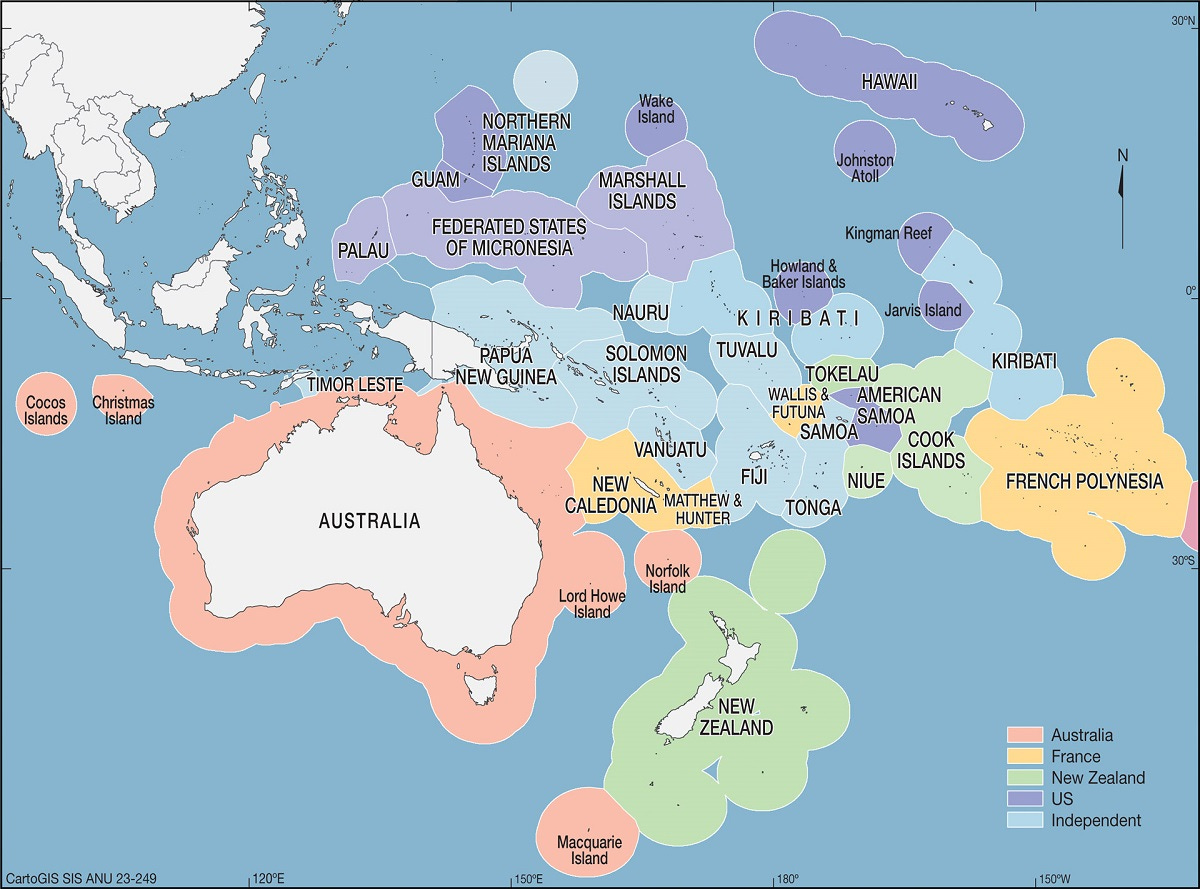
China’s Strategic Objectives in the Pacific
Embed China as a resident power in the Pacific.
Expand a sphere of geopolitical and geoeconomic influence in which interstate relations are based more on transactional calculations, interests and power than on laws, norms or values. Counter perceived Western efforts to promote a liberal international order and contain China. Drive wedges between the U.S., its allies and the Pacific Islands, and reduce Western influence in Oceania.
Extend China’s strategic space, military power projection, intelligence-gathering and surveillance capability into the Blue Pacific. Secure a Pacific maritime periphery, particularly sea lanes, potential shipping “choke points” and supporting infrastructure for commercial and military vessels to access the Central Pacific, South Pacific and Antarctica. Develop the capacity to deny access to transportation corridors and disrupt military operations in the event of conflict. Eventually acquire military port access and basing rights.
Diplomatically isolate Taiwan by inducing and coercing Pacific Islands to switch diplomatic recognition to Beijing. Enlist diplomatic support for Chinese positions. Stifle criticism and limit the influence of rivals, particularly in international institutions such as the UN.
Promote the CCP’s governance system and authoritarian vision of state-driven economic development as a model for other countries, and position China as leader and supporter of the Global South.
Expand and ensure Chinese commercial access to islands’ EEZs and natural resources. Improve resilience and diversity of supply chains.
Through the Belt and Road Initiative, engender economic dependence on China, promote trade and investment, and support and protect Chinese companies and workers in the region. Enhance the CCP’s domestic legitimacy by demonstrating it has made China a maritime great power that leads global initiatives.1

Breaking chains that constrain: China’s overarching goal
As military scholars Andrew Erickson and Joel Wuthnow have noted, Chinese analysts have adopted the American concept of successive chains of islands running north-south across the Pacific Ocean. PLA strategists variously describe these daolian (岛链) as concentric chains of containment to break, as springboards for Western military deployment, and as benchmarks for the PLA’s own expanding force projection capability. They worry that the complexity of the Pacific Islands results in “geopolitical tensions” and “obstacles” to the expansion of China’s national interests. As one PLA Navy scholar asserts:
“there are forces on these island chains aimed at containing China and its navy…. If the United States reduces the strategic importance of Guam, the second island chain’s containment pressure on China will also diminish….”2
China’s response: dominate the first chain, break through the second and distract in the third.3
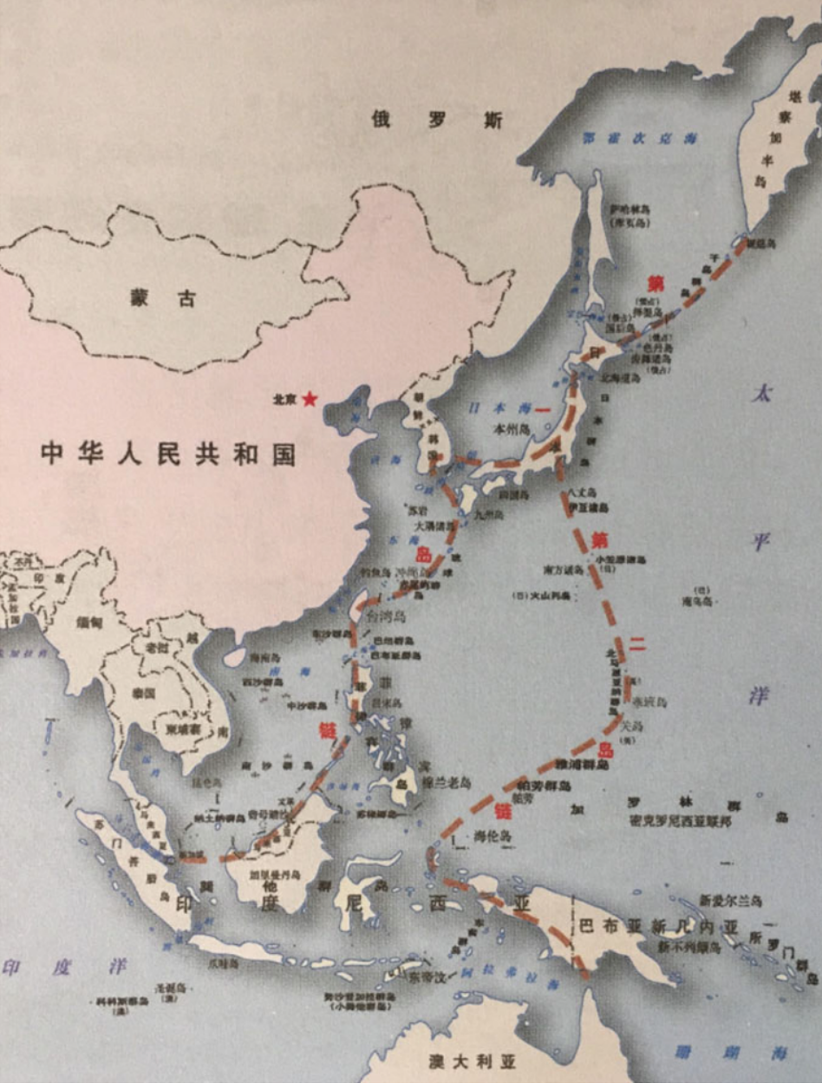
Expanding presence, encircling emptiness, diverting attention: China’s strategy at the regional level
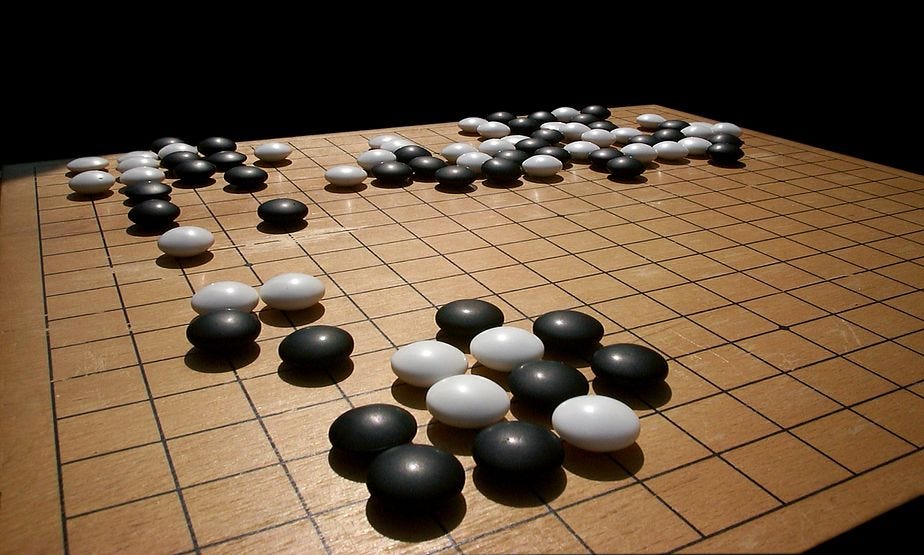
Is China playing weiqi in the islands? I didn’t go into this question in Foreign Affairs, partly because I thought some would dismiss it as an orientalist cliché (“China plays Go, we’re playing checkers”). Still, there’s some evidence that Chinese strategic thinking has been influenced by weiqi (围棋), including its naval analysis. Chinese military scholar and weiqi expert Lin Jianchao (林建超) has written extensively on the topic, including “Weiqi Logic and the Game of Maritime Strategy.”
Here’s how we might apply the concept: In weiqi, the goal is not to capture, but to encircle. Players try to surround a larger empty area of the board than their opponent does. Another weiqi strategy with Pacific relevance is to make plays that force the opponent to respond and draw attention and resources from elsewhere, while seizing the initiative and controlling the flow of the game. Chinese geospatial logic of using creeping expansion to establish presence and influence is already on display in the South China Sea.
PRC analysts also see vulnerability in the complexity and isolation of Pacific Island states. Fragmented political systems, limited regulatory oversight, and thin governance capacity mean even modest Chinese engagement can have outsized impact. In the logic of weiqi, these scattered islands are points of leverage that gradually reshape the board by surrounding oceanic sectors of emptiness to be filled before others move. The game is, of course, just one lens among many we can apply.4
Enticing elites, deepening dependence, entrenching influence
For now the main game is political and economic. Over at least the past decade, the CCP has been increasing its direct engagement with Pacific politicians and political parties. In addition to normal diplomacy, through a process of elite capture, China’s representatives work to align political and business leaders with Beijing’s interests, influencing election outcomes, contracting and regulatory decisions, and control over natural resources.
The essential element is cultivating relationships in which reciprocal favours are exchanged. The goals are to create dependencies and proxies that support China’s policies. Arguably, the most damaging element of Chinese influence is strategic corruption: the deliberate, systematic use of corrupt practices to manipulate political systems in pursuit of state objectives. I heard plenty about it in my visits to nine Pacific Islands and discussions with people from many of the others. I hope to explore this more in future writing.
Pacific Pushback: Ocean of Peace
The context for publishing the Foreign Affairs essay now is that September’s Pacific Islands Forum Leaders Meeting showcased the effects of competing forces in the region’s geopolitics. Mirroring the currents that create the Pacific Ocean’s gyres, one was centrifugal and unifying, the other centripetal and divisive.
The divisions were revealed by who was not at the meeting: Solomon Islands broke with tradition and excluded all non-members, including key partners such as China, Japan, Taiwan, and the United States. The surface reason was to dodge a dispute over Taiwan’s participation. At last year’s meeting, China’s envoys ensured the communiqué made no reference to Taiwan and lobbied to bar its representatives from attending. From a Pacific perspective, this sort of interference erodes Forum members’ authority to choose their partners and run their own meetings.
Demonstrating consensus, the annual gathering of sixteen Pacific Island Countries and Territories with Australia and New Zealand formally established a Pacific Resilience Facility to finance adaptation to climate change and preparation for disasters, and produced a “Blue Pacific Ocean of Peace” declaration that set out normative standards for a region free from militarization and external coercion and committed to uphold international law and state sovereignty. The host, Solomon Islands Prime Minister Jeremiah Manele, called it “a renewed commitment to defend regionalism.”
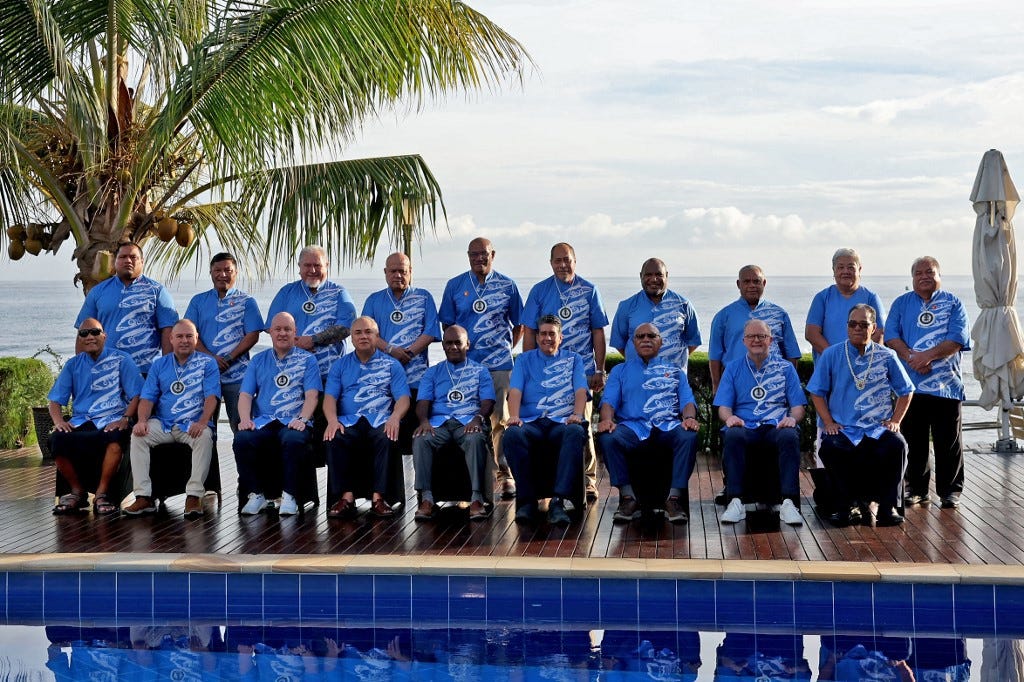
Meanwhile, Australia and others are stepping up their engagement and inking landmark agreements like the Falepili Union, Pukpuk Treaty, and Pacific Policing Initiative.
A much larger topic to explore is how interactions between Chinese actors and Pacific Island decision-makers create complex dynamics that are reshaping the geopolitics and economics of Oceania. Pacific Islanders are playing this game with angles of their own. The question is whether they fully appreciate what they’re dealing with when they talk to Party-state officials, and whether they and their societies will be able to effectively manage its growing influence. Personally, I think that Pacific policymakers—just like elites in pretty much every other country, including G7 ones—would benefit from a deeper understanding of China and the CCP and a healthy dose of humility about their ability to bargain successfully.
It’s not too late to deter coercion, prevent elite capture, and constrain the gravitational pull of spheres of influence in the Pacific. The solutions require Pacific leadership backed by expertise and supported by partners with persistent presence and consistent engagement across Pacific societies.
With research assistance from Joseph Widacki and Patricia Xavier.
#ChinaPacific #PacificChina #PacificIslands #BluePacific #OceanOfPeace #Oceania #CCP #IndoPacific #ChinaAustralia #ChinaNewZealand #ChinaUS #geopolitics #navy #SLOC #StrategicRivalry #weiqi #IslandChain
My list of sources is long, you can contact me if interested.
白炎林:《岛链上的世界海军》, 当代海军 [Bai Yanlin, “The world navies on the island chains”, Modern Navy], (2007), pp. 17–20.
《中国拟在7年内夺第2岛链制海权 变东海为内海》, 钱江晚报 [“China plans to seize control of the second island chain within seven years, turning the East China Sea into an inland sea,” Qianjiang Evening News] 25 June 2013;《敢于亮剑 行胜于言》, 人民日报 [“Dare to Show the Sword: Actions Speak Louder Than Words”], People’s Daily, 8 January 2017; and 萧衡钟, 《解放军已超越台海突破“第一岛链” 》, 台海网 [Xiao Hengzhong, “The People’s Liberation Army has surpassed the Taiwan Strait and broken through the ‘first island chain’”, Taiwan Strait Net], 3 September 2021.
David Lai, Learning From the Stones: A Go Approach to Mastering China’s Strategic Concept, Shi, US Army War College Press, 2004; Alexander Vuving, “China’s Grand-Strategy Challenge: Creating Its Own Islands in the South China Sea”, The National Interest, 8 December 2014; James R. Holmes, “Maritime Southeast Asia: A Game of Go?”, The Diplomat, 20 December 2014; 林建超:《围棋思维与海洋战略博弈》 [Lin Jianchao, “Go Logic and the Game of Maritime Strategy”], China Military Science, (2015-6), pp. 32–49; Lauren Dickey, “Wei Qi or Won’t Xi: The Siren Call of Chinese Strategic Culture”, The Strategy Bridge, 26 September 2017; Matthew Chalfant, “Surround and Conquer: Geopolitical Strategies Influenced by Weiqi (GO)”, Game of GO App blog, 20 November 2020; Katsuji Nakazawa, “Xi floats ‘global security initiative’ with eye on Pacific”, Nikkei, 28 April 2022; Keith T. Holcomb, “Getting Strategy and Force Design Wrong: Failing to Appreciate the Weiqi Model”, The National Interest, 13 February 2023.
The interesting thing is how many frameworks still treat China’s Pacific strategy as a contest of “moves,” when the real dynamic is a contest of coordination systems.
Island chains, elite capture, debt, diplomacy, they’re surface actions.
The underlying game is which actor can impose the most durable coordination architecture on small, fragmented polities.
If you model it this way, Beijing’s Pacific activity looks less like Go and more like a long-horizon attempt to reshape local incentive gradients, so that alignment becomes the path of least resistance rather than the outcome of coercion.
The West keeps trying to counter actions.
China keeps trying to counter options.