

Five years ago this week, I left China after its Communist Party finally agreed to a negotiated end to my wrongful detention there. I’d been a political hostage in its ruthless effort to coerce Canada into releasing a Chinese telecom executive. For the anniversary of my liberation, this post collects most of what I’ve said publicly about the ordeal and its implications. You’ll have to wait a while longer to read the full account of what happened. The story has many layers, and it’s still not over.
Just as the echoes of what became known as the Meng-Michaels Affair still reverberate through me personally, so too its security, economic and legal aftershocks are still rattling relations among Canada, China and the United States.
The Same Three Players, Five Years On
General Secretary Xi Jinping almost certainly personally approved both my abduction and my release 1,019 days later. With unsettling synchronicity, he has spent much of the week on a state visit to Washington for a summit with the U.S. president whose administration precipitated the crisis, Donald Trump. The meetings seem to be mostly about burnishing their status as strongman leaders as I explained in The Diplomat. Read or listen to more of my analysis on CBC’s “As it Happens”.
In a second synchronicity, the U.S. government’s slow-burning legal case against the telecom company, Huawei Technologies, began hearings this month in the New York Eastern District Court — with Federal Prosecutor Taylor Stout calling the PRC tech titan a “criminal enterprise". Huawei faces charges of racketeering conspiracy, violating U.S. sanctions on Iran and stealing trade secrets. Expect the trial to take many months.
Completing the synchronicity trifecta, once again Washington is pressuring Ottawa, mainly through tariffs, in part to align with its economic statecraft against China, as I argue in a new op-ed. As for the third leader involved in the original bizarre geopolitical triangle, Canada’s then-PM Justin Trudeau, well, you’ll have to ask Katy Perry.
My own ordeal as the CCP’s hostage began in December 2018 when Canada detained Huawei’s Chief Financial Officer Meng Wanzhou on a U.S. warrant to arrest and extradite on charges of violating sanctions on Iran and financial fraud. Canada was following longstanding standard procedure under its bilateral extradition treaty with the United States. There was no political involvement by Ottawa, and indeed Canadians soon wished they had never been involved. I explained the context in an interview (clip above) with Al Jazeera’s Peter Dobbie on Dec. 6.
Four days later, under Xi’s direction, China’s Party-state instrumentalized two innocent Canadian citizens — Michael Spavor and me — as bargaining chips and later imposed de facto economic sanctions to pressure the Prime Minister and Justice Minister to intervene in the Meng case, which they refused to do.
Resolving the standoff in a manner that enabled all three governments to preserve their reputations took heroic advocacy and diplomacy by Vina Nadjibulla, Dominic Barton, Kirsten Hillman, my partner and family, the International Crisis Group, and so many other steadfast officials, friends, colleagues, and experts that naming them all would fill a Substack article alone. I’m forever grateful to all, and over the years since — when not busy caring for my loved ones, rebuilding my life and getting back to work researching, analyzing, writing, and advocating — I’ve tried to personally thank everyone who contributed.
If you were one of them and I haven’t expressed my gratitude to you directly, please consider yourself profusely thanked, and feel free to reach out. Connecting deeply and meaningfully with so many extraordinary people has been one of the highlights of the past half-decade. Not a day has gone by for me without some moment of reflection on the experience and appreciation for your help. Indeed, for the past five years, I’ve appreciated every sunrise and sunset I’ve been able to see, and indeed much else in my life, even as I grapple with frustration at much that’s going wrong in the world.

Canada returned all of Meng’s personal property to her. China has so far refused to reciprocate for me. Most of the psychological and physiological damage that the MSS and confinement inflicted has healed, but some of it likely never can.
I still consider myself fortunate. Extradition experts have told me that if Meng’s court process in Vancouver had run its full legal course, including all possible avenues of appeal, it could have continued until 2026. Eight years after I was wrongly detained, I could still be confined to a single cell in the Beijing State Security Bureau’s #1 detention centre or a prison, with any resolution contingent on Meng’s fate. U.S. federal prosecutors dearly wanted to question the Huawei CFO in their court. Instead, they’ve had to settle for her signature on a deferred prosecution agreement — which U.S. District Judge Ann Donnelly has deemed admissible as evidence in the current Huawei trial.

Decisions by Trump, Xi and the political systems they’ve shaped ultimately created that avoidable crisis. The CCP General Secretary has accumulated many titles and epithets. I hope those shaking hands with the “chairman of everything” remember that he’s also China’s chief hostage-taker. Xi and his cadres try to present themselves as responsible stewards of a “more multipolar” international order. But a glance at his relentless purges of his own cadres and generals, and his repeated arbitrary detentions of foreign citizens, makes clear this is a mirage. What Xi is really offering is a methodical authoritarian power that treats humans as mere means to ends and is exploiting global disarray to advance the interests of its own elites. A senior MI6 officer once aptly characterized the Party-state as “a secret service with a state attached to it, not the other way round.” The implication for individual foreign citizens is that its security organs may detain you for political purposes.
Last year, for The Wire China, I described several such cases, and then expanded that catalogue of suffering and assessed the risks for visitors here at Strategic Narratives.
The forced disappearances keep coming
My own case was unique but sadly not the only example of arbitrary detention in China. What the Ministry of State Security did to me, they continue to do to others (mostly China’s own citizens) often under an abhorrent procedure that hides behind a deceptive PRC legal term, “residential surveillance in designated location” (RSDL). Enforced disappearances, hostage-taking, arbitrary detention, solitary confinement, coercive interrogations, torture, isolation, and other human rights abuses continue because Xi Jinping and his loyal cadres evidently consider using individual civilians for leverage to be a morally acceptable tool of statecraft — never mind that it’s illegal to do so in war or peacetime.
On June 3, Min Zin, an American scholar of Myanmar, flew to Kunming at the invitation of a Chinese professor and vanished into one of the Guoanbu’s black jails. He’s reportedly being held under RSDL in a windowless room lit around the clock, coercively interrogated for hours a day, without any formal charges.

Youlin Chen, an American seismologist whose research helped detect North Korea’s nuclear tests, has been held since November 2024 and interrogated more than a hundred times. Washington has designated both men wrongfully detained, and U.S. Senators on Sept. 25 introduced a bipartisan resolution condemning China’s “repeated pattern of arbitrary or wrongful detention” of American academics and urging the return of Zin and Chen.

A Czech businessman, Aleš K., was detained this summer, mere months after Prague arrested a man it identified as a Chinese intelligence officer. To me, that sequence looks painfully familiar.

These three new victims, all of whom travelled to China on apparently legitimate business, are now among scores of foreign citizens the PRC is illegitimately holding, some for so long that the world has nearly forgotten. Others include Huseyin Celil, a Canadian Uyghur activist abducted in Uzbekistan and handed over to state security twenty years ago; Gui Minhai, a Swedish-Chinese publisher seized in Thailand in 2015; and Minnie Chan, the South China Morning Post’s defence correspondent, who hasn’t been seen in public since covering Beijing’s Xiangshan security forum three years ago. Everything points to her being in MSS custody. People well-placed to know believe her disappearance is linked to the investigation of General Zhang Youxia, who this week was expelled from the CCP after months of detention and investigation.
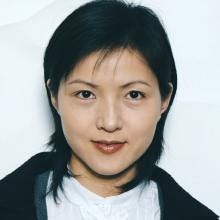
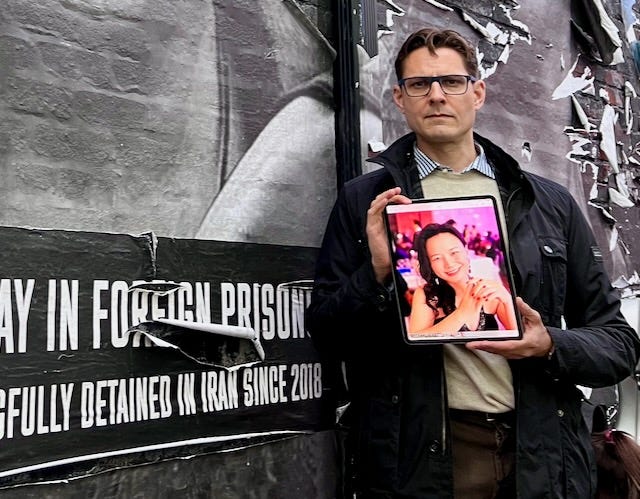
I regained my freedom because enough people with power and influence made it costly for Beijing to keep me while providing a face-saving concession on the one thing it demanded. These wrongful detentions won’t end until someone does the same for them. Each time Trump and his officials speak with Xi, they should show him pictures of these prisoners, humanize them, call for their immediate release, and make clear that continuing to hold them unjustly will bring cost-benefit-calculus-shifting consequences. Every other official who subsequently meets the CCP General Secretary should do the same until each and every one of them is free.
The point they should make to Xi Jinping is simple: Abducting and torturing people makes you look bad. It’s a tactic of the weak. It tarnishes your image, and if you want to be recognized and respected as serious statesman leading a risen and rejuvenated China, then stop behaving like a criminal thug. It’s totally unnecessary for achieving your stated objectives.

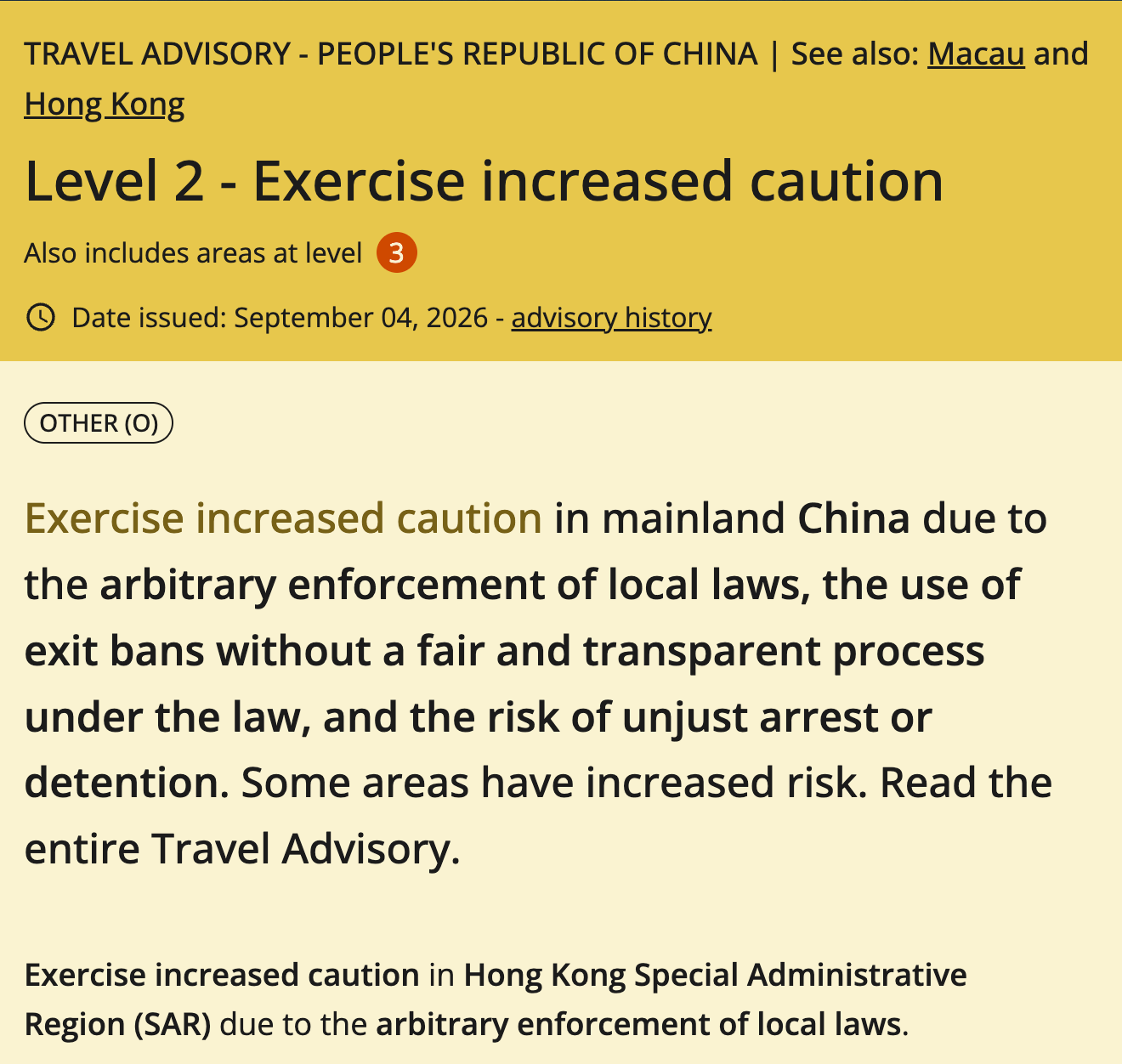
For visitors to China, government travel advisories don’t adequately convey this kind of low-probability/catastrophic impact danger. The US State Department rates China at Level 2—”Exercise Increased Caution”, the level it upgraded the PRC to after a 2024 prisoner swap — despite subsequent wrongful detentions. The UK Foreign Office issues no warning at all. Global Affairs Canada advises only a “high degree of caution” while Beijing’s new visa-free entry makes the trip easier than ever. What does “caution” mean here? It’s a “go or don’t go” question. A line about “arbitrary detention” doesn’t begin to convey the full horror to a prospective traveller. Nor does it explain how an arrest or exit ban for other reasons could turn a prisoner into a pawn once Beijing finds them geopolitically useful. Security over-crank can morph into hostage-making.
Stories and Advocacy Against Arbitrary Detention
To help people understand why this matters, all I have are facts, arguments and true stories. As a timely reminder, I’ve compiled below most of my relevant writing, talks and media interviews on the topic so far, as well as a few important accounts written by others.
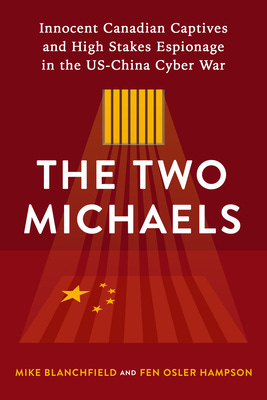
The Two Michaels: Innocent Canadian Captives and High Stakes Espionage in the US-China Cyber War. Journalist Mike Blanchfield and international affairs expert Fen Hampson combine groundbreaking original reporting and keen analysis in this book that focuses on the Canadian aspects of this story of cyber espionage, life-and-death diplomacy, and global superpowers in conflict. Sutherland House, November 17, 2021
Inside the Secret Prisoner Swap That Splintered the U.S. and China. Drew Hinshaw, Joe Parkinson and Aruna Viswanatha crafted the best overall feature story on how Meng’s detention kicked off a standoff between global rivals and opened an acrimonious new era. Their focus is on the final months of diplomatic wrangling that led to the September 24, 2021 prisoner swap. The Wall Street Journal, October 27, 2022
Biden Shouts Out Two Michaels in Speech to Canadian Parliament: ‘Our Citizens Are Not Bargaining Chips’. It’s not every day one experiences three standing ovations in Parliament, meets the U.S. president, and hears him say he’s to see you safely back with your family. Global News, March 24, 2023
Michael Kovrig Testimony to European Parliament Special Committee on Human Rights. I advised how EU members can help to halt arbitrary detention, beginning with my personal experience, followed by context on the problem and concluding with policy recommendations. EU Video, June 28, 2023.
Michael Kovrig Urges Unity Against Hostage Diplomacy, as Canada Helps Craft Rules. Speaking alongside U.S. Secretary of State Antony Blinken, Canadian Foreign Minister Melanie Joly, the foreign ministers of Costa Rica and Malawi, legal expert Amal Clooney, and fellow former detainee Jason Rezaian, I invited an audience of United Nations diplomats to imagine what it would be like to be taken hostage by a hostile state intelligence service. The Canadian Press covered the event for a story which appeared in The Globe and Mail and The Toronto Star, September 21, 2023.

Citizens for Leverage: Navigating State Hostage-Taking in a Shifting Geopolitical Landscape. Vina Nadjibulla and Stephanie Foggett produced the definitive research report explaining how a number of states today are unlawfully detaining foreign nationals within their criminal justice systems for use as foreign policy leverage. This cruel practice places individual citizens at the centre of a complicated calculus where their own governments must balance the individual’s freedom against political, security, economic, and other national considerations. The issue is fraught with challenges and complexities, further compounded by the often opaque political and judicial systems of abductor states. Soufan Center, September 14, 2023
China’s Abductions of Foreign Nationals Should Carry Costs and Consequences. In my first published commentary on arbitrary detention, I argued that governments must reinforce the basic international norm that responsible states don’t abduct each other’s citizens. POLITICO Europe, January 30, 2024
Captive in China: Michael Kovrig’s 1,019 days, Ottawa Morning podcast, CBC News, 22 September 2024
’You’re totally alone’: Canadian Michael Kovrig on his ‘brutally hard’ detention in China, TV interview with Global News, 23 September 2024
Michael Kovrig tells his story, TV interview with The National, CBC News, 23 September 2024
‘From hell to limbo’: Michael Kovrig describes more than a thousand days as China’s prisoner, Peter Zimonjic, CBC News, September 23 2024
‘They’re never going to see me cry’: Interview with Michael Kovrig, broadcast interview, CTV News, September 23, 2024
They’re never going to see me cry’: Michael Kovrig shares experience of more than 1,000 days in Chinese detainment, Stephanie Ha, CTV News, September 23, 2024
En parallèle de l’horreur, l’amour. L’arrivée au monde de sa petite fille aurait dû être un des plus beaux jours de la vie de Michael Kovrig. Mais en mars 2019, quand sa conjointe lui a donné naissance, l’ancien diplomate canadien croupissait en isolement dans un centre de détention chinois. Laura-Julie Perreault, La Presse, September 23, 2024

Michael Kovrig on how he became a political hostage in China. The “Drum Tower” podcast’s David Rennie and I did a deep-dive pair of interviews. David was in Beijing for the duration of the crisis and I particularly appreciated how this was a conversation about each of our experiences living through it. The Economist, September 24, 2024
How Michael Kovrig Survived Three Years in Detention in China. The second of two “Drum Tower” episodes with David Rennie interviewing. The Economist, October 1, 2024
Michael Kovrig, former hostage of the Chinese state. In this print story based on our extensive interview, David Rennie gets the story precisely right. The Economist, October 4, 2024
Inquiry into the Wrongful Detention of Australian Citizens Overseas. I provided a witness Submission and Testimony to the Foreign Affairs, Defence and Trade Reference Committee, Australian Senate, October 28, 2024
China Secretly Executed Four Canadians. A Former Prisoner Explains Why, The Walrus, July 23, 2025
Is It Safe to Visit China? A Former Detainee’s Warning, The Wire China, July 30, 2025
Witness Testimony on the Detention of Jimmy Lai in Hong Kong, House of Commons Standing Committee on Foreign Affairs and International Development, November 6, 2025
Michael Kovrig Urges Canada to Press China for Jimmy Lai’s Release on Health Grounds, The Globe and Mail, November 7, 2025

Mark Carney just ushered in a transformative moment for Canada. It’s also a risky one. Authoritarian regimes test not only policies, but moral boundaries. When they learn that inflicting pain produces concessions, that amnesia is cheap, and that accountability is avoidable, they escalate correspondingly. Op-ed, The Toronto Star, January 24, 2026
Why, After Years of Laying Low, Michael Kovrig Decided to Speak Out About Mark Carney, an interview with ombudsman for The Toronto Star, January 30, 2026
Prioritizing Political Prisoner Advocacy Across China. The PRC is holding several political prisoners who are important to the U.S. government. I and others advocated for their freedom at this panel discussion at the Hudson Institute, March 16, 2026.
Countering State-Perpetrated Arbitrary Detention: A Strategic Framework for Democratic Response. Vina Nadjibulla and I explain that state-perpetrated arbitrary detention has evolved from isolated diplomatic incidents into a systematic tool of coercion that threatens international order. Existing responses have proven to be insufficient deterrence. We present a four-pillar framework that integrates immediate case resolution with long-term deterrence objectives. Journal of Policing, Intelligence and Counter Terrorism, March 30, 2026
To end on a musical note, here’s a cover version of “Gift That Shines” that my pen-pal Tobias Forsner put together with me on backing vocals. For me, it evokes moments in the cell reflecting on what’s been lost and slowly attaining the Buddhist philosophical mindset of coming to terms with the past, being fully in the present moment and letting go of attachments, while recognizing that without liberty, few other things have value. I dedicate it to those still waiting for freedom. You are not forgotten.
I’ve been entertaining yesterday
Past and present they’re all mine
I don’t need a gift from yesterday
I don’t need a gift that shines
Their accusations are groundless against you when they can't even produce anything based on the accusations. Sadly not sure many Canadians realise the problem as they still hold dated stereotypes about ethnic Chinese or truely believe China is the alternative to America as was the case under Justin Trudeau. Plus we still have fipa under Harper
A shocking round-up of detained people I hadn't heard about, thank you for keeping this on the agenda