

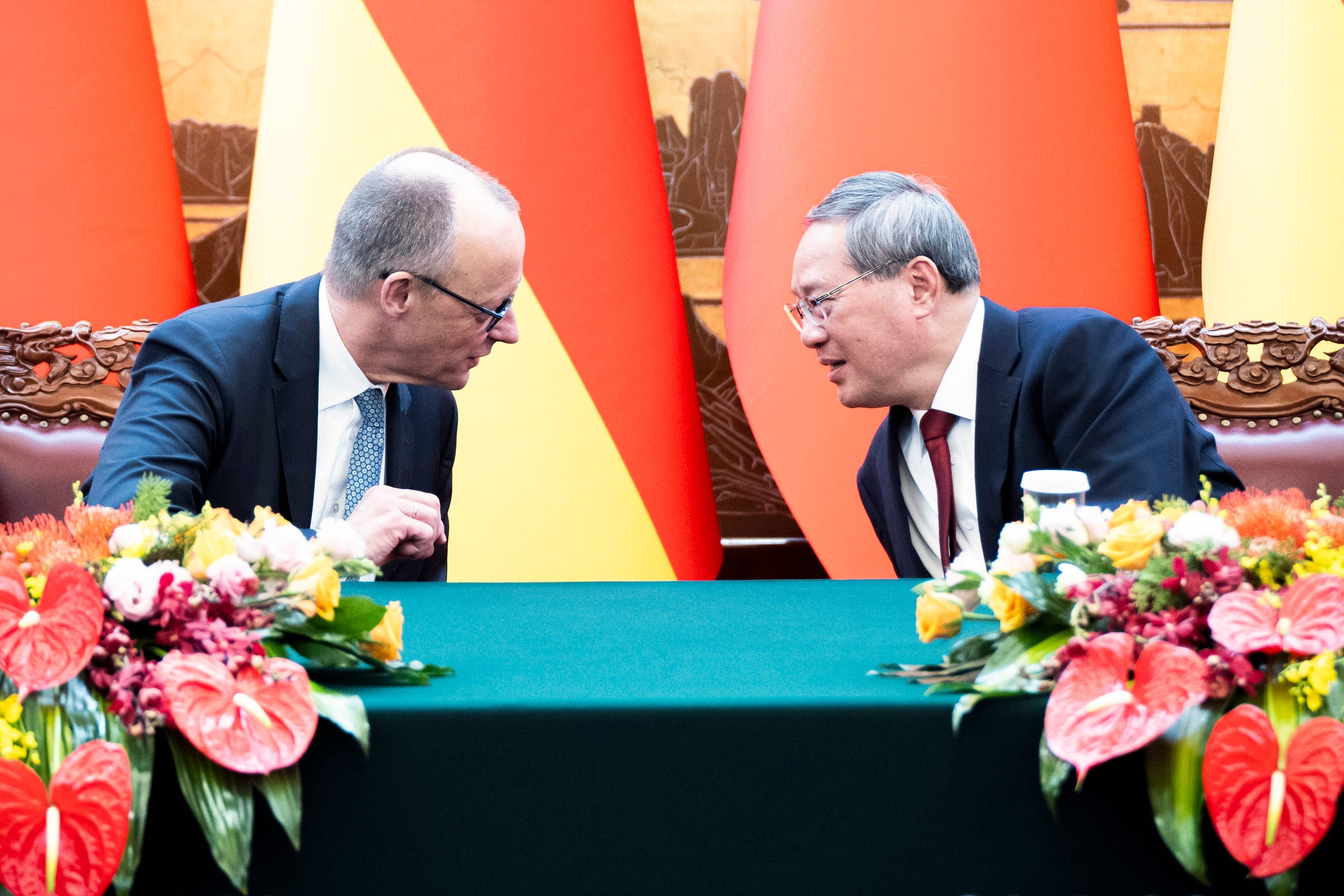
German Chancellor Friedrich Merz told his parliament on March 25 that he could envisage a trade deal with China. The talk is unlikely to lead anywhere. But together with his February 25–26 visit to China, which did more to advance the Chinese Communist Party’s interests than Berlin’s, it illustrates that many European elites still lack a strategic understanding of the multidimensional challenge China poses to their security and prosperity.
Ahead of the Chancellor’s meetings in Beijing, Germany had explicitly rejected Chinese pressure to support an EU-China free trade agreement. Merz’s own officials described the FTA push as an attempt to lock in Chinese market access before the EU’s “Made in Europe” debate reached legislative conclusions. He held the line in Beijing. Then he volunteered a softened version of it four weeks later, unprompted, in the Bundestag. The European Commission immediately pushed back, saying Beijing must “meaningfully” address its distortive practices before any such talks could begin. Meanwhile in Australia, Commission President Ursula Von der Leyen warned that the EU “cannot and will not absorb China’s export-led growth model.” The dissonance between Berlin and Brussels is now explicit and on the record.
Updated April 7, 2026. This is Part II in a series of posts about Germany-China relations. Read Part I:

Merz in Beijing
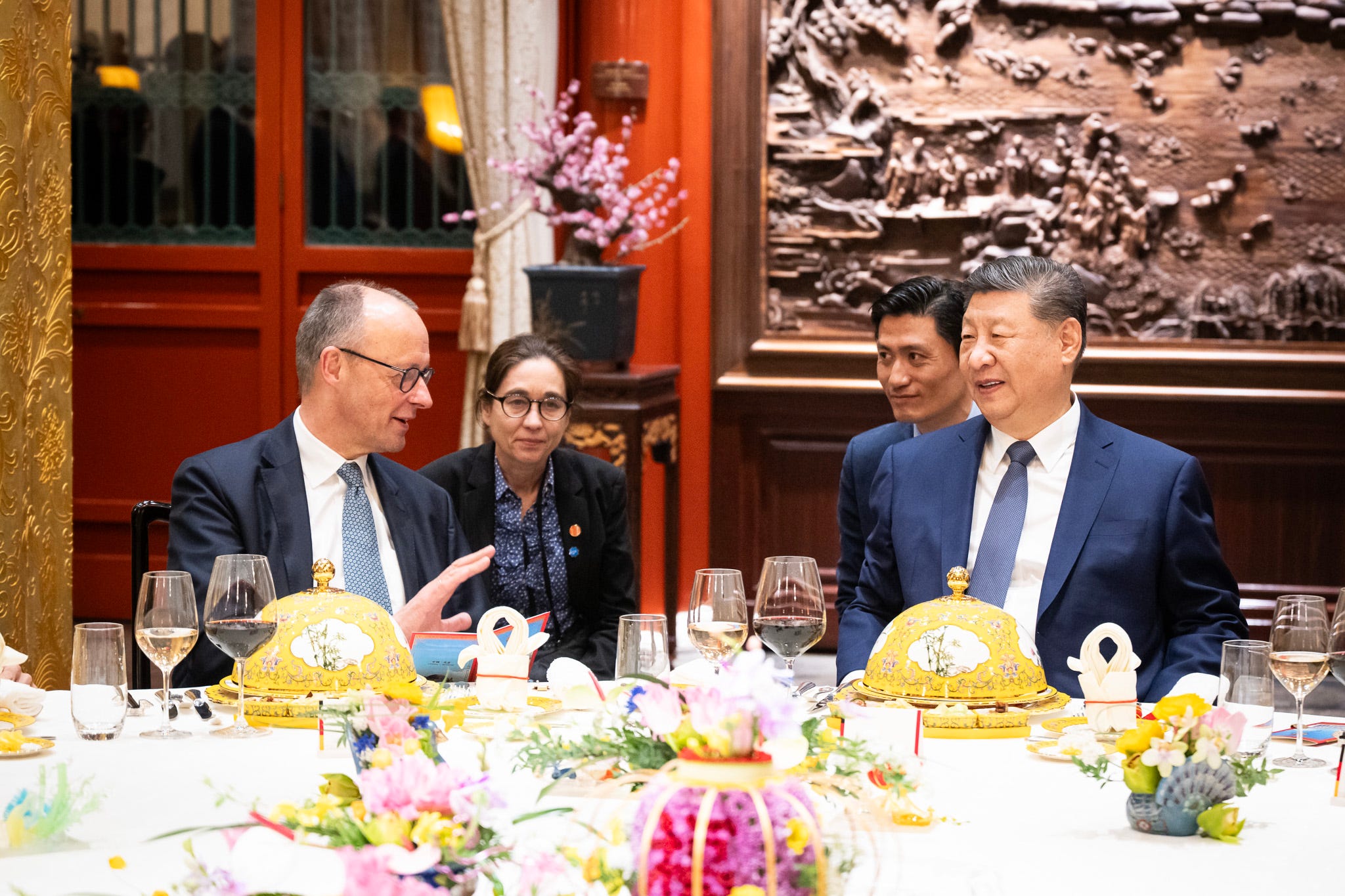
Merz arrived in Beijing on February 25 with a more credible brief than either Mark Carney or Keir Starmer. He hadn’t spent months signalling desperation to get into the Great Hall of the People; he brought no expectation of a reset; and German officials had explicitly drawn a line between Merz’s approach and what they termed Sir Keir’s “Starm offensive.” The visit, they insisted, was not a rejection of Washington or an endorsement of Beijing’s self-serving narrative about Western leaders queuing up to acknowledge Chinese leadership of a new world order. Still, that sensible pre-visit positioning didn’t prevent the Chinese Communist Party (CCP) from getting most of what it actually wanted. The substance was meager. The optics favoured China.
The signed deliverables were five documents covering climate cooperation, animal disease prevention, poultry products, and sports collaboration. If we were counting pieces of paper, that compares poorly with twelve for Starmer and eight for Carney, but that’s not a meaningful metric. The key point is that the joint statement acknowledged bilateral concerns over trade imbalances and export controls and pledged “frank and open dialogue,” but committed Beijing to nothing. China has offered the same platitudes to every European visitor who preceded Merz. Merkel raised overcapacity. Scholz raised the trade deficit. Both got joint statements pledging frank dialogue. The relationship’s “durability” is not evidence that the framework is working, but rather shows that Germany keeps returning to the same table and Beijing keeps serving the same meal. Articulating a problem clearly while securing no commitment to address it is painfully incremental progress.
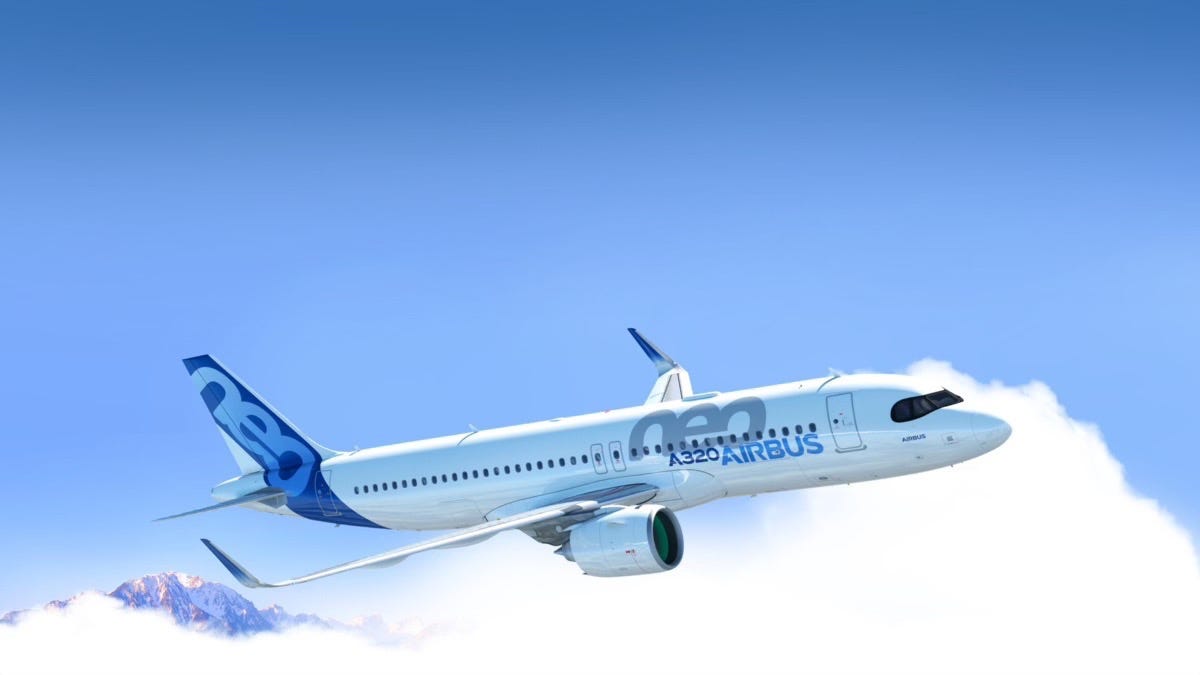
The headline outcome Merz chose to trumpet was an Airbus order for “up to 120 additional aircraft.” Six weeks later, there’s no confirmation about this announcement and the lack of specificity has led to some confusion. After French President Emmanuel Macron’s visit last year, Air China signed a contract for 60 A320neos dated December 30, 2025. Four weeks after Merz’s visit, China Eastern reportedly placed a firm order for 101 A320neos. While I haven’t seen confirmation these are the same planes, it seems likely that by signalling an Airbus order to Merz at a state dinner rather than letting it surface quietly through a stock exchange filing, General Secretary Xi Jinping gave the chancellor something to wave at reporters. But let’s be clear, this is routine fleet modernization, not a new political gift. At least 53 of China Eastern’s existing A320s are due to retire on lease expiry or serviceable age during 2028–2032, so more than half the order is straight replacement. The airline needs these planes regardless of who visits China. What the Party-state controls is the timing of the announcement.
It’s the same tool for each politician: 60 jets for Macron, 101 for Merz, and next Donald Trump reportedly will have a chance to announce an order for “up to” 500 Boeing 737 MAXs which the CCP has been holding in reserve since 2019 trade tensions so it can be deployed at the moment of maximum diplomatic utility. That carrot could be withdrawn, of course. Beijing has been using aircraft orders as diplomatic currency since 1972, when it placed its first Boeing order weeks after President Richard Nixon’s visit. Costuming commercial procurement as a concession—with reciprocity expected—is a 50-year-old playbook. Give the political children some candy and they won’t challenge you on the important things.
Germany’s government also confirmed that bilateral government-to-government consultations, suspended since the pandemic, would resume, potentially by the end of 2026. That’s an easy win—both sides wanted it.
More significant is what Merz did not secure: meaningful movement on the €90 billion trade deficit, substantive commitments on rare earths and critical mineral export controls (German companies are still receiving only a fraction of what they ordered even under the “general licenses” arrangement which allows for multiple shipments of these materials per year), or any credible Chinese undertaking to reduce support for Russia’s war in Ukraine. Xi was polite about Ukraine, but his support for Moscow’s war machine has only deepened, and there is no reason to believe that Merz’s polite entreaties at a state guesthouse dinner registered as pressure.
Quick context in this one-minute Deutsche Welle video:

The Munich-Beijing narrative gap
The most telling indicator was the distance between what Merz said at the Munich Security Conference weeks earlier and what he said in Beijing. At Munich, he accused China of “systematically exploiting the dependencies of others” and described raw materials, technologies, and supply chains as “instruments of power in the zero-sum game of the great.” In Beijing, the same trade deficit became merely one of “a number of challenges that we want to, and certainly can, overcome together through cooperation and dialogue.” This smacks of accommodation dressed as engagement.
The language regression extended beyond tone. In an echo of Mark Carney’s promotion of a revived strategic partnership, Merz likewise spoke of the two countries’ “comprehensive strategic partnership.” Under Chancellor Scholz, German diplomats had deliberately retired that phrase as an obsolete relic of the Merkel era. Merz also declined to call China a “systemic rival”—the term that his own coalition agreement and Germany’s 2023 China Strategy use to define the relationship. These are not minor formulations. The CCP reads official vocabulary carefully, and Merz handed it a revival of the framework it’s always preferred.
The cooperative register was almost certainly unavoidable given the diplomatic context of a first meeting, and Merz’s private conversations may have been more direct than his public statements suggest. But for propaganda purposes, Beijing doesn’t distinguish between the register of private complaints and public statements—it reads and amplifies the public signal, and the public signal was conciliation. Meanwhile in Berlin, Finance Minister Lars Klingbeil warned against “slavishly maintaining market openness” while competitors ignore the rules. I’d like to think the contrast was a masterful good-cop/bad-cop strategy, but I suspect it was just incoherence.
The CEO problem
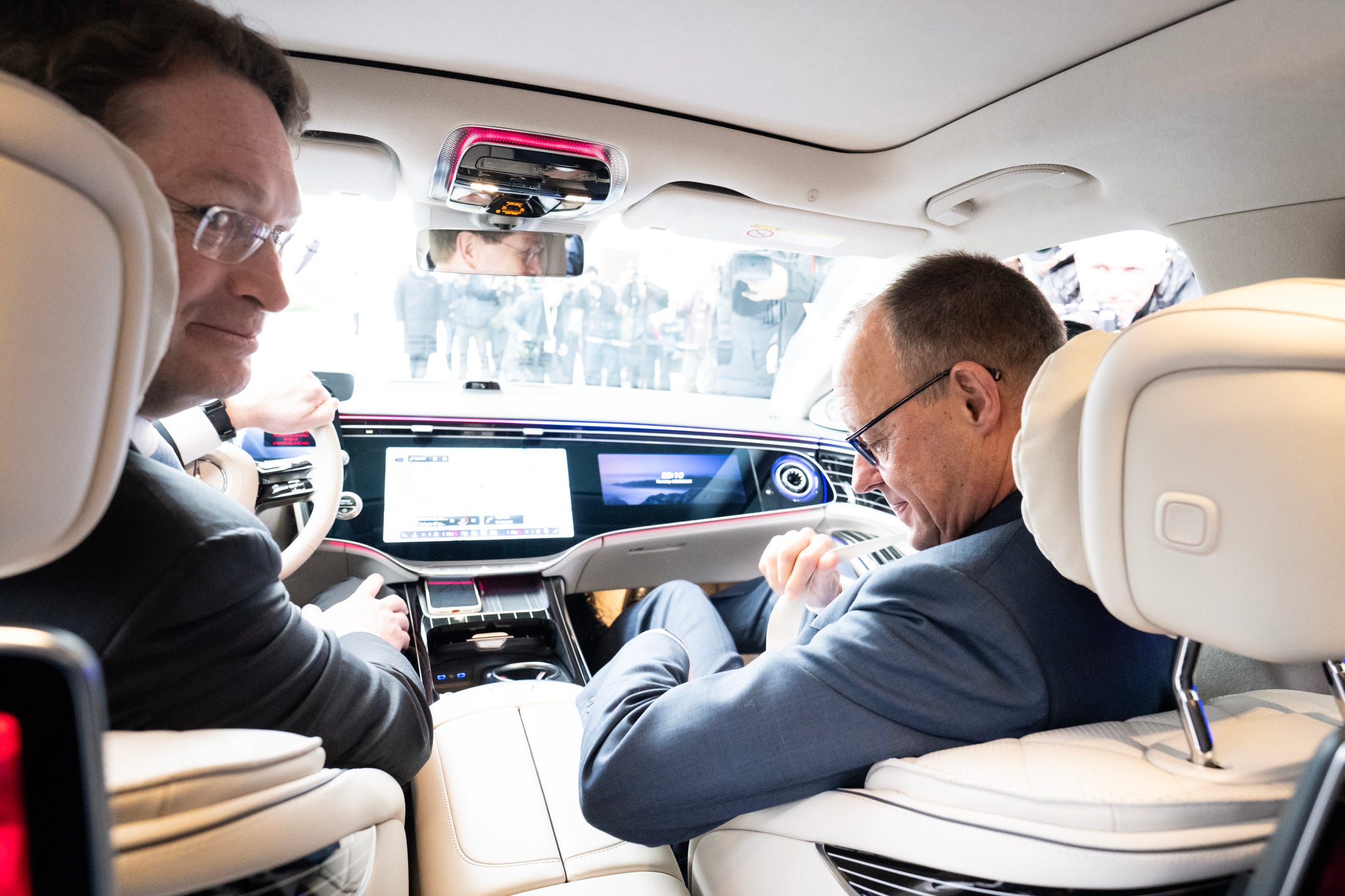
In Beijing, after Merz criticized Chinese trade policy, he rode in a Mercedes-Benz S-Class the next day while the company’s CEO extolled China’s innovation ecosystem, the New York Times reported, illustrating the structural contradiction. The 30+ CEOs who accompanied Merz were largely not there to reinforce his agenda. They went to conduct their own parallel diplomacy to signal to Beijing that German capital remains committed regardless of the chancellor’s complaints about subsidies and overcapacity. Volkswagen Group China’s CEO posted online that “anyone who is serious about driving transformation in key sectors cannot look past China.” Mercedes CEO Ola Källenius had already told the Times in Stuttgart that the Trump administration had not changed his investment calculus.
Elite capture? Res ipsa loquitur. China-critical voices from German industry weren’t even given prominent speaking roles at the business forum Merz co-chaired with Premier Li Qiang, Noah Barkin reports. The trip’s format actively elevated the pro-engagement voices over the critics. This pattern is not unique to Germany. Of the dozen leaders who have visited Beijing in 2025 and so far in 2026, nearly all arrived with large business delegations—roughly 200 with South Korea’s Lee Jae-myung, 80 with Macron, 60 with Starmer. Their firms are deeply enmeshed in China and want political top-cover for business to continue as usual. Their interest is to constrain moves that could sour relations, even at the expense of ceding enduring advantages and sovereignty— for example by locating growing shares of R&D and production in China.
Some commentators treat this business engagement as strategically meaningful. Zhejiang University professor Shen Wei, writing in the South China Morning Post, argued that Merz’s Hangzhou itinerary showed German firms understand that “maintaining long-term competitiveness requires direct engagement with Chinese innovation ecosystems.”
This is a legitimate business argument. But it conflates two distinct things: the commercial logic of individual firms protecting their market positions, and Germany’s strategic interest as a state.
The firms that invested most deeply in China’s innovation ecosystem (VW, BMW, BASF) are precisely the ones that transferred technology, built local supply chains, and are now watching Chinese competitors take their market share in third countries while lobbying Berlin against protective measures. “Engaging the innovation ecosystem” is how Germany deepened the dependency in the first place. Good for China. Not good for Europe.
The result is a structural trap: Germany sends its biggest companies to Beijing as political cover for a diplomatic visit; those companies use the trip to advance their own commercial interests; and the CCP reads this as confirmation that whatever the chancellor says about de-risking, the people who actually control Germany’s China exposure are still all-in. German FDI in China hit a four-year high in 2025, precisely during the period when Merz was campaigning on derisking. As MERICS executive director Mikko Huotari put it, the danger is “re-risking instead of derisking.”
How Beijing used the visit
The CCP wanted three things:
The visual of yet another Western leader in the Great Hall—added to the sequence of Macron, Lee, Carney, Starmer, and several others—to neutralize any perception of Beijing being isolated for bad behaviour.
An implicit German endorsement of the “stabilizing anchor” frame: the idea that the China-Germany relationship is a moderating force in China-EU relations, blunting the EU’s more assertive trade defense measures. A Global Times editorial, headlined “Merz’s China Travel freshens Europe’s perception of China,” made the subtext explicit, praising Merz’s commitment to “free trade and rejecting protectionism” and expressing hope that his “pragmatic approach will help foster a more balanced EU consensus on China.”
A counter-narrative to the “stolen technology” and “state-subsidized overcapacity” frames. The Hangzhou robot factory tour served this purpose deliberately. Merz delighted in watching humanoid robots perform martial arts and boxing and posted clips on social media; European media duly covered it as evidence of Chinese innovation rather than subsidized industrial policy.
The Party-state didn’t immediately get everything it wanted from the visit. The FTA push was rejected. German officials also declined Chinese requests for an MOU reviving the Merkel-era Comprehensive Agreement on Investment (CAI) and a joint statement endorsing Xi’s Global Governance Initiative. These were meaningful holds. But little more than a month later, Merz’s rhetoric is already softening them.
Merz decides not to decide
Merz’s domestic framing had more credibility than Carney’s or Starmer’s. He wasn’t claiming a breakthrough he hadn’t achieved. He raised the necessary thorny issues—subsidies, currency policy, overcapacity, rare earths, Ukraine—and secured a modest process gain on government consultations. He may have drawn on his Beijing impressions when he met Trump in Washington on March 4, to signal that Germany has options and cannot be browbeaten into full decoupling. But as Fudan University’s Song Luzheng observed, any bargaining chips gained from Beijing are “very limited, given Germany’s reliance on the US for security and energy.” And with Trump now preparing his own visit to Beijing in May—following the US-China trade truce secured in South Korea in October—Europe faces the risk of a bilateral US-China accommodation that could leave it exposed on both fronts simultaneously, without having resolved its own China dependencies first.
GMF’s Mareike Ohlberg put the overall balance most precisely: the trip “suggests that Germany will continue to try to muddle through on its policy toward Beijing by avoiding decisive action.” The deeper problem is structural. Germany voted against EU tariffs on Chinese electric vehicles. The Chancellery has historically blocked tougher China proposals from Berlin’s own ministries. Crucially, unlike France, Germany brought no European Commission representatives to its bilateral meetings with Chinese leaders, effectively sidelining the EU framework and reinforcing Beijing’s divide-and-conquer approach to the continent.
This divide is now operating in the open. A Franco-German working group on China policy, set up late last year, has become bogged down in differences over trade measures. France’s advisory body to the prime minister has published a report calling for an across-the-board 30% tariff on Chinese goods. The Chancellery’s deep-seated aversion to trade barriers is blocking movement at precisely the moment France is pressing hardest for EU-level action. The Commission, meanwhile, is moving in its own direction: it adopted new anti-dumping tariffs on Chinese ceramics in February, with further measures covering e-bikes, auto parts, and tires reportedly under discussion. The EU’s trade defence architecture is being built around Germany’s hesitation, not with it.
Shen Wei frames Germany’s bilateral approach as a “blueprint” for the rest of Europe. This inverts the actual dynamic. Conducting negotiations without Commission representation, resisting EU-level trade defence instruments, softening hawkish positions from other member states: this is not a template for European coherence. It’s the mechanism by which European coherence is prevented. Shen defines success as a stable, functional bilateral relationship with managed tensions and open channels. Held against the actual structural problem—a €90 billion trade deficit, deepening industrial dependency, €7 billion in German FDI flowing into China in 2025 despite a domestic manufacturing crisis, and continued Chinese material support for a war on European soil—that standard yields a verdict of managed decline rendered comfortable enough that nobody is forced to act. It’s boiling the frog.
The CCP pits multinationals vs nationals
The test Noah Barkin identified before the visit remains the correct one: the concrete actions Merz takes afterward matter more than anything said in Beijing. As he notes, “the focus of the German government has been on ‘running faster’ by reducing bureaucracy. This strategy will fail if not complemented by more forceful measures to shield domestic industry.” The FTA comment in parliament suggests that Barkin’s test is already being answered in the wrong direction.
Merz has proposed a “Made with Europe” formulation rather than “Made in Europe”—a compromise that suggests he’s already begun accommodating the multinationals’ objections. The auto component suppliers being squeezed out of existence need “Made in Europe” requirements. The multinationals pursuing a “Made in China” strategy are lobbying against them. Merz needs to decide whose Germany he is governing.
Merz has the rhetoric. The question is whether the structures that captured his predecessors will capture him too—not because German politicians are corrupt, but because the system they govern was built to make exactly this kind of choice inevitable. That’s why, even though Beijing has changed nothing, Berlin is talking about strengthening what it calls a “partnership.” Codependency is a more accurate description. Centre for European Reform economist Sander Tordoir told Bloomberg: “As long as Europe depends so heavily on China, it is understandable that the German government wants to avoid escalation. The question is whether the de-risking that this buy-time strategy aims to deliver is moving fast enough.”
My answer is nein. In Part III we’ll explore why that matters for Europe, the West and ultimately the Rest, too.
Dive deeper
“Can anything halt the decline of German industry?” Financial Times, 12 Nov 2025
Brad Setser, “China’s Massive Surplus is Everywhere (Yet The IMF Still Has Trouble Seeing It Clearly)”, Council on Foreign Relations, 12 Nov 2025
SCMP video: Balancing trade and economic rivalry: the future of Sino-German relations
Interesting take on recent German-Chinese relations, even more coming from a Canadian! 😄 As a German I may add that Merz is facing strong economic performance pressure domestically (he has been promising reforms to spur growth for more than one year now, yet didn't deliver) which makes him probably think there's little chance to manage China more resolutely without economic repercussions for Germany. Especially, given the high rare earth dependency being used by Beijing to seemingly have Germany lobby to some extent on EU level for pro-China trade policy (Klingbeil & He Lifeng Meeting last year was pretty open about that) mean this relationship is hardly going to change any time soon.
Thanks for sharing, always interesting in-depth articles! Mercedes CEO saying no change to investment plans as a result of Trump policies. In the meantime - announcement of 4 bln investment in USA :) https://www.reuters.com/business/autos-transportation/german-automaker-mercedes-benz-invest-4-billion-alabama-suv-plant-2026-03-31/