

As Canada’s Foreign Minister Anita Anand visits Beijing for talks, a guest post by Asia-Pacific Foundation Vice-President for Research & Strategy, Vina Nadjibulla. Originally published in The Hill Times 16 October 2025.
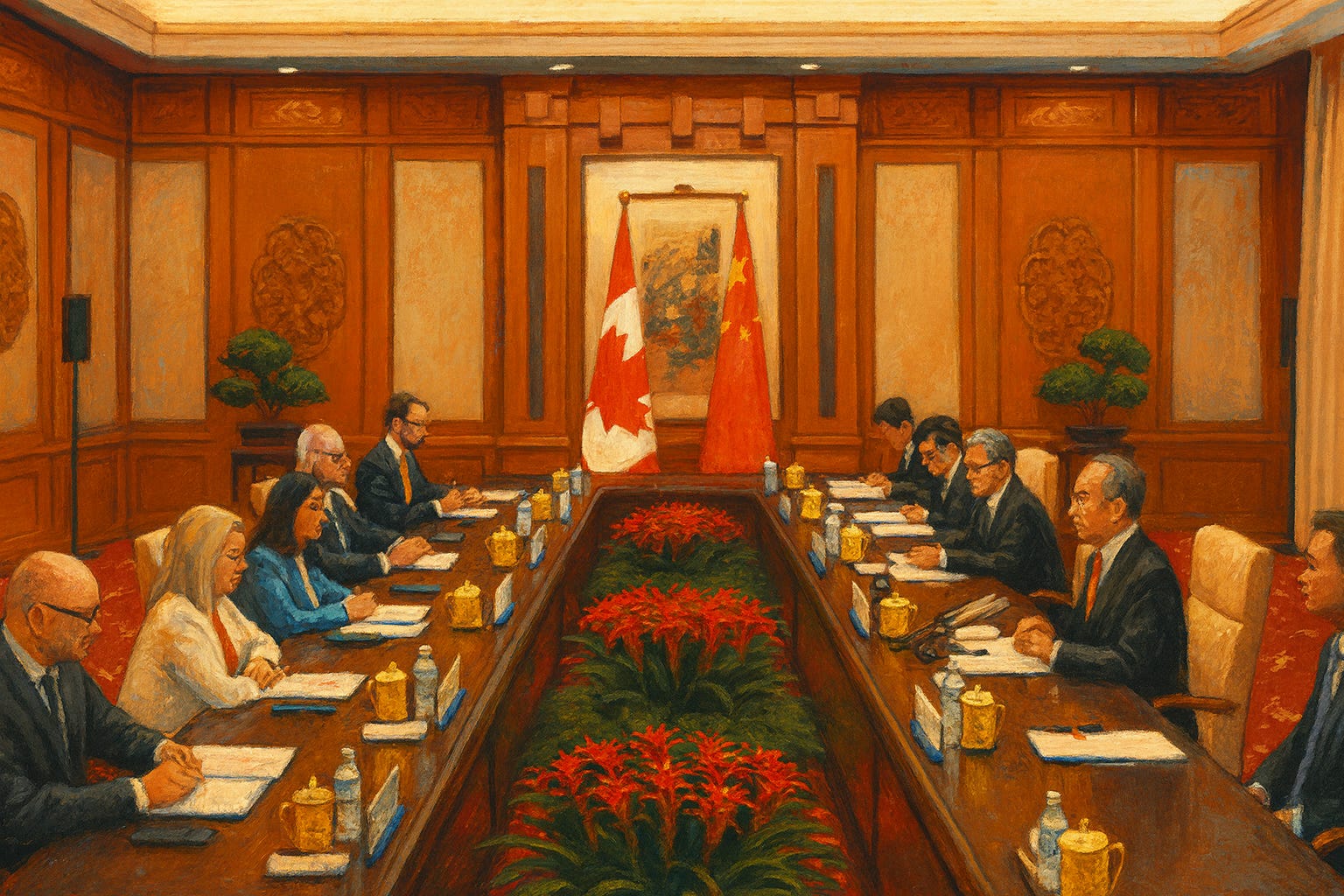
Last week, China’s ambassador to Canada bluntly declared that Beijing would lift its tariffs on Canadian canola if Ottawa removed tariffs on Chinese electric vehicles. What was once coercion by stealth is now coercion in plain sight. The message was no surpriseeveryone understood that canola tariffs were leverage to pressure Ottawa on EVs—but the timing was telling. It came just as China escalated its trade war with the United States through sweeping export controls on rare earths and critical minerals, while Washington doubled down with threats of additional 100-per-cent tariffs on Chinese imports.
We have entered a new era where trade, technology, and security are fused—and leverage is the currency of power. For a country like Canada—long comfortable selling raw materials to the US, and, increasingly, to China—this new reality demands a fundamental rethink. Over-reliance on a single buyer or market is no longer just an economic risk; it is a strategic vulnerability.
For much of the past two decades, Canadian policy toward China was driven by commercial optimism—an assumption that access to China’s vast market could be pursued safely within the bounds of international rules and multilateral institutions. That world no longer exists. Beijing’s industrial strategy—built on state subsidies, export surpluses, currency manipulation, and protection of domestic champions—has tilted the global playing field so sharply that further integration with China now poses real risks to Canada’s competitiveness and prosperity. If Canada wants to remain a G7 economy, not merely an exporter of raw materials, it must approach economic relations with China through the lens of strategic caution, not short-term commercial convenience.
further integration with China now poses real risks to Canada’s competitiveness and prosperity
This is especially true in critical minerals, green technologies, semiconductors, artificial intelligence, and research collaboration—areas Beijing explicitly defines as part of its national industrial and security strategy. China’s tactics in these sectors are designed to absorb innovation abroad, strengthen self-reliance, and ensure others’ dependence. Through policies like Made in China 2025, Beijing pursues self-sufficiency at home—from wafers to battery cells—while using scale, subsidies, and control of upstream inputs to make others reliant on Chinese supply. The result is Beijing’s accumulation of leverage and choke points in rare earths, graphite, gallium, solar panels, battery materials, and critical minerals processing.
This is not just industrial policy; it is a dependency strategy that turns supply chains into instruments of state power. Canada’s response must be to strengthen its domestic capabilities and deepen relations with trusted allies and partners—not expand trade and technological entanglement with a systemic competitor. Building parallel supply chains with allies, rather than hoping for Chinese restraint, is the only sustainable path to resilience.
There are, of course, sectors where selective trade with China still makes sense. Canada can export more oil, liquefied natural gas, and certain agri-food products in the near term, especially where exposure remains limited. But selective trade cannot mean strategic dependence. In this era of weaponized supply chains, no single market should account for more than half of Canada’s exports in any key commodity. Selling 67 per cent of our canola seed to China is a vulnerability we can no longer afford. Even if the current dispute over canola tariffs is resolved, diversification must remain the goal.
We should focus on expanding trade and investment ties with Japan, South Korea, Australia, India, the European Union, and trusted Association of Southeast Asian Nations partners. But diversification will remain out of reach without building domestic competitiveness. Rebuilding domestic competitiveness and resilience requires a modern industrial strategy—one that does not solely rely on subsidies—but prioritizes building productive ecosystems and infrastructure, scales skills and technology, streamlines the regulatory environment, and deploys smart public financing to keep and build manufacturing and processing capacity in Canada.
Canada also needs stronger tools of statecraft for a world where global rules and norms are no longer enough: tighter investment screening, robust research-security guidelines, leading cybersecurity capacity, export controls co-ordinated with allies, and an enforceable foreign-interference transparency regime. Finally, none of this will work without sustained public outreach and deeper China competence across government, business, and civil society to build awareness and resilience.
The goal is not to contain China
but to contain our vulnerability to the Chinese Communist Party.
In this age of great-power competition, the goal is not to contain China but to contain our vulnerability to the Chinese Communist Party. The sooner Canada acts on that understanding, the better prepared we will be for the shocks to come.

https://www.reuters.com/sustainability/sustainable-finance-reporting/dutch-minister-says-he-will-meet-with-china-official-about-seizure-chipmaker-2025-10-19/
Since when has China been in good faith. It's all up to them. Discouraging foreign investments will bleed them. The rest are classified.