

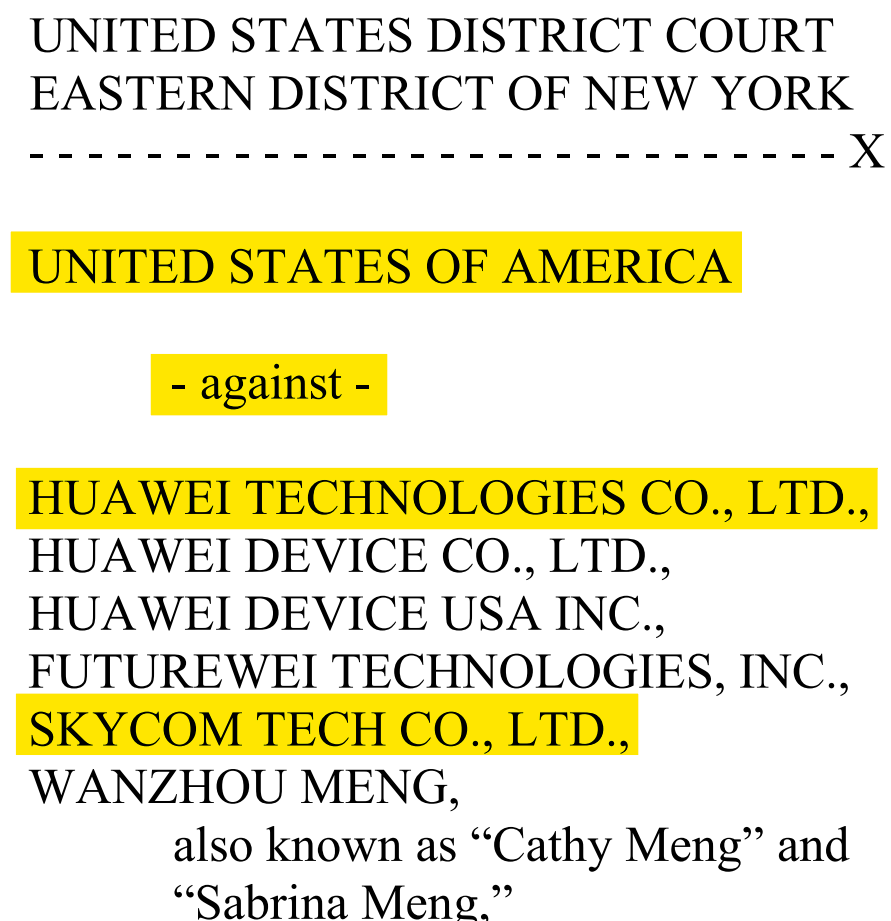
In this post, Jonathan S. Landreth reports from a Brooklyn courtroom as Strategic Narratives brings you the first in a series of blog entries on the ongoing trial of Huawei Technologies in the Eastern District of New York.
Trial Day Five: September 14, 2026
Eight years after the arrest of Huawei CFO Meng Wanzhou set off one of the most consequential diplomatic crises in recent Canada-China history, the Chinese telecom giant itself is finally on trial in a United States federal court.
At the end of Meng’s nearly three-year extradition process in Vancouver, she did not plead guilty, but agreed in writing that she had knowingly made false statements to the London-based bank HSBC about Huawei’s relationship with its Tehran-based affiliate Skycom and its business in Iran.
The trial of the company her father founded, Huawei, is taking place in Brooklyn because U.S. government prosecutors allege that its executives, including Meng, deceived HSBC and three other international banks about Huawei’s dealings in Iran, and that those banks processed millions of dollars in transactions through American financial channels based in New York, in violation of U.S. law.
Because U.S. v. Huawei is a federal criminal case involving serious felony charges, it is being tried by a jury, which will decide whether Huawei committed the alleged crimes.
The trial opened September 8. After jury selection, prosecutors told jurors the next day that Huawei had operated in a pattern of “theft, lies and cover-ups” for two decades—stealing technology and trade secrets from U.S. companies; hiding its ties to Skycom to conduct sanctioned business in Iran; misleading the banks; and helping Iranian authorities with surveillance capabilities. Read the full indictment here.
Among the first witnesses were a former Iran-based worker who testified about Huawei-linked surveillance work, and a former Huawei U.S. engineer who testified that a colleague had boasted about stealing patented technology used in Amazon’s cloud platform.
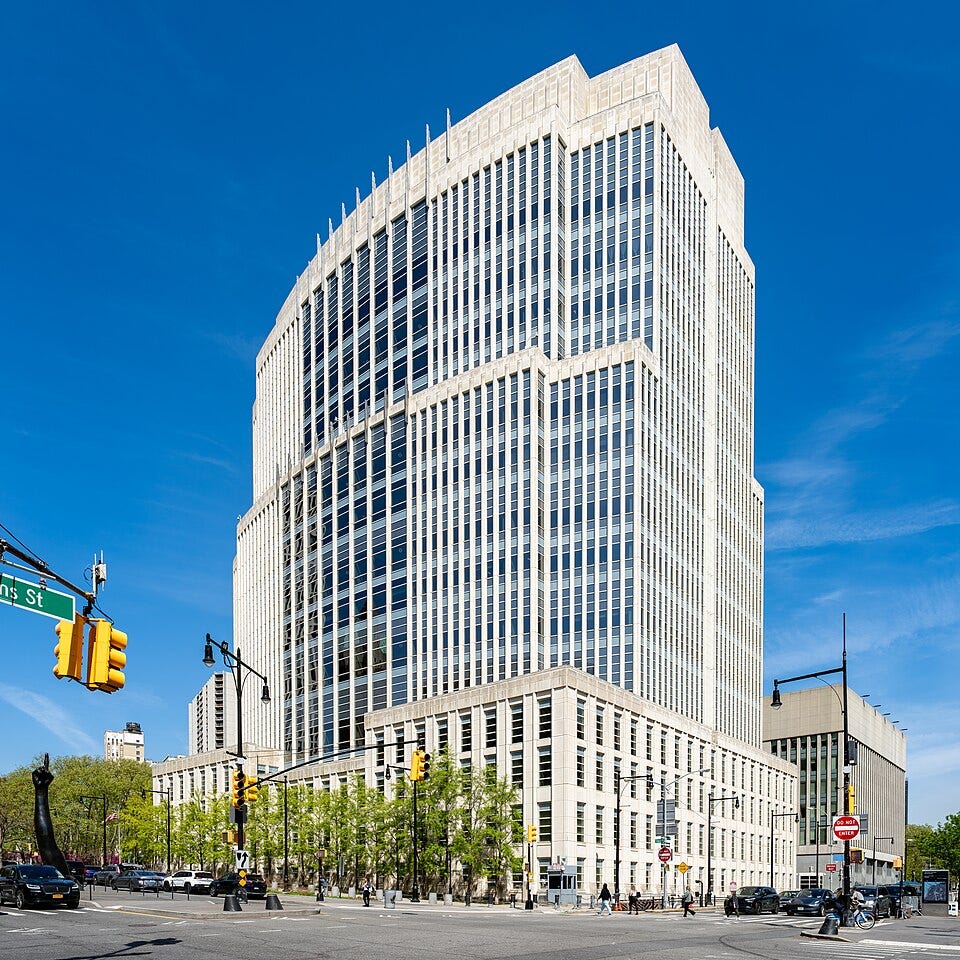
All this is unfolding at 225 Cadman Plaza East in downtown Brooklyn in the glass-and-steel U.S. Courthouse that is home to the Eastern District of New York. Outside, the plaza is quiet. Inside, on the sixth floor, courtroom 6D South is high-ceilinged and bright, with pale wood paneling, a pinkish marble wall behind the judge’s bench and a big silver seal of the United States dominated by an eagle.
On the morning of September 14, the fifth day of the trial, the courtroom was full and buzzing with whispers.
At two long tables sat the opposing sides. At one table sat at least six attorneys for the U.S. government. Behind the government attorneys, at another long table strewn with laptops and coffee cups, sat about a dozen lawyers from Steptoe LLP representing the Chinese telecommunications giant. The public benches at the back of the courtroom were filled with additional lawyers, reporters and observers. A group of Chinese men in suits sat directly next to Huawei’s attorneys.
“They’re from Huawei,” whispered a Chinese reporter for an overseas outlet.
In Huawei’s opening statement on September 9, the company’s lawyers denied the U.S. government allegations and said that prosecutors would paint a false portrait of a company whose success actually came from research, innovation and competition.
The case is much bigger than a corporate criminal trial. Meng’s December 2018 arrest in Vancouver at Washington’s request was followed days later by China’s Ministry of State Security taking Canadians Michael Kovrig and Michael Spavor hostage in Beijing and Dandong, respectively. They spent 1,019 days in wrongful detention before being released simultaneously with Meng’s own departure from Canada and return to China in September 2021.
The Huawei trial therefore connects Canada’s ordeal directly to the larger U.S.-China struggle over technological supremacy: Huawei, once at the centre of the global battle over 5G, is now also an important player in Beijing’s drive to develop advanced chips and artificial intelligence despite U.S. efforts to restrict China’s access to cutting-edge technology.
“The first days were testimony about Huawei’s theft of American technology,” a Chinese reporter who had been attending since day one told me. “Today’s going to be more interesting. They’re going to talk about Iran.”
It’s worth noting that in the 5G market globally, Huawei’s competitors are not American firms but rather the Swedish firm Ericsson and Nokia of Finland. The U.S. does not have a full-scale equivalent to Huawei. The stakes couldn’t be higher. Next year, for the first time, China will host the World Radiocommunications Conference 2027, where 194 nations will gather to debate and possibly rewrite the rules that govern how satellites, smartphones, military networks and WiFi routers use the radio spectrum worldwide for the decade to come.
At 9:45 a.m., a court officer announced Judge Ann Donnelly. Firmly middle-aged, Caucasian and bespectacled, Judge Donnelly has straight, sandy-blond hair that falls to the shoulders of her black judicial robes. Before most people present had finished standing to honour her entry into the courtroom, Judge Donnelly smiled and said kindly, “Everybody can sit down.”
The morning’s witness was an Iranian engineer called ‘Babak Vedadi’ (spelling unconfirmed). A former employee of Skycom, the telecommunications company at the centre of the government’s allegations concerning Huawei’s business in Iran, Vedadi had joined as an electrical engineer in Tehran in 2005. He later worked for Swedish telecoms giant Ericsson and mobile data leader Irancell. He was not a lawyer or sanctions expert, merely an engineer specializing in wireless networks. But what he had seen while working for Skycom had become evidence.
A Huawei defense attorney began by revisiting Vedadi’s earlier testimony. He had told government lawyers that he saw what he believed was American-made telecommunications equipment bearing the logos of Dell, IBM, Hewlett-Packard, and Sun Microsystems at a Huawei facility in Iran.
The U.S., Canada and dozens of other countries restrict exports of sensitive technologies under their own national laws informed by the 1996 Wassenaar Arrangement, which coordinates controls on nine categories of “dual-use” technology—including telecommunications and information security. China is not a Wassenaar member, but maintains its own export-control regime.
The Iranian engineer did not know how the American-made equipment got to Tehran, whether it was new or secondhand, or who imported it. He understood that the ultimate customer was TCI, Iran’s principal fixed-line telecommunications operator.
The defense attorney pressed him on the limits of his knowledge.
“Do you know about the de minimis rule?” she asked.
“Objection, Your Honor,” a government attorney said.
“Sustained,” Judge Donnelly replied.
But the question went to an important issue: Under U.S. law, the de minimis rule allowed certain foreign-made products containing less than a specified threshold of U.S.-origin technology or components to be exported to Iran without a U.S. license—a threshold central to whether Huawei’s Iran-related transactions violated U.S. export controls.
The questioning then turned to Skycom itself.
Vedadi testified that although his employment contract was with Skycom, he understood from the beginning that he was working for Huawei. He was given a Huawei email address.
“Ericsson was Ericsson,” he said. “Nokia was Nokia. Skycom was Huawei.”
“We never asked the question. It was just understood.”
The defense displayed emails from 2010, showing that Skycom employees continued using Huawei email addresses while conducting Skycom business.
After several government objections, Judge Donnelly called the lawyers to the bench. White noise poured through the courtroom’s speakers to prevent the jury from hearing their sidebar.
When testimony resumed, the defense established that Vedadi had not known that Nokia also operated in Iran under a local corporate name.
“Nokia was Nokia,” he repeated.
“No further questions, Your Honor.”
A government prosecutor rose for redirect. Through Vedadi, he sought to draw a distinction between Huawei’s internal and external communications: employees used Skycom addresses when dealing with outsiders, he testified, but Huawei addresses when communicating internally.
“How did Huawei and Ericsson present themselves differently in Iran?” the prosecutor asked.
Vedadi said he had signed a contract directly with Ericsson. With Huawei, there was a third party: Skycom.
The point the government seemed to be trying to make was that Huawei chose to operate in Iran through its affiliate Skycom to mask its alleged illegal import and use of U.S.-made equipment there. Sweden’s Ericsson and Finland’s Nokia, which also had local partners, saw no need to hide behind their local affiliates. Nothing about their trade in Iran was illegal, because it didn’t include high-end, dual-use U.S.-made parts, even if the sale of Scandinavian equipment to Iran was distasteful to Washington and went counter to the spirit of the U.S. economic embargo on Iran, according to John Strand, founder and CEO of Copenhagen-based telecommunications consultancy Strand Consult.
That embargo, in place since 1995, has banned nearly all American goods and services being sold to Iran whether or not they have military uses. The embargo, which also restricts Iran’s access to the U.S. banking system, aims to apply economic pressure to constrain the Iranian regime. U.S. prosecutors accuse Huawei of breaking these rules by using its Iranian affiliate Skycom to obtain American equipment and services and misleading banks about its business in Iran.
When, in 2018, U.S. President Donald Trump reimposed sanctions on Iran—after withdrawing from the JCPOA—Ericsson wound down its business in Iran for fear of upsetting Washington, Strand said, leaving Tehran few options and making business with Huawei more attractive.
Vedadi, the Iranian engineer witness, also described traveling to Shenzhen for training at Huawei headquarters.
By late morning, his testimony was finished. As Vedadi walked into the sixth-floor lobby, a reporter followed and asked him how to spell his name.
“I don’t think I can give that to you,” he said politely.
Then he walked away.
AUTHOR’S NOTE
The court bars recording devices and does not make transcripts available immediately. Quotes are based on my notes.
RESOURCES
“The story behind the Huawei story—it’s not a politically-orchestrated car accident in slow motion,” Strand Consult, December 14, 2018

I followed this news story and one of the things that struck me was the vitriol and outright threats Chinese diplomats were making towards anyone who may have even mildly disagreed with their propaganda. Our former leaders seemed to react like a deer in the headlights. The last time official diplomats spoke like this was in 1930s Germany...
I think the federal government should buy all 50,00 chineses EVs and give them to engineering schools and our auto parts makers. We could reverse engineer it all and make it ourselves. After all, isn't this the "New World Order" The Communist Party of China has given the world