

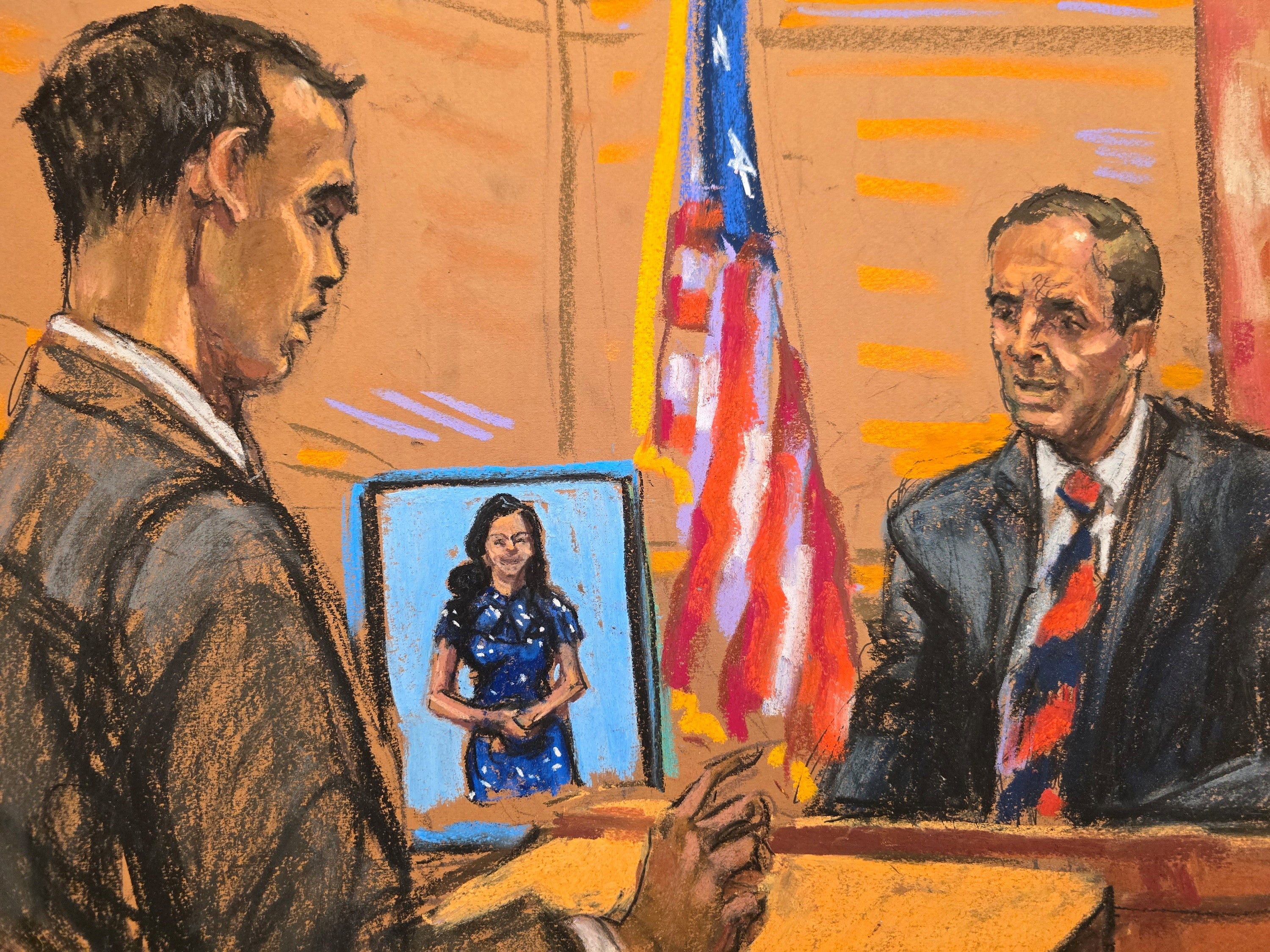
This is the second in our series of blog entries with in-person coverage from the ongoing trial of Huawei Technologies (华为技术有限公司). Entry #1 here.
Trial Day 15: October 1, 2026
October 1 is National Day in China, a holiday of grand proportions marking the founding of the People’s Republic. Everybody gets a whole week off to celebrate Mao Zedong’s 1949 declaration in Beijing of a new form of government under the Communist Party.
But in Brooklyn, this October 1 was just another day in the U.S. federal trial of the giant Chinese company Huawei Technologies on felony charges including racketeering, intellectual-property theft, fraud and evasion of U.S. trade sanctions.
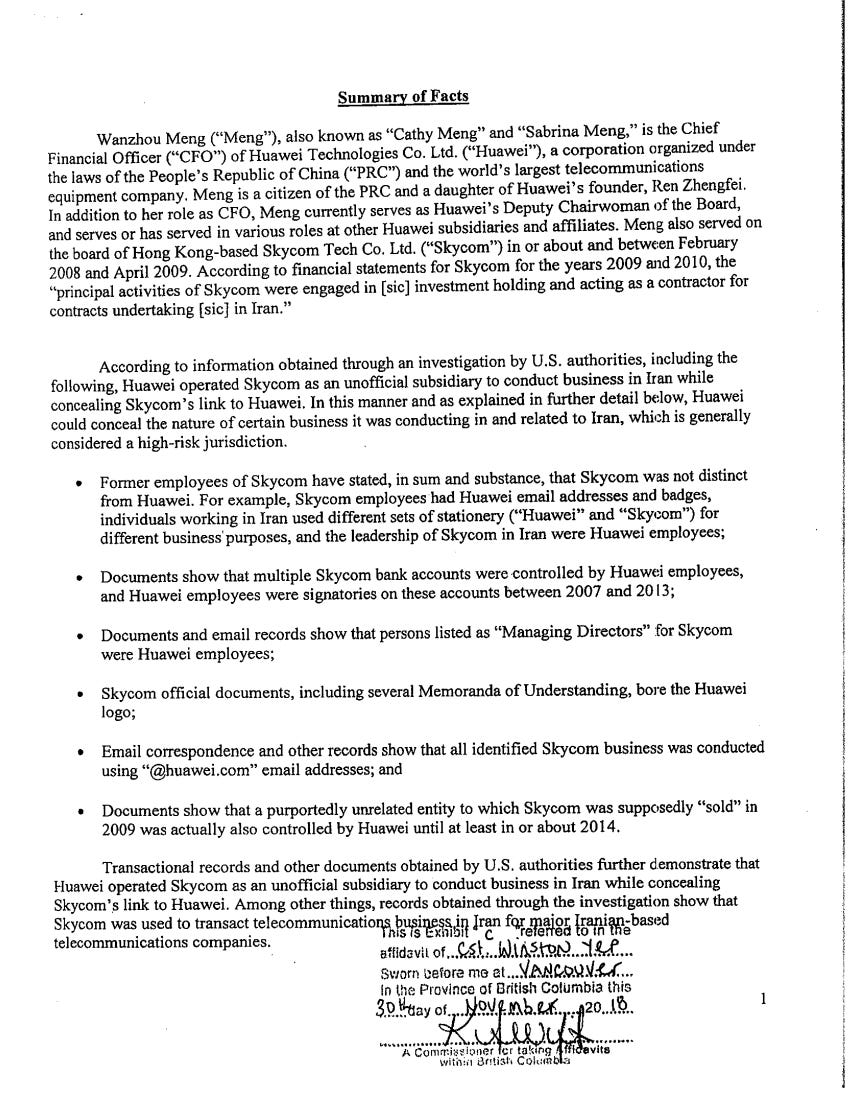
The U.S. case against Huawei comes eight years after Meng Wanzhou, the company’s CFO and daughter of its founder, was arrested in Canada at the behest of the U.S. Department of Justice, which sought to extradite her to New York for trial. The ongoing case against the company—in which Eastern District Court Judge Ann Donnelly ruled that Meng’s admission of wrongdoing will be admissible as evidence—sits at the nexus of the U.S.-China struggle over technology, national security and economic power.
Following are my impressions of a morning session of another day in the fourth week of the trial in courtroom 6D South.
I arrive at 9:30 a.m. and sit next to a lawyer on a wooden bench in the public gallery. Also named Jonathan, he is here for the first time, attending in order to hear testimony from a bank witness.
At the Huawei table, roughly a dozen lawyers huddle. Most are men. At the government table, seven lawyers smile and talk. They too are mostly men. Lawyers from both sides meet in the middle to confer over a sheaf of papers. They are relaxed. This is not a murder trial. Nobody is glum. These lawyers are preparing arguments for a battle over the rules of international commerce.
Lawyer Jonathan tells me he has read about the case in Law360, a paywalled legal journal that covered the Iranian witness I observed September 14 in the first instalment of this blog. He is surprised at the scant mainstream press coverage.
At 10:05, still no judge and no jury.
From my recent stint as a juror on a hit-and-run case in a courtroom a few blocks away from this building at 225 Cadman Plaza in downtown Brooklyn, I’m reminded that the court waits for The People—citizens with lives, kids and jobs, people whose plans are foiled by big city traffic, illness, heartbreak and sometimes broken alarm clocks. The People matter. Their judgment will decide this case, too.
We wait.
At 10:07, Judge Donnelly arrives and immediately notes “train trouble.” One juror is 45 minutes away and the court hasn’t heard from another. Though alternates are available, train trouble is not enough to replace a juror.
Judge Donnelly invites Huawei’s lawyers to raise legal issues concerning an upcoming witness. A defense attorney from Steptoe LLP objects to the government’s repeated presentation of evidence showing U.S. telecommunications equipment in Iran. Huawei, he argues, does not want jurors left with the impression that the mere presence of American-made equipment there was necessarily illegal.
“Doesn’t matter if the equipment is from the U.S., Iran, or the moon,” he says, calling the issue “a sideshow.”
“It is not necessary to bring up the export laws,” Judge Donnelly says. “Most regular people don’t know about export laws. It’s not in the indictment.”
A prosecutor counters that the equipment is relevant because the government alleges Huawei violated sanctions through services and transactions connected to Iran. The U.S. equipment’s presence, he says, provides background for those services and helps establish Huawei’s motive to distance itself from Skycom, its local Iran subsidiary, which had offered U.S. goods to MCI, Iran’s leading mobile telecommunications company.
Under U.S. law, the de minimis rule allowed certain foreign-made products containing less than a specified threshold of U.S.-origin technology or components to be exported to Iran without a U.S. license—a threshold central to whether Huawei’s Iran-related transactions violated U.S. export controls.
The prosecutor also says the government expects to show that U.S. equipment went to Iranian state-owned companies.
All this happens before the jury has even set foot in the courtroom. I find myself doubting that the proceedings of Michael Kovrig’s March 2021 trial in Beijing were this transparent and am certain that there was no public audience.
Huawei’s defense lawyer counters that the company also used U.S.-dollar transactions to pay network employees in Iran and objects to prosecutors creating the impression that Huawei necessarily violated sanctions. The government, in turn, says witnesses understood the presence of U.S. equipment in Iran to be “wrong”—evidence, it argues, of “motive” and “state of mind.”
“I will think about it,” Judge Donnelly says.
At 10:20, Huawei asks for a sidebar. The lawyers from both sides gather around the bench and white noise fills the public-address system. The rest of the courtroom cannot hear what they are discussing. Somebody (the judge?) says something and they all laugh.
I ask lawyer Jonathan about a report that the courtroom may close for three days. He has seen the motion, which he calls “very rare.”
“Why would someone move to close the court?”
“To protect witnesses.”
A SIDEBAR OF OUR OWN
Since this October 1 post was written, the court was indeed closed, enforcing a secrecy at the behest of the U.S. government that observer Fierce Network’s Stephen Saunders notes “should bother us.”
On October 2, Judge Donnelly closed her courtroom to the public and press for the testimony of three government witnesses.
The Justice Department says the witnesses or their families could face retaliation by a foreign government (presumably China or Iran). Even the filings explaining the need for secrecy are sealed. While the security threats may be real, closing a U.S. criminal courtroom is extraordinary, particularly when there is precedent in sensitive cases for anonymous testimony, concealed identities or partial closure to be used as workarounds.
Who are these secret witnesses? Saunders speculates that the unusual level of protection raises the possibility that they are U.S. intelligence or national security officials, but notes there is no evidence to prove that. They could also be Iranian or PRC citizens.
Thirty-eight minutes later, the white noise stops. Judge Donnelly admonishes the courtroom for socializing during the sidebar because it makes the court reporter’s job difficult. Then she calls the first witness.
Alex Manson, a slender, silver-haired man in a dark suit, white shirt and silver tie, strides in and takes the witness box.
At 11:02, we rise for the jury. One juror wears a blue-and-orange New York Rangers ice hockey T-shirt. Another has a red hoodie with a white cross and the word LIFEGUARD across the chest. A third wears a bubblegum pink sweatsuit.
Judge Donnelly thanks them for overcoming the train trouble.
Manson is sworn in. He lives in Singapore and has worked for Standard Chartered Bank since 2012, where he is now CEO of a group building digital fintech ventures. Previously, he held senior roles in wholesale and global transaction banking, overseeing cash management, payments and trade financing.
Huawei was a major Standard Chartered client. Manson served as a senior representative to the company, meeting regularly with Meng Wanzhou—whom he knew as Cathy Meng—and her team.
Standard Chartered provided Huawei with transaction banking, cash management, foreign exchange, trade finance and supply-chain financing across Asia, Africa and the Middle East. Huawei’s international reach, Manson explains, made sophisticated global banking particularly important.
His relationship with Huawei began in 2012. Prosecutors introduce a call report from a meeting that December 11 in London attended by Standard Chartered bankers and Huawei executives including Meng. In it, Manson congratulated Huawei on overtaking Sweden’s Ericsson as the world’s largest telecommunications-equipment provider.
Meng, according to the report, said Huawei needed “a close partner” such as Standard Chartered to serve as “a trusted adviser.”
Standard Chartered became one of Huawei’s main banking partners outside China.
A January 2014 email records another conversation between Manson and Meng after meeting at the annual World Economic Forum in Davos. Meng complained that Chinese banks outside China held meetings but “don’t do anything.”
Manson explains that Huawei’s global business required capabilities many Chinese banks then lacked: geographic reach, technical proficiency and sophisticated international services. HSBC, Standard Chartered and Citi were among the principal banks helping Huawei outside China.
The government prosecutors then turn to risk.
Standard Chartered, Manson explains, could not onboard clients it considered too risky. Credit mattered, but so did reputation. Its Wholesale Banking Reputational Risk Committee met every six weeks to review potentially problematic clients and transactions.
Prosecutors introduce the committee’s December 5, 2012 agenda. One item reads: “ZTE FBI investigation and related issues,” referencing Huawei’s smaller Chinese telecom rival, ZTE (中兴通讯股份有限公司).
A report from the month before, November 2012, notes “considerable adverse media in the United States in the context of U.S.-China relations against the backdrop of a presidential election year.”
Manson says the bank did not automatically believe negative media. It asked clients about allegations and gave them a chance to respond.
Then prosecutors introduce reports concerning ZTE and Huawei supplying U.S. equipment to Iran, including a 2010 Washington Times story alleging ties between Huawei and the Iranian military.
Did that concern Standard Chartered?
“We would not process any transaction in violation of sanctions,” Manson says. “We take these very seriously.”
A young man in jeans and a white T-shirt printed with the traditional Chinese characters used in Taiwan quietly enters the courtroom and sits beside me. He pulls a paperback copy of Gabriel García Márquez’s Love in the Time of Cholera in the original Spanish from a denim tote and begins reading, apparently paying no attention to the trial.
The government continues.
A February 2013 Standard Chartered memo assessed whether Huawei posed enough reputational risk that the bank should reconsider “BAU”—Business as Usual. Much of the memo is redacted. Of four listed risks, three are hidden.
The visible one reads: “Dealing with sanctioned countries.”
The memo followed some “adverse media”: a December 2012 Reuters report about a 2010 Skycom proposal to sell €1.3 million in U.S. equipment to MCI in Iran. Reuters also reported that Meng had served on Skycom’s board.
The February 2013 Standard Chartered memo lists “mitigants”—reasons the bank might consider the risks acceptable. They include phrases such as “Huawei said that” and “Huawei stated that,” indicating that the bank confronted Huawei about the allegations and Huawei responded.
Another email, dated February 27, 2013, states that Huawei did business in Syria, Iran, Sudan and other sanctioned countries.
The government then jumps forward to a November 7, 2017 call report involving Steven Tian, a senior member of Huawei’s overseas finance operation.
Huawei was announcing a two-year withdrawal from its banking relationship with HSBC, citing inefficiency and differences over compliance.
Manson says he found that explanation plausible—but incomplete.
“Call it a banker’s instinct, a form of pattern recognition,” he says.
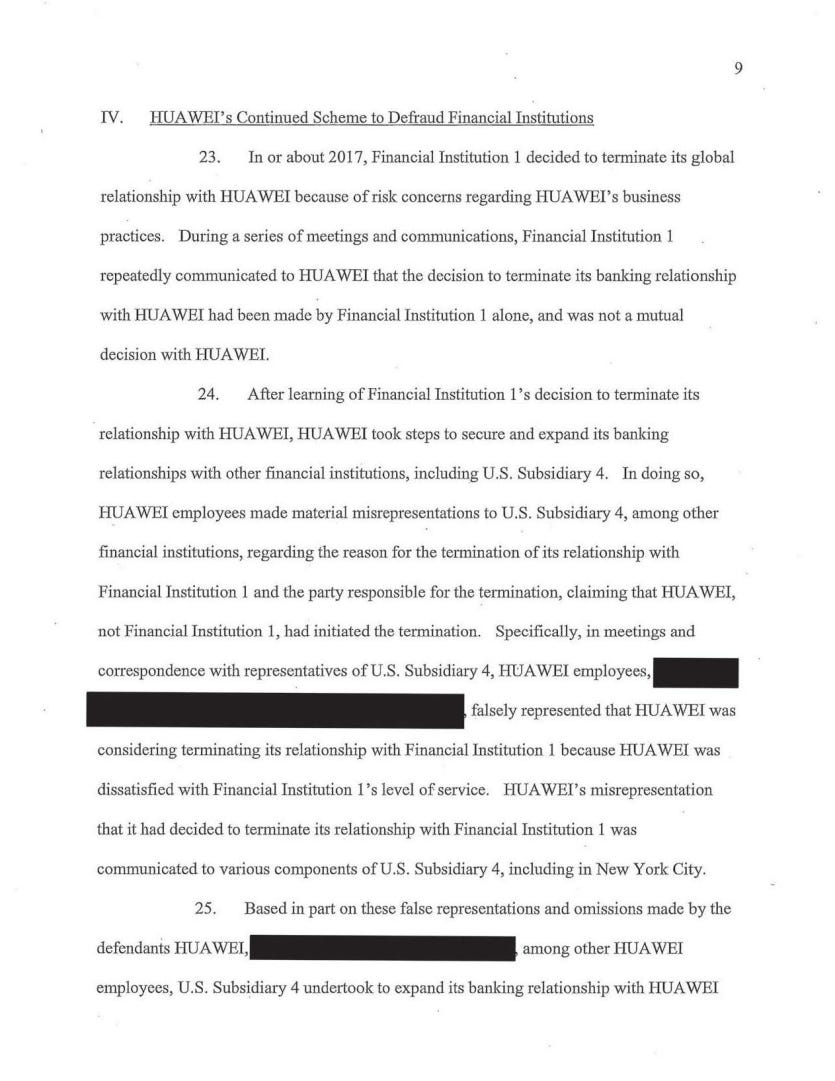
The story sounded one-sided. Manson wondered whether HSBC had actually decided to terminate Huawei, rather than the other way around.
Tian reassured Standard Chartered that Huawei’s cash business was not related to sanctioned countries and that Huawei had not caused HSBC to violate sanctions.
HSBC and Standard Chartered had similar policies against processing transactions involving sanctioned countries. Asked who ended the HSBC relationship, Manson says Huawei did. Asked whether Standard Chartered relied on Huawei to explain why, he says yes.
But Manson had another thought: “Did HSBC find out something we didn’t know?”
At 12:45, a Huawei lawyer begins her cross-examination. She appears to be in her 40s, with close-cropped blonde hair, a dark suit and chunky eyeglasses.
She places photographs of Manson and other Standard Chartered bankers on a magnetic whiteboard in view of the jury.
Manson describes himself as a “Senior Sponsor” of Huawei, responsible for understanding the company’s overall needs and maintaining relationships with senior executives.
The defense establishes that Manson has an engineering background.
“Would it be fair to say that you admired Huawei’s products?”
“Yes.”
At 1 p.m., Judge Donnelly calls the lunch break.
The young man reading García Márquez and I begin to talk. His name is Aiden. He studied history at Carleton College in Minnesota, is partly ethnic Chinese and grew up in New Jersey. He is in court hoping to catch up with a friend whose father, one of Huawei’s attorneys, is in town from Los Angeles and has been working on the case for years.
“Huawei wants to wrap the case up,” Aiden says. “There’s a lot of pressure on the U.S. firms representing them.”
AUTHOR’S NOTE
The court bars recording devices and does not make transcripts available immediately. Quotes are based on my notes.


Its worth noting that the explosive rise of Huawei occurred at roughly the same time as the collapse of NORTEL, and there has long been speculation that Chinese hacking of NORTEL intellectual property (which was documented) was one factor that contributed to both the rise of Huawei and the fall of NORTEL