


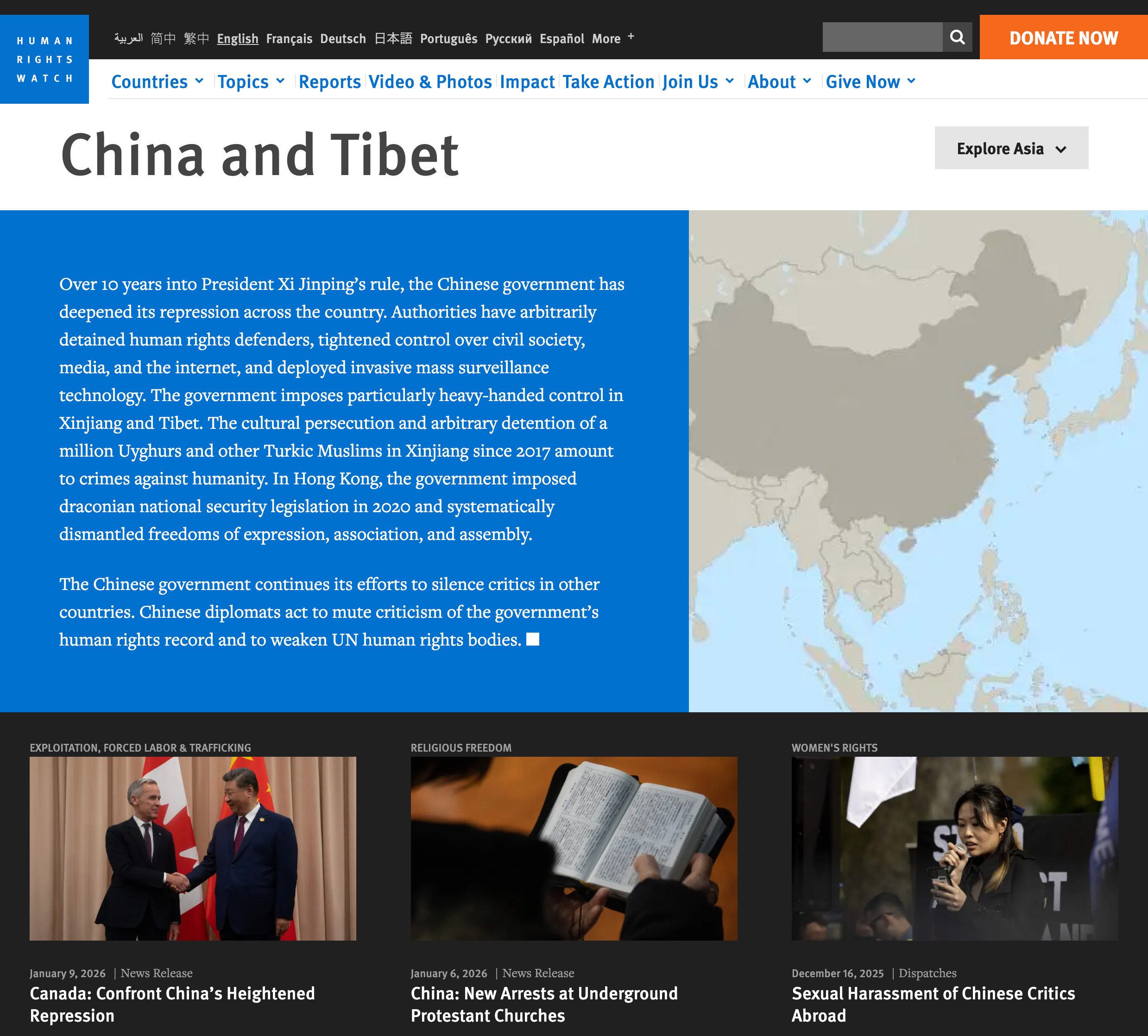
Human Rights Watch says Canada’s Prime Minister Mark Carney should make human rights a key focus of his Jan 14-17 visit to China. Since the last trip by a Canadian leader nearly a decade ago, the CCP has significantly increased its authoritarian repression both at home and abroad, the organization accurately warns. The United Nations, HRW, and other organizations have for several years reported on crimes against humanity by Chinese authorities, Wang notes. Repression is getting worse. Last week, for example, police detained Christian church members.
That dire trend “threatens not just the rights of people in China but, increasingly, Canada’s core interests and values,” says the NGO’s China expert Maya Wang in a January 9 press release. “Carney should ensure that engagements with the Chinese government on trade and security are consistent with Canada’s values, which includes the promotion of human rights.”

“Key issues Carney should raise include links between the Chinese government’s forced labour and imports to Canada; the persecution and imprisonment of human rights defenders; and China’s targeting of critics abroad, including in Canada,” Human Rights Watch says. “Carney should also raise concerns about drones produced by China-based companies being sold to Russia and then used to attack civilians in Ukraine.”
Carney has a particularly timely opportunity to advocate for humanitarian release for Apple Daily publisher Jimmy Lai, a champion of freedom convicted of conspiracy last year in a political show trial. The 78-year-old faces a prison term ranging from 10 years to life, and mitigation hearings to debate the severity of his sentence run Jan. 12–15, coinciding with the PM’s visit.
Canada’s PM and Foreign Minister Anita Anand should also raise other concerns and cases. Calling for changes in the Party-state’s treatment of ethnic minorities such as Uyghurs and Tibetans, dissidents like Wang Bingzhang, lawyers such as Xu Zhiyong and Ding Jiaxi, and journalists including Dong Yuyu and apparently the South China Morning Post’s Minnie Chan, is not only about defending universal human values, it’s also a matter of national security and sovereignty. Several are foreign citizens or residents with close family ties in Canada or elsewhere.
In addition, the PRC has also egregiously sanctioned reputable Canadian civil society organizations and moderate advocates including Sherap Therchin and Margaret McCuaig-Johnston. A few months before Carney took office last year it executed four Canadian citizens.
As those and far too many other examples illustrate, how the CCP behaves toward people it governs, detains, or dislikes is a flashing warning light about how it’s likely to deal with other citizens and countries it acquires power over. The Party-state system interprets silence about violations of international laws, norms, and human rights treaties as acquiescence that emboldens it to grind further into aggression, totalitarianism and weaponizing its political-legal system.
Human rights aren’t a separate issue that can be tidily compartmentalized into perfunctory dialogues. From detaining individuals to oppressing groups to coercing countries, PRC violations are an inextricable part of a continuum of geopolitical, geoeconomic, and global security challenges its one-party state increasingly poses. That’s why the necessary whole-of-government-and-society responses must be holistic, strategic, and grounded in principled realism and a long-term vision of statecraft rather than short-term, transactional, issue-by-issue dealmaking.
I encourage you to read the full press release and HRW’s annual China report, and to add your own voice. Silence is deadly.
Totally agree, human rights is paramount.
China is not a normal country like Finland or South Korea