

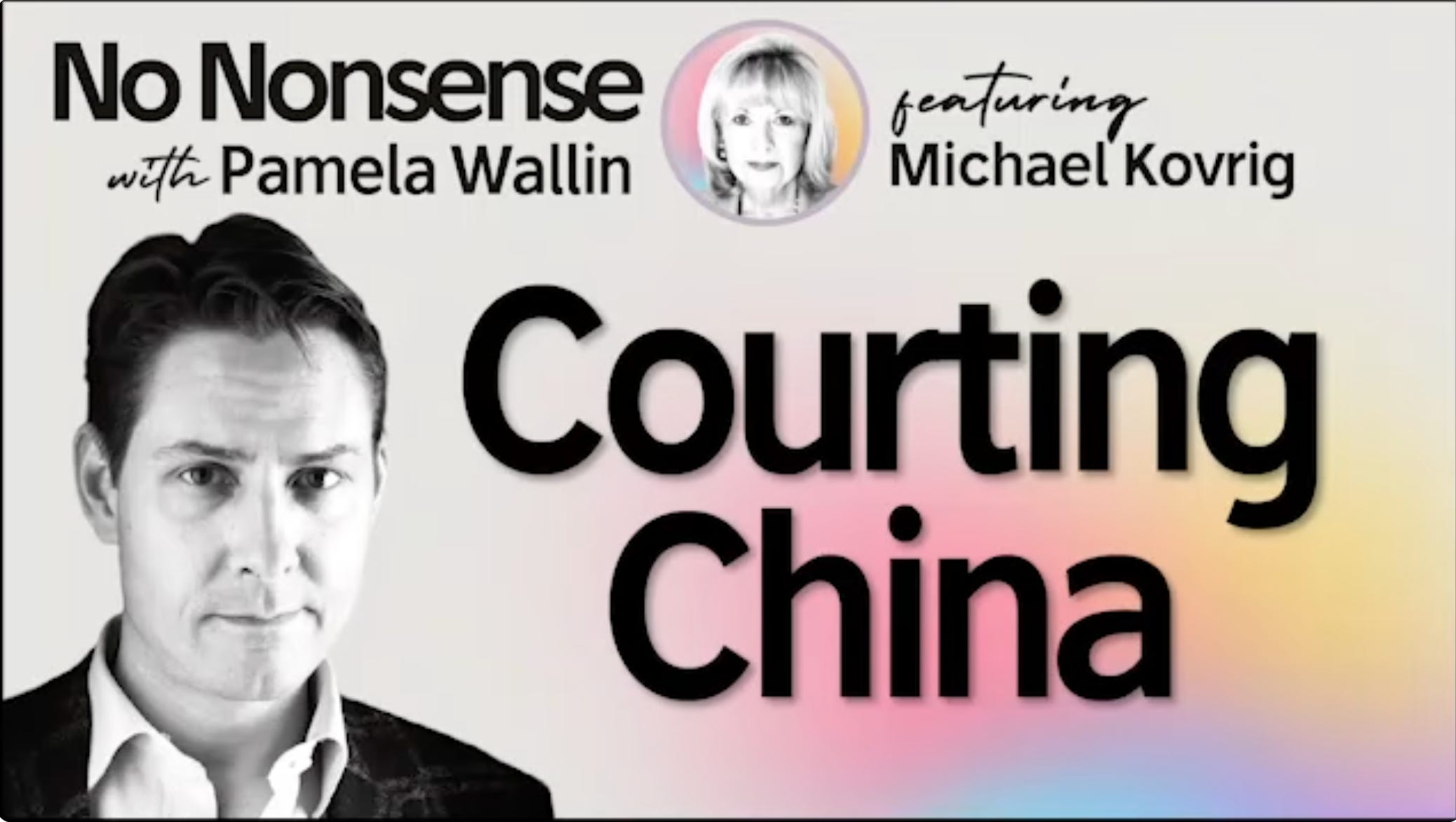
Canadian Senator Pamela Wallin recently interviewed me on her No Nonsense video podcast for a deep dive into Canada’s renewed strategic partnership agreement with China. Our discussion explored the true meaning of this shift, including potential costs, distinguishing between the aspects that are necessary and those that are less justifiable. The world is watching how leaders navigate the complexities of diplomacy with both Donald Trump and Xi Jinping, making this a rare moment where what Canada does and says in Beijing can have extensive ripple effects.
For subscribers, here’s a tidied-up transcript of our timely January 16 discussion on the last day of Mark Carney’s first official visit to Beijing.
In it, I argued the liberal rules-based international order has eroded and we are living in a time between orders. Trade and technology are being used for power, leverage, and coercion, meaning dialogue with China cannot be treated as neutral or technocratic. Silence on sensitive issues is often read as acquiescence, and unilateral concessions can be taken as weakness rather than goodwill. The conversation also covered human rights, political prosecutions, Taiwan, electric vehicles, cybersecurity, industrial hollowing out, and the risks of elite capture and strategic dependence. The through-line is that high-level diplomatic dialogue with the PRC is necessary, but substantive cooperation should come with strict conditions, clear red lines, and coordination with allies.
Q&A
Pamela Wallin: You’ve had a bit of a trip to hell and back with the Chinese. What’s your state of mind today? Have you come to terms with this? Are you at peace? You seem very calm in your comments about China, this deal, and our relationship.
Michael Kovrig: Well, I meditate a lot. I’ve been watching the events unfold with a combination of concern and anxiety about the implications, but also a recognition that some elements are necessary, while others are less necessary. It’s a complicated set of shifts that will have far-reaching implications, not only for Canada but globally. This is a rare case where what Canada did and said will have ripple effects quite widely, because countries across the world are all watching closely how their fellow leaders are dealing with both Donald Trump and with Xi Jinping.
New World Order?
When Mark Carney uses phrases like New World Order in relation to this deal, what do you think he sees?
I don’t know what was going through the man’s mind while doing that, but I think he’s looking to acknowledge that the liberal rules-based international order has significantly eroded and we’re no longer under unipolar U.S. hegemony, which was a relatively short period from the 1990s to the global financial crisis.
We’ve passed into a new phase. I would argue we’re not in a clearly-organized new order. It’s more of a time between orders, increasingly driven by great-power rivalry, particularly between China, the United States, and Russia, that’s much more about power, coercion, leverage, and weaponized interdependence, with states using economic relations for political purposes rather than operating under a World Trade Organization system where trade could largely be based on economic advantage rather than geopolitics.
So we’re in a more geopolitical world, and that’s a more dangerous world for Canada. I don’t think the country is ready for it, and we need to get ready quickly.
Mark Carney sees himself as making some of those necessary changes. The risk is that any change can have unforeseen consequences, and he has to manage a complicated set of issues that touch not only on economics, which is his forté, but also geopolitical challenges, national security issues, and, not least, how to preserve Canadian values, including a belief in human rights, the value of the individual in society, democracy, a free press, and all the other things that make Canada a unique and stable place.
China’s different worldview drives its diplomacy
You write about wolf warrior diplomacy, and that is how China plays the game, and we may have to up ours in order to understand what they’re up to.
Yes, that’s right, absolutely. Chinese diplomacy is very subtle and well-informed, but it also tends to mirror-image and has limits in understanding the rest of the world.
A key thing for Canadians to understand is that the Chinese Communist Party and the government it controls have a fundamentally different worldview than Canadians do. It’s much more realist and power-based, and it’s increasingly using that power to reshape the world. It has a Leninist basis that’s oriented toward struggle and dominance. It cannot trust, so it seeks to control as much as possible. It doesn’t have trusting relationships or true partnerships with other countries, but rather relationships of dominance and subordination, of stronger and weaker parties. Those are the “Law of the Jungle” calculations that its leaders and decision makers are constantly making.
We need to be very clear and careful about what we are dealing with and how to manage the risks. My deepest concern is that whenever you increase engagement, interaction, trade, and investment with China, you also open the door to negative aspects that can put Canadians, national security, and the integrity of our political system at risk.

The CCP’s appalling human rights abuses
This is a country that abuses [human rights]. Some have even used the word genocide to describe how it deals with the Uyghurs and other Muslim populations. You yourself are a direct victim, and there are hundreds of Canadians being held. There is also the flow of illegal drugs into our country and others, including fentanyl precursors. This is a nasty country on many counts.
I would clarify that it’s a nasty regime that uses the people of China. I have a great deal of empathy for the people of China, because this has nothing to do with ethnicity or race. It’s about a political system. If anyone has suffered most at the hands of the Chinese Communist Party and its security organs, it’s the people of China themselves, particularly ethnic minorities, political dissidents, human rights lawyers, and journalists. More than 50 journalists are in prison for doing their jobs and asking questions the Party didn’t want asked. The regime has perpetrated mass human rights violations against over a million Uyghurs. It’s repressed Tibetans for decades. There are thousands of political prisoners in China who are treated worse than I was, and my treatment was not kind.

Democracies must do more to protect themselves
We need to understand that reality. We are not going to change China, at least not anytime soon. Liberal democracies must find ways to protect themselves while still speaking out and coordinating responses to harmful Chinese behaviour. That response can be calculated and strategic, but it cannot be silent, because the Party-state will treat silence as acquiescence and become more aggressive until it meets resistance.
My concern about this visit is that pragmatic steps may have been taken from an economic perspective, but nothing was said publicly about more sensitive issues. Did the Canadian government make clear its red lines? What is Canada not willing to trade away for economic benefit? What signal did that send from a national security perspective? Certain actions should draw consequences from Canada and its allies, because unless that signalling is clear—even if strategically ambiguous on issues like Taiwan—you risk undermining collective deterrence. Middle powers like Canada can deter larger authoritarian states such as China and Russia only through collective deterrence.

Making early concessions on Taiwan shows weakness
On Taiwan, the Prime Minister said Canada’s “one China” policy will remain in place. But he also sent a couple of Liberal MPs home who were on an information-gathering trip to Taiwan and asked them to return ahead of this visit. So it appears the compromises may already have begun.
That’s exactly right. Recalling Canadian MPs from Taipei on the eve of Carney’s Beijing visit looks like a unilateral concession with nothing concrete in return. Why do that? If the idea was goodwill, history should disabuse us. Decades of Western accommodation, from renewed engagement after the [June 4, 1989] Tiananmen Square and related protests and massacres—which were far more widespread than often acknowledged—to WTO accession, enabled China to access vast foreign investment and global markets and rapidly develop its economy. I see no gratitude or moderation in China’s behaviour as a result. The CCP doesn’t reciprocate goodwill. It exploits it.
From the Party’s perspective, that kind of self-censorship—anticipating it will not like something and pulling back Liberal MPs who were already in Taiwan—signals weakness. In the logic of Party cadres, nothing good is given away for free. A leader who restrains himself preemptively is seen as someone who can be pressed harder, whether out of fear, calculation, or personal interest. That’s the challenge.
Is Carney using China to hedge against Trump?
This is the concern many people have about the Canada-U.S. relationship. Some even argue that Prime Minister Carney is deliberately provoking the United States, because that creates space for him to step onto the international stage and pursue new relationships. They suggest the current strain in Canada-U.S. relations presents an opportunity to do things he might not otherwise get away with, especially since Canadians are of mixed mind about the situation.
Everything in Beijing [during Carney’s visit] was carefully watched in Washington: electric vehicle concessions, the energy dialogue, and the language on strategic autonomy that the Chinese side likes to push. It encourages U.S. allies to pursue strategic autonomy because it leads to divide and conquer. Or as Benjamin Franklin said, if we don’t all hang together, we will surely be hanged separately.
All of that intersects with CUSMA (USMCA), Five Eyes intelligence cooperation, NATO, and other long-term accords between the U.S. and Canada that China would like to weaken. It’s almost always the larger party in a negotiation that has the leverage. Even modest moves now carry amplified consequences. The danger is not simply engagement with China, but conditioning. It pairs economic relief with expectations of political restraint later. That is why guardrails are needed, including after the cameras are gone.

When Canada self-censors, it sets an example for others
I can’t really see any particular guardrails that we have put in place in this arrangement, other than we’re going to pay attention and we’re going to be left in the hands of the Prime Minister alone to monitor this, because there’s nothing written, there’s nothing to judge them against, in a concrete way.
A very important part of this meeting and the evolving relationship with China is what happens afterward. People in government have tried to reassure me that even though the Carney government has chosen to be quieter about calling out China’s problematic behavior—his reference to “no more megaphone diplomacy,”—that does not mean the concerns have disappeared.
For Canada, much of that public commentary was often virtue signaling for domestic audiences and had little effect on China, so perhaps some of it was not necessary. But other aspects are important, especially on geopolitical issues, because if Canada is silent, it sets an example for others.
Canada needs to uphold deterrence by signalling that it has an interest in preserving the status quo in the Taiwan Strait and that any attempt by China to change it by force would be unacceptable to Canada and many other Western countries. If enough countries make that clear, you can achieve some deterrence. But if that consensus erodes, there is a high likelihood China will move on Taiwan, with catastrophic consequences for peace and security in the Asia-Pacific region and for the global economy.
China is not the environmental champion it pretends to be
The other thing I found odd is the price, and it’s not the first time, but these repeated references to Canada and China partnering on the move to net zero, that they’re environmental leaders. Nowhere in the world are there more coal mines, dirtier air, and dirtier production. Again, it seems to be a give without a get.
It seems Mark Carney is leaning on aspects of the Chinese system he knows from his previous work in finance and climate policy. The technocrats still working on climate issues are skilled, and China has real capacity and affordable technology to offer Canada. There’s a clear overlap in interests. But we shouldn’t delude ourselves that China is a champion of net-zero emissions. It still produces vast amounts of coal and continues to finance and build coal plants abroad. There’s also a political problem if China floods global markets with subsidized clean technology like solar panels, wind turbines, and electric vehicles. In the short term, cheaper products benefit consumers and may accelerate the green transition. In the long term, they can create strategic dependence on China for supply chains, batteries, and vehicles. China has already shown a willingness to weaponize such dependence for political leverage.
Strong industrial policies and trade barriers are needed to ensure domestic industries in critical sectors can survive. My concern is that China is shaping a world in which it produces nearly half of global manufacturing, while countries like Canada grow food and extract resources but manufacture little, importing advanced technology in return. High-tech is central to power and influence in the 21st century. The question is how to preserve it under those conditions.
