


As Sir Keir Starmer travels to China this week, the British government’s agenda is ambitious: resetting bilateral relations, boosting trade and investment, and securing practical agreements on matters including visas and embassy reciprocity, all while eking out economic opportunities without sacrificing national security. Not easy. To avoid pitfalls that have hindered his predecessors and other Western leaders, the prime minister should keep the political optics and leader-level agenda tightly focused on measurable deliverables that advance a long-term strategic transformation in the United Kingdom’s policy toward China.
As an analyst and diplomat who served in Beijing and Hong Kong—and spent nearly three years as a hostage within China’s Orwellian political-legal-security apparatus, conversing with its insiders and inmates—let me offer a few insights into the worldview and agenda of the Chinese Communist Party (CCP). Based on my team’s research on previous visits by British prime ministers and recent trips by leaders from Spain, Australia, France, Ireland, Finland, and Canada, we can also draw lessons on how Chinese officials assess and manipulate their guests, and identify a narrow path for success.
China is the UK’s #3 trading partner and #5 export market
London is the top offshore RMB trading hub
The UK is the top study destination for Chinese students1
China’s enormous scale and exceptional capacity to marshal massive means to achieve strategic ends already make it a unique challenge. The additional complication is that China’s autocratic leader, Xi Jinping, and his authoritarian one-party state are fundamentally different beasts from their Western counterparts. The Party-state may speak of building trust, but what it really seeks is control. Its hostile behaviour stems from a legitimating ideology currently personalized as Xi Jinping Thought, Leninist organizational behaviour, solipsistic Han Chinese ethno-nationalism, and a political culture of perpetual struggle, cyclically rotted by endemic corruption and cauterized by relentless purges, most recently roiling the People’s Liberation Army. Through an increasingly aggressive foreign policy, this vast and secretive organization aims to shatter the West into fragments it can remold within a new, more Sinocentric world order.
Fools’ gold and false premises
That’s the toxic atmosphere Sir Keir will inhale as the first British prime minister to enter Beijing’s Great Hall of the People since Theresa May in 2018. Like David Cameron, May spoke of a “golden era” in relations. But as Martin Thorley illuminates in his book All That Glistens, intractable frictions removed the golden shine together with delusions the CCP would prioritize Western legitimation and market access over geopolitical rivalry, that interdependence would constrain confrontation, and that London could arbitrage between Washington and Beijing. And yet the “golden” fantasy now risks an unwise comeback.

Times have hardened, as has the CCP. Starmer is travelling in the wake of Beijing’s abrogation of the Sino-British Joint Declaration, torture of a former British consulate employee, persecution of other citizens, spy scandals, thuggery, and myriad other moves against the UK and its allies.
It should be obvious now: a China policy fails if it overlooks the Party’s adversarial nature and intentions. All governments are one political hostage, trade dispute or frank statement away from a China crisis.
Internally divided and desperate to balance budgets without cutting entitlements, British and other Western elites have nonetheless accommodated Xi’s agenda in the vain hope of economic lifelines and competitive coexistence. But the Party treats stability as tactical and constantly seeks to improve its position in a zero-sum pursuit of security through centrality. The Labour government must internalize that cohabitation is possible only as the consequence of a favourable balance of power restored through economic resilience, military rearmament, industrial and technological renewal, allied and likeminded coordination, deterrence by denial, and constant constraints on the Party-state.
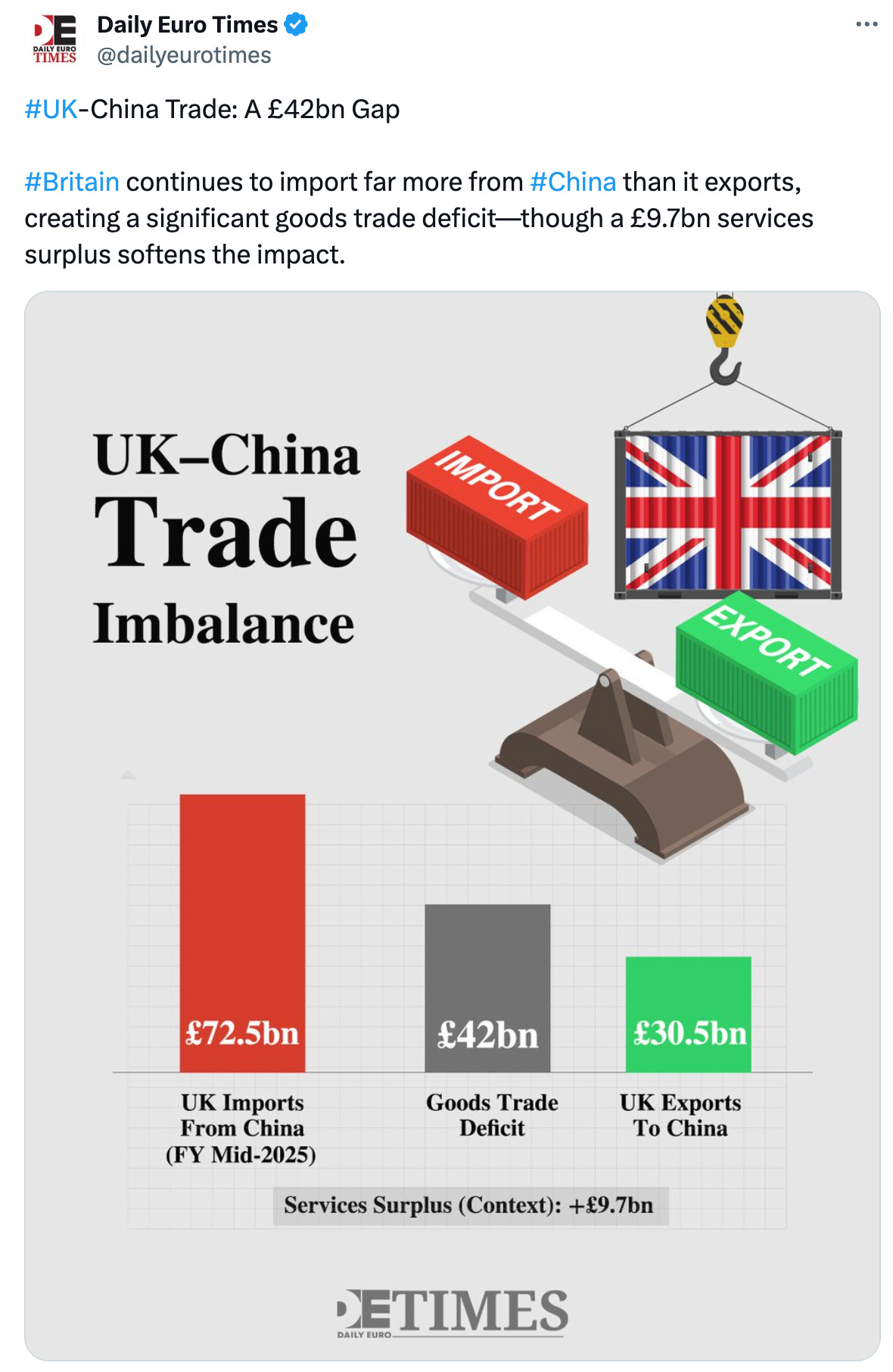
Focus on what’s possible and don’t let Beijing shape the narrative
The CCP’s propaganda portrays an economically strained, strategically stressed London, pragmatically seeking investment while balancing between Washington and Beijing. It will use the visit to ratify a narrative that Britain can normalize and stabilize relations through trade and investment, “strategic autonomy” and a “correct” perception of China. The PM must counter with his own strategic narrative that he is there to take China’s measure, defend British and Western interests, lock in a few narrow economic opportunities, and deploy leverage to shape incentives and deter bad behaviour. He should smile less than the Chinese do, favour a determined, statesmanlike demeanour, stick to undramatic language with clear conditionality, and reinforce it in any communiqués and memoranda. And please, no talk of “strategic partnership for the new world order.”
The price of the PM’s entry ticket to the Middle Kingdom was the approval of a new mega-embassy in London and revival of a business dialogue. Accepting access as a prize already puts Starmer at a disadvantage—the Party will treat it as a sunk cost. So, any further concessions must be balanced with fair sequencing of reciprocal ones. That requires defining a few deliverables with follow-up processes and timelines, measurable benchmarks, off-ramps to reverse course, and consequences for non-fulfillment.
Similarly to Canadian Prime Minister Mark Carney’s recent visit, three areas where Starmer’s delegation can make material progress are targeted, verifiable commercial and regulatory agreements that advantage and protect British businesses; re-opening and stabilizing diplomatic dialogue and negotiation mechanisms and giving them leader-level direction to resolve problems; and incremental progress on mobility and people-to-people issues such as visa processing and educational and cultural exchanges.
Firmly and diplomatically convey red lines, costs and consequences
He should resist downplaying discussion of security issues. Silence abets China’s manipulation of British public perceptions. Clarify red lines, particularly with Xi, and press for measurable geopolitical outcomes. The General Secretary is unlikely to concede anything on points of contention such as China’s strategic technology policy, overproduction and aggressive mercantilism, espionage and interference, mass human rights violations and transnational repression, decisive enabling of Putin’s war on Ukraine, or coercion of Asian neighbours and UK allies. But by resolutely raising them, Starmer—and leaders who follow him this year, including Germany’s Friedrich Merz in February and Donald Trump in April—can at least signal costs and consequences in the form of growing opposition to China’s aims and damage to its reputation.
Reconciling economic benefits with national security costs without compromising core democratic values requires commensurately strengthening the government’s defence and offence. That includes human rights advocacy with specific, measurable objectives. The CCP’s jailing and persecution of British citizen and free speech champion Jimmy Lai in Hong Kong presents a test of whether leader-level engagement dilutes or reinforces values. Ministers should press relentlessly for consular access, humane conditions, and humanitarian release.

Toward a UK strategy for China and the new world disorder
Geopolitical winter is coming because authoritarian powers treat rules as tools and coercion as normal. Britain’s response must be whole-of-society: rebuild industrial capacity, invest in defence and resilience, educate the public about the challenge, protect democratic institutions, and demand competence and honesty from leaders.
First, Whitehall must build security guardrails that are stronger than Beijing’s economic incentives. If market access can be exchanged for political restraint, the Party will keep offering “relief” that conditions British behaviour.
Second, the relevant ministries must incentivize companies to diversify trade, or be coerced by China. This isn’t abstract, it’s arithmetic. Set a national exposure standard: no critical export sector should rely on China for a dominant share of sales without a funded diversification plan.
Third, the government must lead a re-industrialization so Britain is not trapped between two powers with leverage over it. The Second China Shock is not just coming, for many sectors it is here, in the form of subsidized overproduction, below-cost exports, and industrial dominance in batteries, electric vehicle supply chains, and clean tech. Britain must rebuild advanced manufacturing in sectors where it matters, protect strategic industries, and invest in productivity, not resign itself to being a services annex. Workers will thank the Labour Party for doing what it says on the tin.
In foreign policy, Mark Carney’s recent rousing speech in Davos offers a way forward—but only if it is backed by consistent, unified action from other Western countries and middle powers. So far, most have failed to implement a coherent China policy of their own, let alone a common approach across liberal democracies and like-minded partners. The United Kingdom is uniquely positioned to play a crucial role in changing that, and in forging networks and coalitions with a common approach that constrains the CCP’s worst impulses while preserving some limited gains from engaging with Chinese businesses and people.
Starmer should treat 2026 as a year to stabilize diplomatic channels, harden defences and ensure any new points of connection don’t create strategic vulnerabilities. He should be careful not to overestimate economic opportunities or underestimate Xi’s tolerance for disagreement—the General Secretary respects toughness.
A successful official visit to China is about achieving substantive outcomes, avoiding concessions, and controlling the narrative. By reinforcing what their predecessors did well and avoiding their errors, Sir Keir and likeminded leaders can mark a different kind of turning point in relations: one that starts to constrain the CCP and reverse its efforts to hasten the West’s slide toward civilizational assisted suicide.
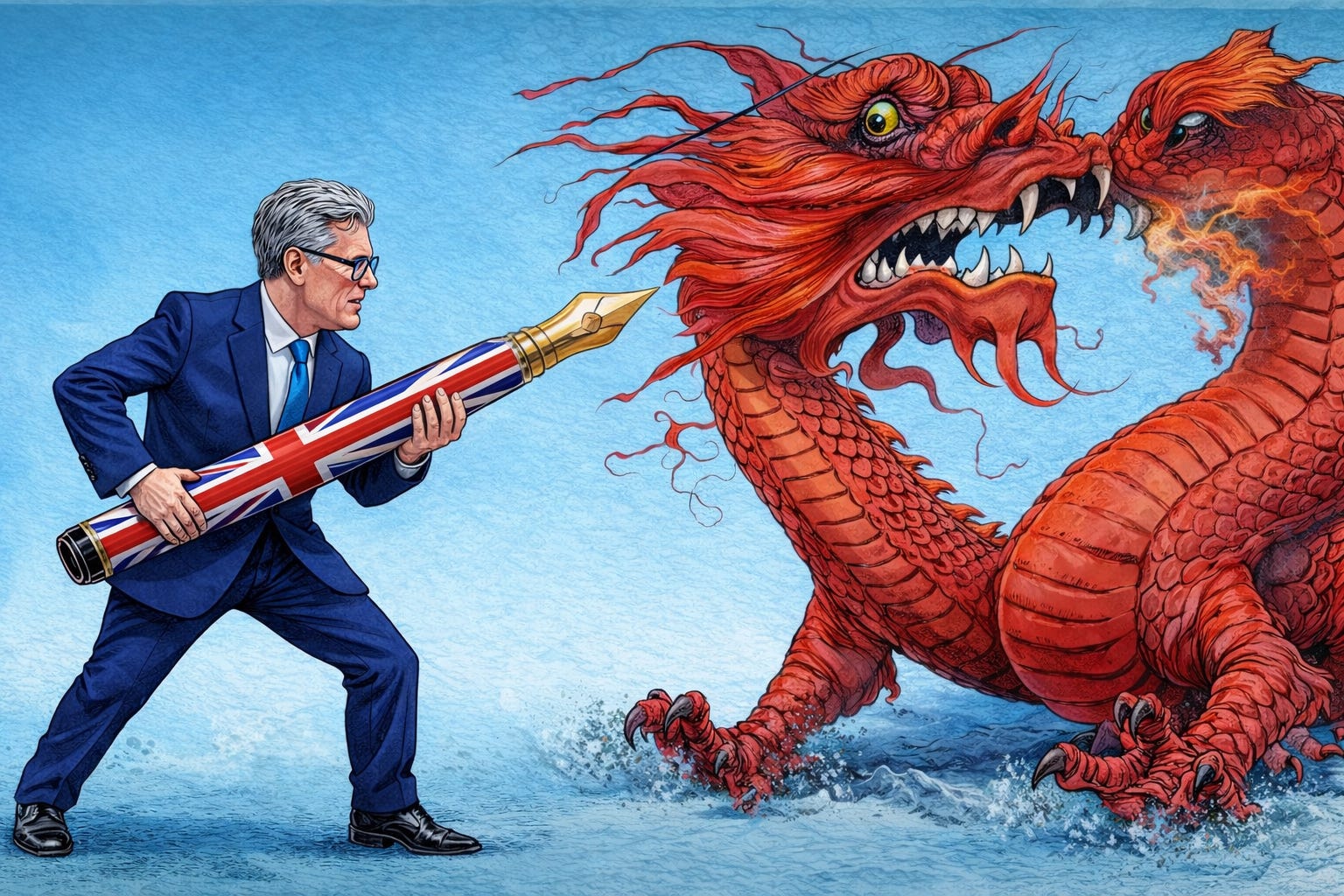
The Labour government must internalize that cohabitation is possible only as the consequence of a favourable balance of power restored through economic resilience, military rearmament, industrial and technological renewal, allied and likeminded coordination, deterrence by denial, and constant constraints on the CCP.

StrategicEffects consultants Jonathan Landreth, Patricia Xavier and Joe Widacki contributed research for this post.
Key Facts about UK-China Relations, China-Britain Business Council, September 2025.
UK-China relations deep dive: recommended further reading
Veerle Nouwens and Andrew Cainey, Assessing the UK–China Commercial Relationship, RUSI, 12 June 2020, https://www.rusi.org/explore-our-research/publications/rusi-newsbrief/assessing-uk-china-commercial-relationship
Charles Parton, What the Chinese Communist Party wants from the United Kingdom, Council on Geostrategy, March 2021, https://www.geostrategy.org.uk/research/what-the-chinese-communist-party-wants-from-the-united-kingdom/
Charles Parton, Empty threats? Policymaking amidst Chinese pressure, Council on Geostrategy, July 2021, https://www.geostrategy.org.uk/research/empty-threats-policymaking-amidst-chinese-pressure/
Nick Pay, V., & Buszta, P., China in the UK’s Foreign Policy: Shifting to Progressive Liberal Internationalism, European Journal of East Asian Studies, 21(3), 372–394, 2022, https://brill.com/view/journals/ejea/21/3/article-p372_3.xml
Our position on China: Foreign Secretary’s Mansion House speech, James Cleverly MP, Foreign, Commonwealth & Development Office, http://gov.uk/, 25 April 2023, https://www.gov.uk/government/speeches/our-position-on-china-speech-by-the-foreign-secretary
Cindy Yu (host) with James Cleverly, Sophia Gaston, and Sam Hogg, Does China care what Britain thinks?, Chinese Whispers (The Spectator), 2 October 2023, https://www.spectator.co.uk/podcast/does-china-care-what-britain-thinks/
Andrew Cainey, Six Principles for a More Dynamic and Effective UK–China Strategy, Royal United Services Institute, 8 November 2023, https://www.rusi.org/explore-our-research/publications/policy-briefs/six-principles-more-dynamic-and-effective-uk-china-strategy
Ben Bland, Andrew Cainey, Philip Shetler-Jones, Transatlantic China Policy: In Search of an Endgame, RUSI, 22 February 2024, https://www.rusi.org/explore-our-research/publications/emerging-insights/transatlantic-china-policy-search-endgame
Out-compete, out-cooperate, out-innovate: Foreign Secretary calls for a harder edge for a tougher world, Lord Cameron, Foreign, Commonwealth & Development Office, http://gov.uk/, 9 May 2024, https://www.gov.uk/government/speeches/out-compete-out-cooperate-out-innovate-foreign-secretary-calls-for-a-harder-edge-for-a-tougher-world
James Crabtree, Keir Starmer Should Rethink Britain’s China Policy, Foreign Policy, 8 July 2024, https://foreignpolicy.com/2024/07/08/britain-uk-china-starmer-labour-xi/
Charles Parton, China: The Top 10 Priorities For Early Labour Government Action, Coalition on Secure Technology and Council on Geostrategy, September 2024, https://www.geostrategy.org.uk/research/china-the-top-10-priorities-for-early-labour-government-action/
Andrew Yeh and Sam Goodman, Implementing the UK’s “China audit”, China Strategic Risks Institute, 3 October 2024, https://www.csri.global/research/implementing-china-audit
Kerry Brown, Can the UK have a stronger relationship with China?, King’s College London, 20 November 2024, https://www.kcl.ac.uk/news/comment-can-the-uk-have-a-stronger-relationship-with-china
Sidharth Kaushal, René Balletta, Philip Shetler-Jones, Elizabeth Lindley, China’s Strategic Options in the Euro-Atlantic, RUSI Occasional Paper, 28 November 2024, https://www.rusi.org/explore-our-research/publications/occasional-papers/chinas-strategic-options-euro-atlantic
The UK’s Indo-Pacific policy: FCDO Minister’s speech to the IISS, Foreign, Commonwealth & Development Office, http://gov.uk/, 25 November 2024, https://www.gov.uk/government/speeches/the-uks-indo-pacific-policy-fcdo-ministers-speech-to-the-iiss
The Future of UK–China Relations: Key Takeaways for the Next Five Years, LSE–Fudan Global Public Policy Hub, 12 December 2024, https://www.lse.ac.uk/social-policy/Assets/Documents/PDF/The-Future-of-UK-China-Relations-Key-Takeaways.pdf
Philip Shetler-Jones, Time for an Update to the UK’s Taiwan Policy, Royal United Services Institute, 19 December 2024, https://www.rusi.org/explore-our-research/publications/commentary/time-update-uks-taiwan-policy
2025 UK–China Economic and Financial Dialogue: policy outcomes, HM Treasury, 11 January 2025, https://www.gov.uk/government/publications/2025-uk-china-economic-and-financial-dialogue-policy-outcomes
Charles Parton, Putting trade and investment with China into perspective, Council on Geostrategy, March 2025, https://www.geostrategy.org.uk/research/putting-trade-and-investment-with-china-into-perspective/
Joint Statement on Transatlantic Unity on China, Inter-Parliamentary Alliance on China, 23 May 2025, https://www.ipac.global/news/joint-statement-on-transatlantic-unity-on-china
Andrew Yeh and Sam Goodman, After the China Audit: 5 next steps for UK–China policy, China Strategic Risks Institute, 25 June 2025, https://www.csri.global/research/after-the-china-audit
William Matthews, What the UK must get right in its China strategy, Chatham House, 8 July 2025, https://www.chathamhouse.org/2025/07/what-uk-must-get-right-its-china-strategy
Six-monthly report on Hong Kong: 1 January to 30 June 2025, Secretary of State for Foreign, Commonwealth and Development Affairs, http://gov.uk/, 23 October 2025, https://www.gov.uk/government/publications/six-monthly-report-on-hong-kong-january-to-june-2025/six-monthly-report-on-hong-kong-1-january-to-30-june-2025
Former top British official says China is a threat to UK national security, Financial Times, 9 October 2025 (paywalled) https://www.ft.com/content/9a2d8b8a-7e4a-4c0a-9c2c-uk-china-national-security]
Elizabeth Lindley, How the CCP duped Britain, UnHerd, 12 January 2026, https://unherd.com/2026/01/how-the-ccp-duped-britain/
Tim Shipman, Here be dragons: the truth about Chinese espionage, The Spectator, October 2025, https://www.spectator.co.uk/article/here-be-dragons-the-truth-about-chinese-espionage/
Sam Olsen, China really is a threat to Britain, The Spectator, 17 October 2025, https://www.spectator.co.uk/article/china-really-is-a-threat-to-britain/
A Policy of Omertà on China Policy Is No Longer Tenable, RUSI commentary, Royal United Services Institute, 23 October 2025, https://www.rusi.org/explore-our-research/publications/commentary/policy-omerta-china-policy-no-longer-tenable
“Has Britain gone soft on China?”, The Economist, 14 October 2025 https://www.economist.com/britain/2025/10/14/has-britain-gone-soft-on-china
Martin Thorley, All That Glistens: Chinese Party-State Influence in Britain, Hurst, December 2025, https://www.hurstpublishers.com/book/all-that-glistens/
The UK Government’s China Audit, UK Parliament, Foreign Affairs Committee, 20 January 2026, https://committees.parliament.uk/event/26226/formal-meeting-oral-evidence-session/
Resilient by design: Building secure clean energy supply chains, Institute for Public Policy Research, 16 January 2026, https://www.ippr.org/articles/resilient-by-design
Charles Parton, The new Chinese embassy in perspective, Council on Geostrategy, 19 January 2026, https://www.observingchina.org.uk/p/the-new-chinese-embassy-in-perspective
George Magnus, The second China shock is coming and the UK’s response is too timid, The Guardian, 23 December 2025, https://www.theguardian.com/world/2025/dec/23/the-second-china-shock-is-coming-and-the-uks-response-is-too-timid
Tahlia Peterson, Starmer’s China visit is the big story – but Beijing’s invisible leverage warrants greater scrutiny, Chatham House, 23 January 2026, https://www.chathamhouse.org/2026/01/starmers-china-visit-big-story-beijings-invisible-leverage-warrants-greater-scrutiny
Alex Ralph, How Keir Starmer hopes to revive “golden era” with visit to Beijing, The Times, 23 January 2026, https://www.thetimes.com/uk/politics/article/keir-starmer-revive-golden-era-china-wp8g9m3p7
Sam Olsen, Starmer in China: Engagement Without Leverage, States of Play, Substack, 28 January 2026 https://samolsen.substack.com/p/starmer-in-china-engagement-without
Charles Parton, The Prime Minister’s visit to China, Observing China, Council on Geostrategy, 29 January 2026 https://www.observingchina.org.uk/p/the-prime-ministers-visit-to-china
Jimmy Lai, The Committee for Freedom in Hong Kong (CFHK) Foundation, https://thecfhk.org/jimmy-lai/