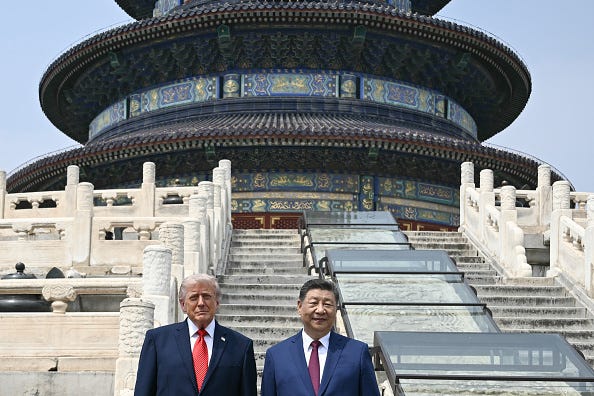
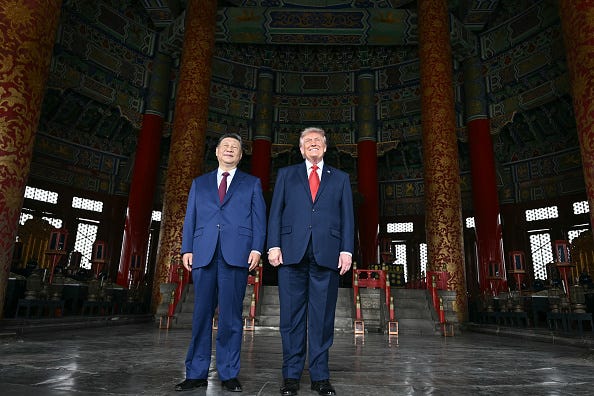
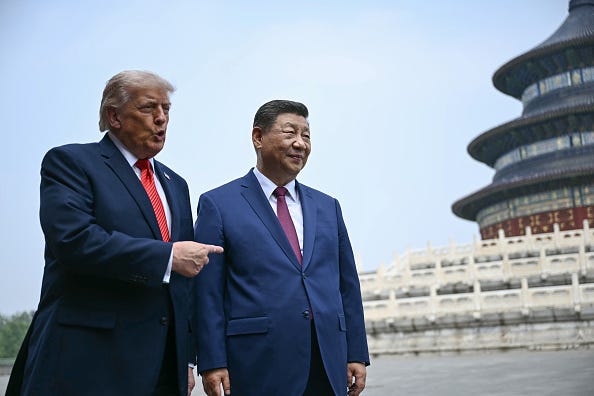
In May, Xi Jinping escorted Donald Trump through Beijing’s magisterial ancient buildings, where the Ming and Qing emperors performed rites that mediated between heaven and the earthly order. It’s appropriately called the Temple of Heaven. But when these two men with autocratic impulses and outsized egos strolled through the complex, it became not a Temple of Heaven but a Temple of Thymos – a stage for distributing recognition rather than cosmic concerns. Now, the neoclassical architecture of the White House provides the set for their September 23–25 follow-up encounter. (Sadly the ballroom will not be ready.)
In a new piece in The Diplomat, Strongmen at the Temple of Thymos, I argue thatleaders who build regimes around their own yearning for recognition —Francis Fukuyama’s interpretation ofwhat the ancient Greeks called thymos or thumos — areerecting edifices that appear magnificent but are internally brittle. I call this theThymos Trap.1
Overlaying both heavily choreographed summits are the two men’s interpersonal dynamics. Trump’s evident desire for Xi’s respect — and a close relationship that leads to political and economic benefits for himself and key constituencies — has stymied efforts by all three branches of the U.S. government to further constrain the Chinese Communist Party’s power and influence.
Xi arrives in the shadow of intractable US-China strategic rivalry sharpened by a trade war that’s been in an uneasy stalemate since October 2025. The current tariff and supply-chain ceasefire expires November 10. Washington is proposing to extend it by six months; the PRC favours an extension through the rest of Trump’s term. They’ll also negotiate the format of a new, ongoing dialogue on AI. And Xi, in Washington for the first time since 2015, will surely press Trump to weaken US support for Taiwan.
Assessing how those and other pivotal elements in the relationship will play out requires a clear understanding not only of the structural geopolitical and geoeconomic factors that bind the two countries, but also the political psychology that drives the two self-styled strongmen and the elites around them.
I invite you to read the Diplomatessay, consider whether you agree, and then come back here for some further strands of corroborating evidence below.
What psychologists, diplomats and biographers see in Xi
Donald Trump’s persona has already been thoroughly marinated in a bottomless stew of comment and analysis, so my emphasis here is on his more guarded, reserved and inscrutable opposite number: Xi Jinping. In aggregate, the additional lenses collected here make a more persuasive case than any one source, because they come from different professional vantage points: academic psychologists, a biographer, a veteran diplomat, and a journalist of ideas. The takeaway is that they all converge on the same portrait of the Communist Party General Secretary as a disciplined, sincere, status-driven leader who for 14 years has been reshaping China’s Party-state in exactly the ways my essay warns about.
The prescient psych profile
In 2021, political psychologist Aubrey Immelman and his co-author Yunyiyi Chen produced an academic paper titled “The Personality Profile and Leadership Style of China’s President Xi Jinping” by applying Theodore Millon’s diagnostic framework to some 350 media reports. A caveat up front: we can’t put a head of state on a psychiatrist’s couch, so like my essay’s reference to the Dark Triad, it was an at-a-distance assessment, not a clinical diagnosis.
Still, its corroboration is uncanny. I and others have observed that personalist rulers risk succumbing to isolation, the suppression of bad news, and a refusal to concede, particularly when perceptions of status are in play. In Millon’s framework, the defining ego-defence of the “Dominant” personality the authors assign to Xi is precisely isolation — the capacity to detach emotionally from the consequences of one’s actions — and the type “rarely concedes on any issue, even in the face of evidence negating the validity of their position.” That’s my warning of a closed information loop that excludes corrective criticism, mapped through psychology.
Their most incisive conclusion helps interpret the evidence I find most persuasive and least comforting: Xi’s relentless purges. Immelman and Chen classify Xi as an “aggressive enforcer,” a fusion of dominance and conscientiousness that produces a leader who believes he has a moral duty to punish and control. As time passes and resentment builds, the enforcer’s crackdowns “provoke opposition and resistance, which in turn incites ever-stronger countermeasures,” hardening into a “bunker mentality.”
That’s the self-reinforcing spiral my Diplomat essay describes through Milan Svolik’s work on how dictators fall to insiders rather than to crowds — emanating through the leader’s temperament from the centre outwards. From this perspective, Xi’s evisceration of the Central Military Commission and People’s Liberation Army’s high command, which has reached Death of Stalin levels over the past two years, looks less like a show of strength than the enforcer’s spiral running its course. Certainly, one deep impression I took away from my years of daily interaction with Chinese cadres, is the power of psychological drivers, particularly fear, in shaping internal Party-state organizational behaviour.
The biography: never make concessions
Michael Sheridan’s spicy recent bio of Xi Jinping, The Red Emperor, deepens the portrait, particularly of Xi’s difficult childhood and youth, which seems to have infused with both a sense of entitlement to rule, and a burning humiliation and hunger to reverse it. Xi’s favourite summit partner Vladimir Putin can surely relate. Sheridan notably relates how, in 2011, Xi told a visiting Vice President Joe Biden that the lesson he had drawn from history was that China must never make concessions. That’s the Thymos Trap as a first principle: a leader who forecloses compromise operating in an international system where compromise is unavoidable has pre-committed to collision. Sheridan’s Xi is not a hothead but a cold, patient student of power — which is exactly why the rigidity matters. His discipline doesn’t disarm the trap; it meticulously builds an inescapable one.
The diplomat in the room
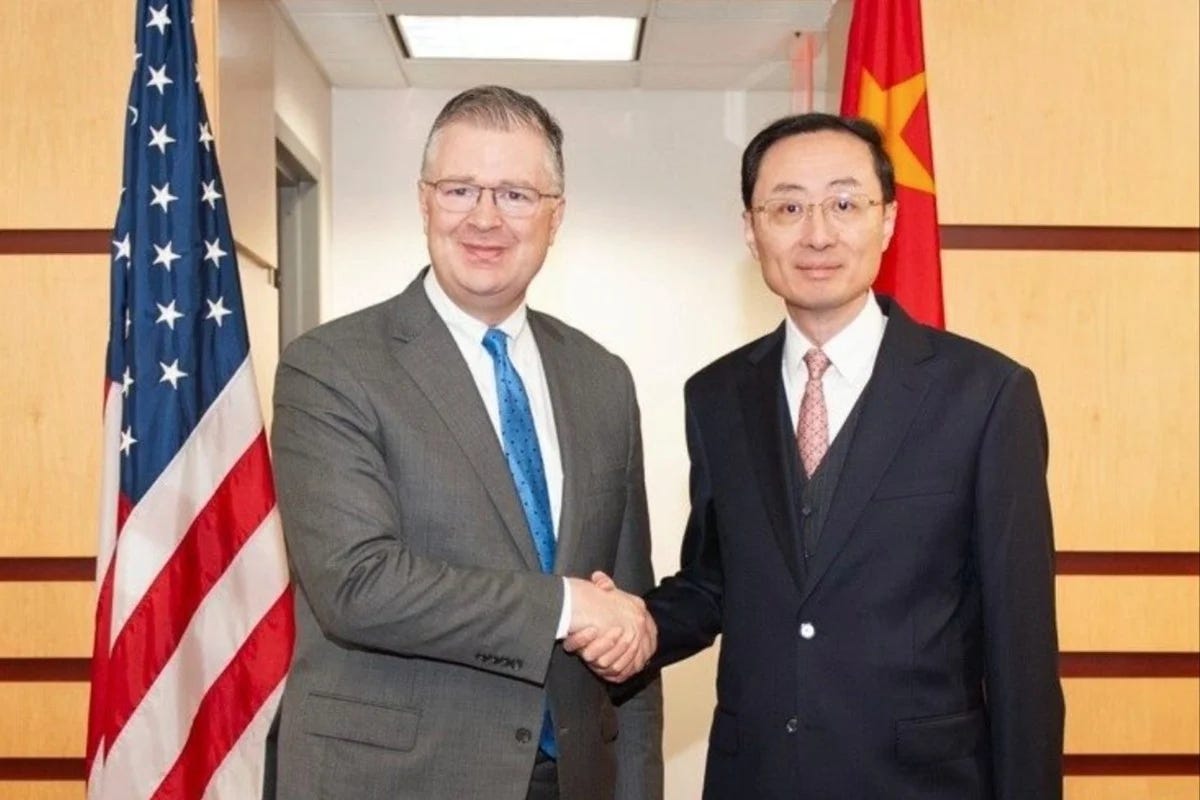
Daniel Kritenbrink with PRC Vice-FM Sun Weidong | X @USAsiaPacific
Speaking with Henrietta Levin on the invaluable CSIS podcast “Pekingology” ahead of this week’s Washington summit, Ambassador Daniel Kritenbrink — a former Assistant Secretary of State for Asia who was present for dozens of meetings with Xi — provides a portrait that reads like field notes for the same thesis. Kritenbrink’s Xi is “decisive, confident, calm, unflappable,” but above all a “calculated risk taker” whose toughness he traces to survival inside a brutal system. That’s the personality profilers’ “deliberative, emotionally controlled” leader in a practitioner’s words.
More striking is how Kritenbrink independently reaches for the vocabulary of recognition. Chinese summitry, he says, is organized around “the face and dignity of their leader”; Xi’s foreign policy is “focused on issues of security and status. Kritenbrink then gives a warning that encapsulates the Thymos Trap: what concerns him most is not China’s weakness but Chinese officials “more confident than perhaps I’ve ever seen them,” convinced they’ve got Donald Trump’s number. Kritenbrink’s fear: “an overconfident China is a China that very well may overplay its hand.” That’s the Thymos Trap’s causal engine — inflated recognition breeding miscalculation.
Mind over manner
My fourth witness speaks to the mind more than the manner. In Dans la tête de Xi Jinping (available in English as Inside the Mind of Xi Jinping), the French journalist François Bougon argues that the collapse of the Soviet Union became the organizing trauma of Xi’s worldview. Xi’s governing question, in Bougon’s telling, is almost clinical: how to reform without collapsing? In a January 2013 speech, Xi reportedly asked why the mighty Communist Party of the Soviet Union “dispersed like a flock of sparrows,” and answered that no one had been “man enough” to resist ideological subversion. He famously vowed that would never be the CCP’s fate. Those who expected a Chinese Gorbachev, Bougon writes, got a Chinese Putin instead.
That’s a Thymos Trap biopic screened inside the Party supremo’s own head. The rigidity I’m pointing to from the outside, particularly Xi’s refusal to concede, perpetual hunt for enemies and suffocation of feedback, is not pathology but prophylaxis — preventive action driven by what Bruce Bueno de Mesquita and his co-authors call The Logic of Political Survival.
As Tanner Greer put in his review of Bougon’s book, Xi “knows who his enemies are,” and treats cultural change the way other leaders treat insurrection. A man who believes that any concession risks a USSR-style disintegration is building a concession-proof, criticism-proof political machine that’s probably growing increasingly blind to its own errors. The fear of collapse may one day become the cause of it.
The audience wants the performance
Photo: Brendan Smialowski - Pool/Getty Images
So far, we’ve focused on the recognition-absorbing men on the summit stage. But each strongman needs his crowd, and the crowd has its own twisted social psychology. In a January 2026 article in Psychology Today, leadership scholar Ronald Riggio addresses the question of why publics support such leaders even against their own interests.
The cognitive taproot is threat: when a group feels endangered, it closes ranks, and support flows to whoever seems most able to fight back. It’s the ancient in-group–out-group reflex, sharpened by the human tendency to frame the out-group’s transgressions in moral terms. Add tribal loyalty (“my party, right or wrong,” sustained by rationalization even as a leader turns tyrannical) and, above all, resentment — the sense that one’s rightful status has been unjustly stolen and handed to others — and you have a population primed to want exactly the domineering figure my essay describes.
This demand side of the Thymos Trap locks in the supply side. Fukuyama’s megalothymia isn’t just a hunger inside the leader; it’s a hunger he cultivates in the led, by naming their humiliation and promising reversal and redemption. Xi offers the Chinese nation the recovery of dignity stolen in the “century of humiliation”; Trump offers MAGA supporters the restoration of a respect they feel has been taken from them. The leader’s craving for recognition and the follower’s resentment at recognition denied are the same emotion pitched at two scales. It makes the strongman’s performance of strength devilishly hard to interrupt, because it’s not simply imposed on a recalcitrant populace, it’s demanded by an anxious crowd, whether Trump’s American electorate or Xi’s Red selectorate. That’s a further source of fragility. A leader who rules by mobilizing threat and resentment must continually conjure and magnify foes — foreign or domestic — long after prudence would counsel calm.
Two qualifiers
Photo: Brendan Smialowski - Pool/Getty Images
My thesis is intended to be taken impressionistically, not clinically, and I welcome civilized debate and counterargument, for which I’ll add two qualifiers.
First, before someone caricatures the argument, let’s be clear that in characterizing Xi as “ego-driven” I don’t mean that he’s an impulsive blunderer. He usually appears to be deliberate, patient, controlled, and — in Bougon’s reading — largely sincere in his Communist worldview, rather than cynical. That’s not a hole in the argument — it is my argument. A disciplined true believer who’s convinced that concession invites collapse is more likely, not less, to build the calcified, feedback-starved Party-state system I describe. Xi may be calculating, but the terror he instills in the cadres around him leads them to respond impulsively, and sometimes to overcrank by, perhaps, grabbing hostages in response to the arrest of a Chinese telecom executive.
Immelman and Chen add a further useful corrective: they situate Xi’s narcissism not in the disordered range, but at an adaptive level. And they caution against applying a lurid “enforcing sadist” label. The system may be conditioned to behave even more ruthlessly than he intends — which is an analytical nuance, not an excuse for the “core” leader.
“He’s a great gentleman; we get along great. We have a very good trading relationship and, you know, they’re a competitor and all of that, but we have a very good relationship with President Xi.”
—Donald Trump on Xi Jinping
The second qualifier is Kritenbrink’s parting advice, which I also keep in mind: don’t overestimate what the personal chemistry between Trump and Xi can achieve. Whether planning policy or forecasting geopolitical trajectories, it’s still crucial to cooly calculate interests. That refines my point. The theatrical personalization of the relationship on display at summits is the vulnerability, not the remedy. A world in which stability depends on keeping two autocrats’ egos aligned is a world that’s sliding into a Thymos Trap in which too many leaders look destined to lose the mandate of heaven in catastrophic ways.
For the deeper dive — including discussion of Francis Fukuyama’s thymos, Stephen Kotkin’s “The Weakness of the Strongmen,” Gideon Rachman’s continuum, Ye Xue’s cultural honour vs face, and why Trump sits at the opposite end of all this from Xi — see the full article in The Diplomat.
For more on managing and interpreting leader-level diplomacy with the PRC, see my Foreign Affairs essay, “Trump’s China Trap: Why Xi Keeps Winning the Summitry Game” and series of Strategic Narratives posts explaining how other heads of state and government have responded with various forms of geopolitical hedging. Read Part 1, Part 2, Part 3, and Part 4. More to come after the Trump-Xi Washington summit.
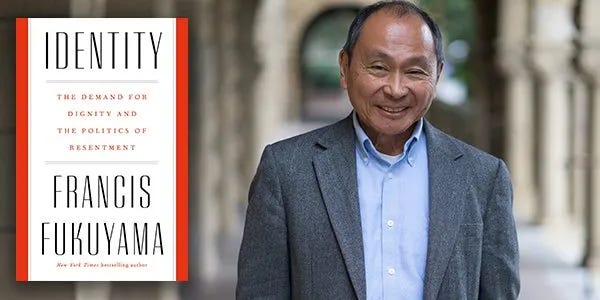
Francis Fukuyama took inspiration from Plato for his conceptualization of thymos and first discussed it in his classic work The End of History and the Last Man (1992). The formulation in my essay and this post is from his more recent Identity: The Demand for Dignity and the Politics of Resentment (2018).