


This is the third in our series of blog entries with in-person coverage from the ongoing trial of Huawei Technologies (华为技术有限公司). Entry #1 here. Entry #2 here.
Trial Day 20: October 13, 2026
It’s a beautiful, sunny October day in downtown Brooklyn and I’m late to week six of United States v. Huawei Technologies Co., Ltd., the federal trial in which the PRC tech giant faces 12 criminal counts of racketeering, trade-secret theft, bank fraud, money laundering and U.S. trade sanctions violations.
My bicycle and I got caught on the wrong side of the drawbridge over the Gowanus Canal at 9th Street, where Brooklynites have been waiting since the time of horse-drawn wagons and coal barges. When I reach the U.S. Courthouse at 10:25 a.m., nearly an hour late, there’s still no Eastern District Judge Ann M. Donnelly, and no jury.
The court has forgotten to change the judge’s name on the door. “This is not Judge Donnelly’s usual courtroom,” says Frank, a gray-bearded lawyer beside me. The jurors are late returning from the Indigenous Peoples Day weekend.
On the jury side of courtroom 6DS, about a dozen observers, mostly lawyers and reporters, occupy the gallery. A young man reads a paperback. Behind me, an Asian woman with her arm in a sling reads a Chinese novel. On Huawei’s side sit about 20 observers, mostly suited men, many Asian.
Disputed Documents
At 10:30 a.m., Judge Donnelly enters and asks whether either party has business before the jury arrives.
Huawei’s lawyers seek rulings on two documents.
The first, GX 22608, is a Standard Chartered Bank memorandum discussed in Huawei on Trial #2. The defence argues that it reveals the bank’s “state of mind,” having characterized Huawei as presenting a “low-to-moderate” reputational risk.
The government calls it “irrelevant” and “prejudicial.” Judge Donnelly is “inclined to admit it.”
The second, DX 374, is an email between Standard Chartered employees concerning a loan sought by a Huawei client, subject line “SCB in Iran.”
The defense argues that it supports Huawei’s contention that Standard Chartered knew Skycom was a Huawei affiliate, contrary to prosecutors’ allegations that Huawei concealed their relationship.
Judge Donnelly discusses redacting the documents for the jury while preserving them for potential “appellate issues we haven’t thought of.”
There, for the first time, is the idea that this trial, already expected to last at least three months, might someday produce an appeal if Huawei is convicted, if Judge Donnelly makes a consequential legal ruling during the proceedings, or if the restrictions she placed on public access to portions of the trial are challenged. (For more on this, see ‘A Sidebar of Our Own’ in Huawei on Trial #2)
Defence attorneys David Bitkower and Katya Jestin of Jenner & Block LLP have nothing further to raise.
The government says Donnelly’s decision will affect how Huawei edits a video for later testimony.
Donnelly smiles.
Judge Donnelly: “Are you harassing me?”
Government: “No, Your Honor.”
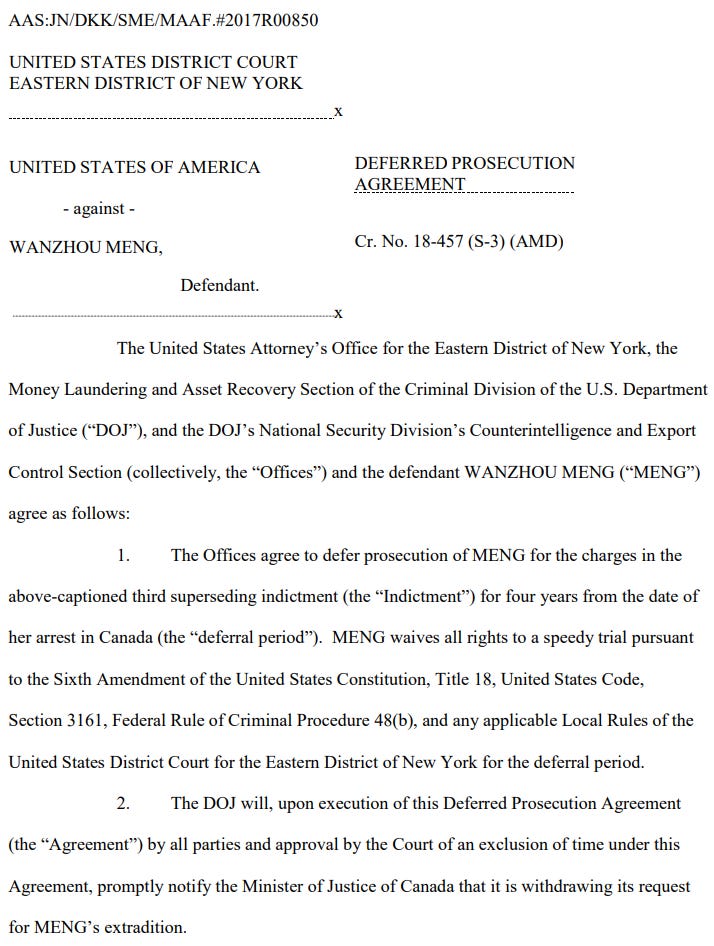
The response comes from Assistant U.S. Attorney Alexander Solomon, who signed the September 2021 Deferred Prosecution Agreement (DPA) that ended the U.S. effort to extradite Huawei CFO Meng Wanzhou from Canada.
CATCHING YOU UP
On October 7, Trial Day 18, the jury heard former FBI agent Leigh Ann Sweeney read aloud Meng Wanzhou’s DPA statement acknowledging that Huawei controlled Skycom, a subsidiary operating in Iran, and that she had misled international banks about their relationship.
Sweeney also described for jurors a videotaped hearing in which Meng confirmed she understood and did not dispute the statement of the DPA, according to court coverage by MLex.
Meng returned to China as a heroine in September 2021 in a prisoner swap with Canada for the Two Michaels. The charges against her were dismissed in December 2022, having fulfilled the terms of the DPA not to dispute her admissions or commit new crimes during its term.
Judge Donnelly rejected Huawei’s attempt to exclude Meng’s statement, noting that the company had an opportunity to challenge it in 2021.
With the jurors out of the courtroom, prosecutors also revealed that Meng’s lawyer had refused to accept a subpoena seeking her testimony in Brooklyn, leaving them to serve her directly. But U.S. courts generally cannot compel foreign nationals residing abroad to appear at criminal trials. Unless Meng enters U.S. jurisdiction and is properly served, the subpoena has no force.
Prosecutors may now ask Judge Donnelly to tell jurors about her absence, a move Huawei opposes as it could suggest to the jurors that she or Huawei were concealing evidence.
The Government Calls Heather Campbell
At 10:43 a.m., the jurors enter carrying coffee, tea, legal pads and pens.
“I hope you all had a nice long weekend,” Judge Donnelly says.
The government calls Heather Anne Campbell, a woman in her 50s with sandy-blonde hair, wearing a gray dress and black cardigan.
Campbell lives in Farmersville, Texas. She joined the Marines at 17, trained as a Chinese linguist, and studied Mandarin at the University of Hawaii and the University of Texas. Her answers come with a “Yes, sir” and “Yes, ma’am.”
Her career included work at telecom carrier MCI, researching Chinese companies for AsiaInfo Services, 13 years raising children, an MBA and four years at JPMorgan Chase.
From April 2012 until January 2016, Campbell worked in human resources and corporate training at Huawei Device USA’s Plano, Texas, office.
There she worked closely with in-house counsel Charles de Chateauvieux, whose office was down the hall. They had a cordial relationship.
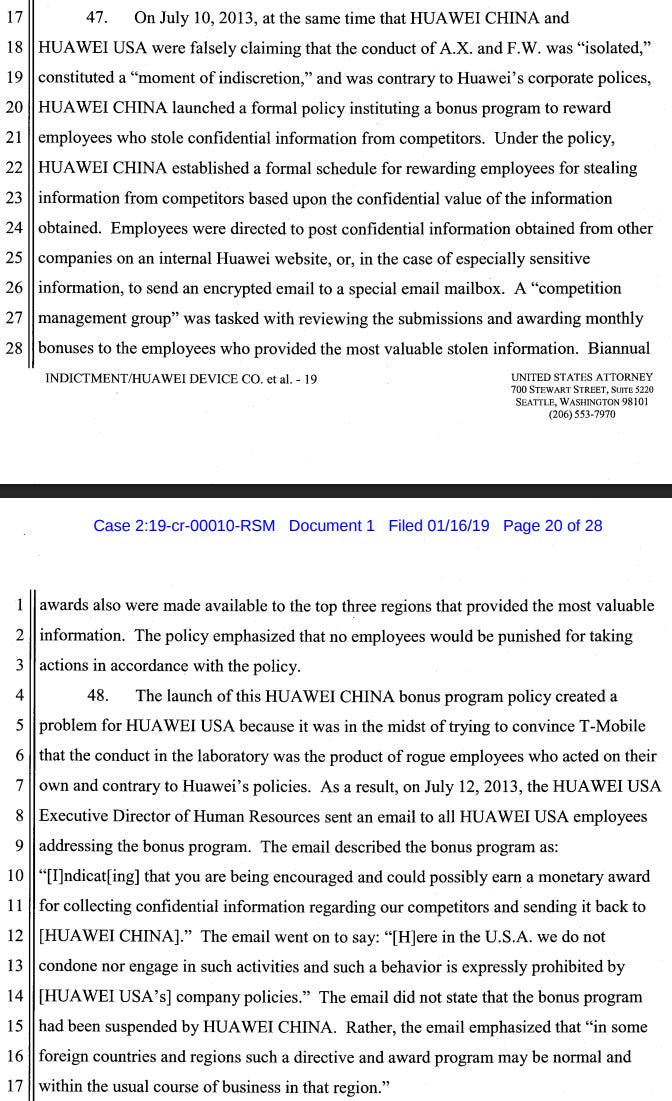
The government asks about a July 2013 conversation concerning a memorandum from Huawei headquarters distributed to company offices worldwide.
The document described a program rewarding employees for supplying information about competitors, with cash payments determined by the information’s perceived value.
Asked about de Chateauvieux’s demeanor, Campbell recalls his concern and “a serious look.”
Campbell: “Basically, it was asking our employees to steal company information from our competitors.”
Huawei Device USA’s human resources director, Jennifer Ponder, had advised employees to ignore the memorandum, which Campbell had not received.
Government: “Did you want to see the document yourself?”
Campbell: “Yes. I wanted to see it for myself, especially because I had awareness of other things that had happened.”
Among those events was the May 2013 incident at T-Mobile’s Bellevue, Washington, laboratory, where Huawei engineers allegedly photographed its proprietary “Tappy” smartphone-testing robot and removed a mechanical arm to help develop a competing device.
Campbell and de Chateauvieux arranged to exchange the memorandum discreetly in a sixth-floor hallway.
Government: “Why there?”
Campbell: “There weren’t a lot of people there.”
“I walked toward him. He walked toward me, and he handed me an envelope in passing, without saying a word.”
Government: “Had anything like this ever happened during your time at Huawei before?”
Campbell: “Never.”
Government: “What happened next?”
Campbell: “I took the envelope down the stairs, into the parking lot, and into my car.”
Government: “Why?”
Campbell: “I wanted to read it in private because of the sensitive nature of the document.”
Huawei’s Competitor Information Program
The envelope contained two documents.
The first, Exhibit 16336, is a five-page memorandum, three pages in English and two in Chinese, headed “Huawei Device Company Limited — Internal.”
Dated July 10, 2013 and signed by Kevin Gu, it was addressed to account-management personnel.
Campbell says its formatting resembled the official Huawei communications ordinarily reviewed by senior executives, including Ponder, de Chateauvieux, Huawei Device USA President Cui Jiangao and Chief Operating Officer Zhang Yufeng.
The memorandum instructs employees to collect competitors’ information, providing a website and email address for submissions.
Headquarters would reward employees according to the information’s value and confidentiality. Twice, the document encourages participation with “no punishment.”
Regional competitions would be judged every six months. Awards ranged from 200 to 2,000 yuan.
An accompanying chart assigns values to competitors’ product roadmaps, 2,000 yuan; business documents and project pricing, 1,000 yuan each; distribution structures, 500 yuan; and aftermarket strategies, 200 yuan.
Other categories include customer relations, market information, salaries and organizational structures.
At 11:15 a.m., Judge Donnelly calls a sidebar. White noise fills the courtroom.
Questioning resumes with the memorandum’s information-security provisions, encouraging encryption of valuable submissions.
The second document, Exhibit 16335, is a high-priority email dated July 12, 2013 — two days after the memo — from Jennifer Ponder to Huawei Device USA executives.
Ponder acknowledges headquarters’ memorandum encouraging employees to gather competitors’ information. While such practices might be standard elsewhere, she writes:
“Here in the USA we do not condone such behavior.”
Employees engaging in such conduct, she warns, could face discipline, including possible termination.
Government: “Have you ever seen an email like this during your time at Huawei?”
Campbell: “No.”
Asked what she did after reading the documents, Campbell says:
“I sat there and thought. I sat there and thought. I wondered, what does this mean? What am I really reading? Am I understanding this correctly?”
She showed the memorandum to sales executive Charles Pickett, who seemed unconcerned, and then to Doug, the head of engineering, whose surname she cannot recall.
Doug’s reaction:
“Wow, that’s bad.”
Campbell says she considered approaching Congressman Mike Rogers, then serving on the House Intelligence Committee, but Huawei objects and Judge Donnelly sustains.
Campbell ultimately contacted the FBI.
Campbell: “It was clear the memo was asking our employees to commit theft, and that’s wrong.”
Government: “Did you offer the document to the FBI?”
Campbell: “Yes.”
The government concludes its examination.
Huawei Cross-Examines Campbell
After another sidebar, Huawei’s attorney begins cross-examination at 11:33 a.m.
She has dark hair, eyeglasses perched on her head, a patterned white blouse beneath a dark suit and a large diamond ring.
The defence establishes that Campbell was not an original recipient of the memorandum and knew neither who conceived it nor how it was approved or distributed.
Kevin Gu, its signatory, was a device strategy analyst, not a director. According to the defence, only 15 to 20 people initially received the memorandum, all in device sales.
Huawei: “Not research-and-development engineers?”
Campbell: “Correct.”
Lost in Translation?
The defence questions Campbell’s Mandarin proficiency.
Huawei: “Are you fluent in Mandarin?”
Campbell: “I once was.”
Huawei: “And you were able to read and write?”
Campbell: “I once was able to do that.”
When the attorney turns to the Chinese original, the government objects and Judge Donnelly calls another sidebar.
Returning, the attorney says:
“We’re not going to ask you to dust off your Chinese-language skills.”
Instead, she displays the original English version beside another translation.
The defence suggests that the phrase concerning “no punishment” could mean employees would not be penalized for declining to participate.
Campbell concedes that interpretation is possible.
Small Rewards
The attorney converts the incentives into 2013 U.S. dollars: approximately $30 to $330.
Huawei: “These were not executive-level bonuses, were they?”
Campbell: “Correct.”
The defence returns to Ponder’s July 12 email, characterizing it as a formal rejection of headquarters’ memorandum.
There is an awkward moment for Huawei when its attorney says that Ponder’s email “condones” the memo for headquarters when she means “condemns,” prompting a colleague of hers to leap from his seat behind her to whisper in her ear and Judge Donnelly to voice the word “condemns.”
The Huawei attorney, Julia Gatto of Steptoe LLP, apologizes and continues her description of the meaning of Ponder’s message about the HQ memo.
Huawei: “This is not a policy.”
Campbell: “Correct.”
Huawei: “It means we take it back.”
Campbell: “What she’s saying is we don’t condone this behavior.”
The attorney emphasizes that Huawei Device USA management expressly prohibited the conduct.
Office Culture, Corporate Training
Questioning shifts to Huawei Device USA President Cui Jiangao.
Campbell compliments the attorney’s pronunciation of Cui’s surname.
“I’ve been working on that,” Gatto replies.
Campbell confirms that Chinese expatriate employees spoke Mandarin and appeared respectful of Mr. Cui.
Huawei: “Did anybody overrule Jennifer Ponder’s email?”
Campbell: “Not that I’m aware of.”
The defense introduces Exhibit DX 11567, a redacted document shown to Campbell but not the jury.
The attorney argues that Huawei organized training in July and August 2013 to teach employees to respect third-party intellectual property.
Campbell agrees but says the training may have responded to both the memorandum and the T-Mobile incident.
Huawei: “Did you participate in the training?”
Campbell: “Yes.”
Huawei: “Were you proud of the training?”
Campbell: “Yes.”
Campbell says she never considered it a mere “check-the-box exercise.”
The defence suggests Huawei’s training helped advance Campbell’s career, including subsequent work in global sourcing for Japanese telecommunications company NTT.
Compensation and Bonuses
Defence Exhibit 20230 establishes that Campbell earned approximately $5,000 monthly in 2014, plus bonuses, retirement contributions and health benefits.
At 12:21 p.m., Judge Donnelly calls another sidebar. The court reporter brings water to the jury. One juror rubs his knee.
Judge Donnelly: Does anybody need a break? I don’t want to make you suffer.
The defence notes that Campbell received a $400 “headquarters award” in 2014 and two more, of lesser amounts, in 2015 for good performance.
Huawei: “Were you going to get rich from these awards?”
The government objects. Judge Donnelly allows the question but says she is “struggling to see its relevance.”
Huawei: “Were you going to get rich from these awards?”
Campbell: “Not on that particular day.”
Contacting the FBI
The defence questions Campbell’s decision to approach Congressman Rogers and the FBI.
Huawei: “Did you actually take the memo to the FBI?”
Campbell: “Yes.”
The attorney asks whether Campbell felt urgency and whether her husband, who had FBI connections, encouraged her to contact investigators.
Campbell says no.
She confirms that she was already involved in corporate training when she contacted the FBI, including training related to T-Mobile.
The defence returns to de Chateauvieux, attempting to establish his legal qualifications and previous Justice Department employment. The government objects successfully.
Campbell does not know whether he still works at Huawei. (He does.)
The defence establishes that Campbell continued working for Huawei after contacting the FBI.
Huawei: “You stayed on at Huawei?”
Campbell: “Yes, for two more years”.
She also sought promotion in 2014, completing a self-assessment and company evaluation.
Huawei: “You described Huawei as a positive and pleasant place to work?”
Campbell: “Yes.”
Finally, the attorney questions Campbell about her FBI interview, during which she provided the memorandum, Ponder’s email and information about T-Mobile.
Huawei: “You sat down for a formal interview with two FBI agents and shared the memo, the email, and other information about T-Mobile?”
Campbell: “They asked questions, and I answered.”
Huawei: “You shared information about Mr. Cui?”
Campbell: “They asked questions, and I answered.”
The defence suggests Campbell also described Cui’s office and habits: a Buddha statue on his bookshelf and daily 6 p.m. ping-pong games.
The government objects.
At 12:42 p.m., Judge Donnelly calls another sidebar. White noise fills the courtroom. A juror stands to stretch.
Three minutes later, the judge announces lunch recess until 2:15 p.m., reminding everyone not to discuss the case.
The sixth week of Huawei’s trial continues.
AUTHOR’S NOTE
The court bars recording devices and does not make transcripts available immediately. Quotes are based on my notes.
