

This is the fourth in our series of blog entries with in-person coverage from the ongoing trial of Huawei Technologies (华为技术). Entry #1. Entry #2. Entry #3.
Trial Day 24: October 20, 2026
As I bicycle across downtown Brooklyn this sunny Tuesday morning to attend week seven of Huawei’s federal criminal trial, one question is on my mind: “What was the motion hearing on Monday?”
It’s a treat to attend the trial of the Chinese multinational technology conglomerate on 12 counts of racketeering, trade-secret theft, bank fraud, money laundering and U.S. trade sanctions violations. But I cannot afford to attend daily. Which means I miss stuff. And since the court doesn’t make transcripts readily available, I have to fill in the blanks.
I ask Diego, the first-name-only attorney sitting next to me in the public gallery of courtroom 6DS at the U.S. Courthouse, 225 Cadman Plaza. Diego, whose client has “an interest in the outcome of the trial,” wasn’t here Monday either.
As we talk, the government’s lead prosecutor, Assistant U.S. Attorney Alexander Solomon, walks past in a gray suit and yellow patterned tie.
Diego calls him “a nice guy.”
“Do you know him?” I ask.
“I’ve said a few things to him,” Diego replies.
Another mystery. Today I may be the only writer in the back of the courtroom. Everyone else seems to be wearing the attorney’s uniform of a dark suit, a legal pad and at least two cellphones—devices the media cannot bring into court.
Why the Court Was Closed
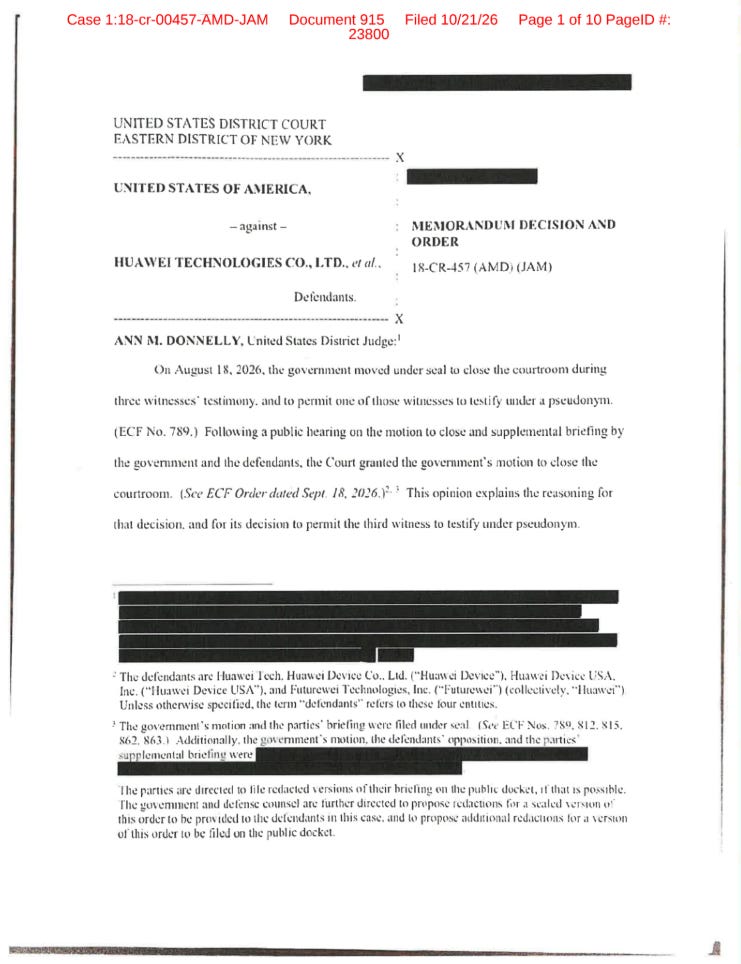
A couple of weeks ago, this courtroom was closed for a few days in a rare move in the U.S. justice system. Turns out that three Iranian witnesses knew enough about Huawei’s business in Iran to put themselves and their families in Iran at risk by testifying in Brooklyn, according to a heavily redacted judicial opinion made public October 21.
Prosecutors said their testimony would expose Tehran’s suppression of dissent and could invite retaliation.
Changing their names would not suffice. Their knowledge of Huawei and its Iranian subsidiary, Skycom, was so specific that the substance of their testimony could identify them.
Judge Donnelly accepted that danger as grounds for closing her courtroom during their testimony, explaining her September 18 ruling.
Prosecutors also warned that Beijing might retaliate against the witnesses for helping American authorities. Judge Donnelly recorded that warning without making a separate finding about Chinese retaliation.
This day, court once again wide open to all, Judge Ann M. Donnelly walks in at 10:12 a.m. and invites everyone to sit. She asks “the parties”—the government and Huawei—to raise any issues before the jury enters. I count seven lawyers on each side.
Solomon says the government will call a financial analyst and seeks to introduce two documents.
The first is an internal Huawei PowerPoint presentation about U.S. sanctions against Iran and ways to move dollars out of the country. It describes how Skycom, Huawei’s Iranian affiliate, accepts the local currency, rials, from its customer Irancell, then uses intermediaries in Dubai to remit dollars to Huawei in China.
The second is a memorandum of understanding involving Arya Hamrah Samanah (AHS), an Iranian intermediary; Skycom; CMEC International Trading Co., Ltd., a Chinese trading company; and Panda International Information Technology Co., Ltd., controlled by the state-owned China Electronics Corporation.
Under the arrangement described by prosecutors, Arya Hamrah pays Skycom in rials while corresponding dollar payments travel through Dubai to CMEC and Panda in China.
A 2013 Arya Hamrah email instructs a transfer of $156,471 to Panda because the equivalent has been paid to Skycom in rials.
Huawei defence attorney David Bitkower of Jenner & Block objects, calling the evidence hearsay. He argues that the intermediary’s identity is unestablished and that payments prosecutors seek to connect to the document date from 2009-10—a time, it should be noted, before Washington tightened sanctions against Iran.
Solomon does not dispute the dates on the evidence he intends to submit establishing payments through two Dubai intermediaries—dates that fall before U.S. sanctions. He says the government will show that those earlier payments match later payments in amount and contract number.
The defence counters that these are inferences and the MOU says nothing about sanctions evasion.
Judge Donnelly suggests the objection concerns potentially prejudicial evidence rather than hearsay. At 10:34 a.m., she overrules it.
Solomon warns that he has many exhibits to introduce. The defence says it will not submit certain redacted documents today.
“So, in other words, we will drive off that bridge when we come to it,” Donnelly says. Laughter in the courtroom.
At 10:37 a.m., the jury enters.
The FBI Forensic Accountant
The first witness is Boram “Jennifer” Moon, an FBI forensic accountant.
Dressed in a black suit, white blouse and short heels, her black hair pulled back to reveal pearl earrings, Moon says she has worked for the bureau for nine and a half years, investigating financial matters. Previously, she spent nine years in the private sector.
Solomon asks whether Moon can analyze records from correspondent banks, which enable international banks to clear dollar payments through the United States. She can.
This is important. Doing business in Iran is not, by itself, necessarily illegal for a Chinese company. But when payments pass through American banks—in this case, in New York—they become subject to U.S. sanctions restrictions.
Solomon asks Moon to define “tracing.”
Essentially, following the money.
She has prepared charts for her testimony, she says—a point that becomes abundantly clear as Solomon introduces chart after chart over the next several hours.
Moon explains the “last in, first out” tracing principle using a kitchen analogy: the last pancake placed on a stack is the first removed. Applied to banking, the most recent deposit is treated as the first money withdrawn.
She groups accounts under the same name into a “big common pool of funds controlled by a single account holder.”
Think of adding food coloring to a bucket of clean water, she tells the jury. Even a few drops change the color of the whole bucket. Here, those drops could represent millions or billions of dollars in “dirty money.”
Moon acknowledges limitations. Companies maintain different accounts for different purposes, and incomplete banking records require assumptions. She knows of no personal Huawei accounts.
Solomon begins reading government exhibit numbers: 6304, 6311, 6325-1, 6612, 6613, 1361-12, 20101, 2003, 2004, 2009, 2012, 2014—and many more.
His recitation of exhibit numbers continues for nearly ten minutes. The jurors’ eyes seem to glaze over. Eventually we learn Solomon has 170 slides to show the jury.
When he finishes, Bitkower jokes:
“Your Honor, I think it’s time for a lunch break.”
Everyone laughs.
“There will be a test at the end of the day,” Judge Donnelly adds.
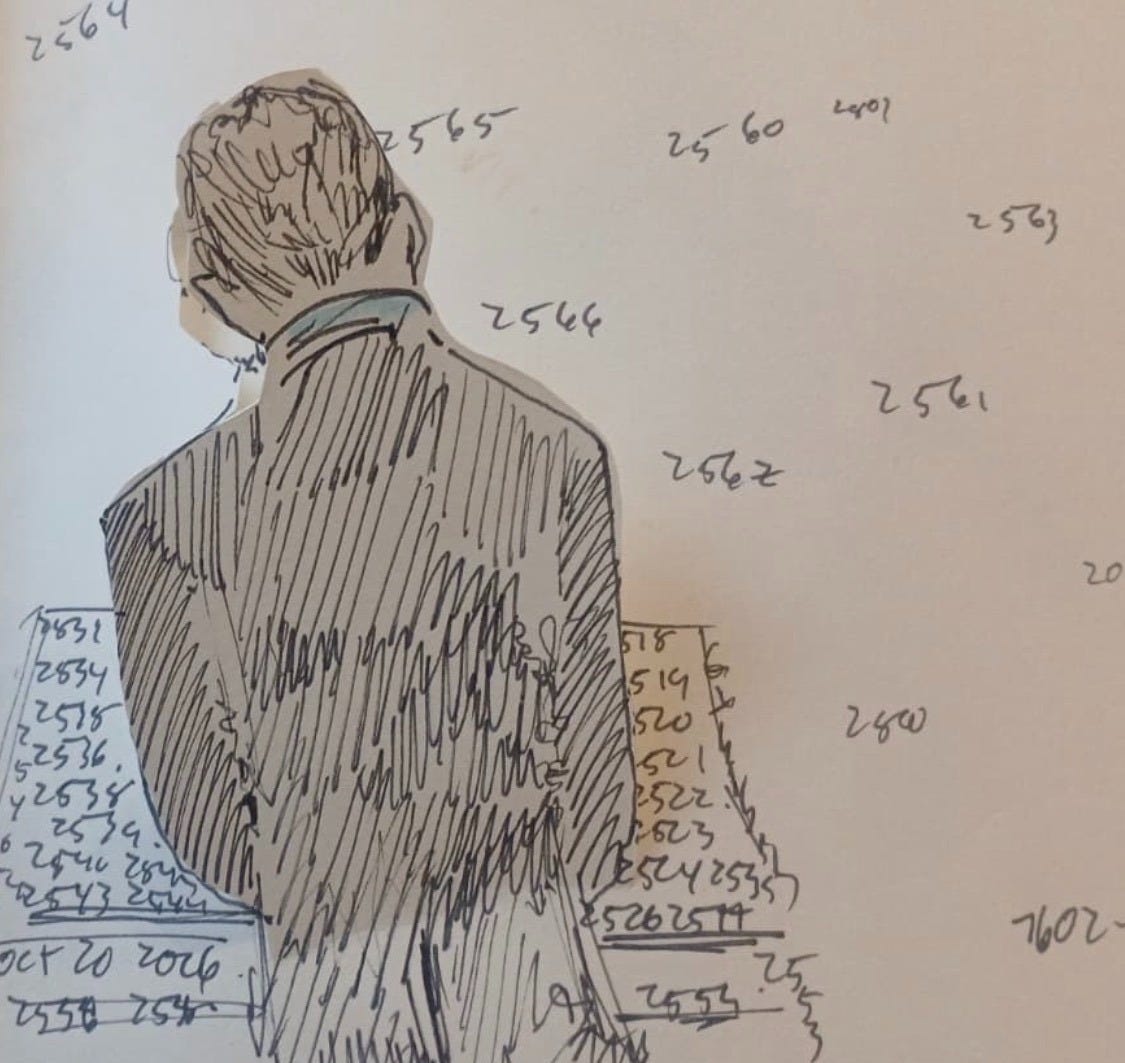
A late arrival is Matthew Zaklad, head of the research firm China Six. Sitting beside me in what he calls “the pews,” Matt, a friend, wears lemon-yellow corduroy trousers, black sneakers without socks, and a blue blazer with a red paper flower in its lapel.
From a small zippered pouch he produces colored pencils and pens, then sketches courtroom scenes with intense concentration, annotating drawings with snippets of testimony. Occasionally he cuts figures partly free from the page, turning his notebook into a pop-up book for lawyers.
Solomon returns to Moon and the sale of Skycom.
She describes a “circular transaction” using a hypothetical example of a family whose members sell shoes, flowers and cookies to one another for equal amounts. Their sales figures look impressive, but collectively they end up with the same money.
A December 31, 2008, exhibit shows Huawei CFO Meng Wanzhou on Skycom’s board in 2008-09. It also identifies Skycom business in Iran, Burma, Cuba, North Korea, Sudan and Syria—all countries subject to U.S. sanctions.
A reminder that it was Solomon who signed the September 2021 Deferred Prosecution Agreement (DPA) that ended the U.S. effort to extradite Meng from Canada, where she was afforded nearly three years of the Canadian justice system while under house arrest, at the same time Michael Kovrig and Michael Spavor, Canadians both wrongfully detained in retaliation, suffered months of solitary confinement and coercive interrogation followed by two years in pretrial detention centre cells.
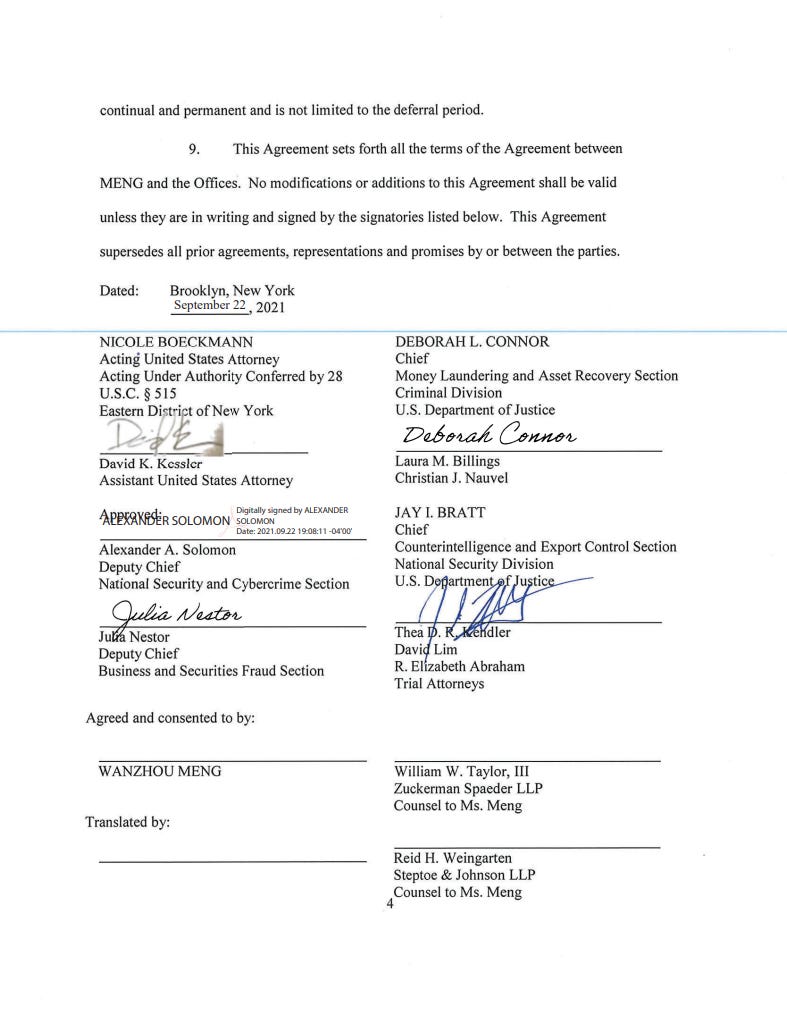
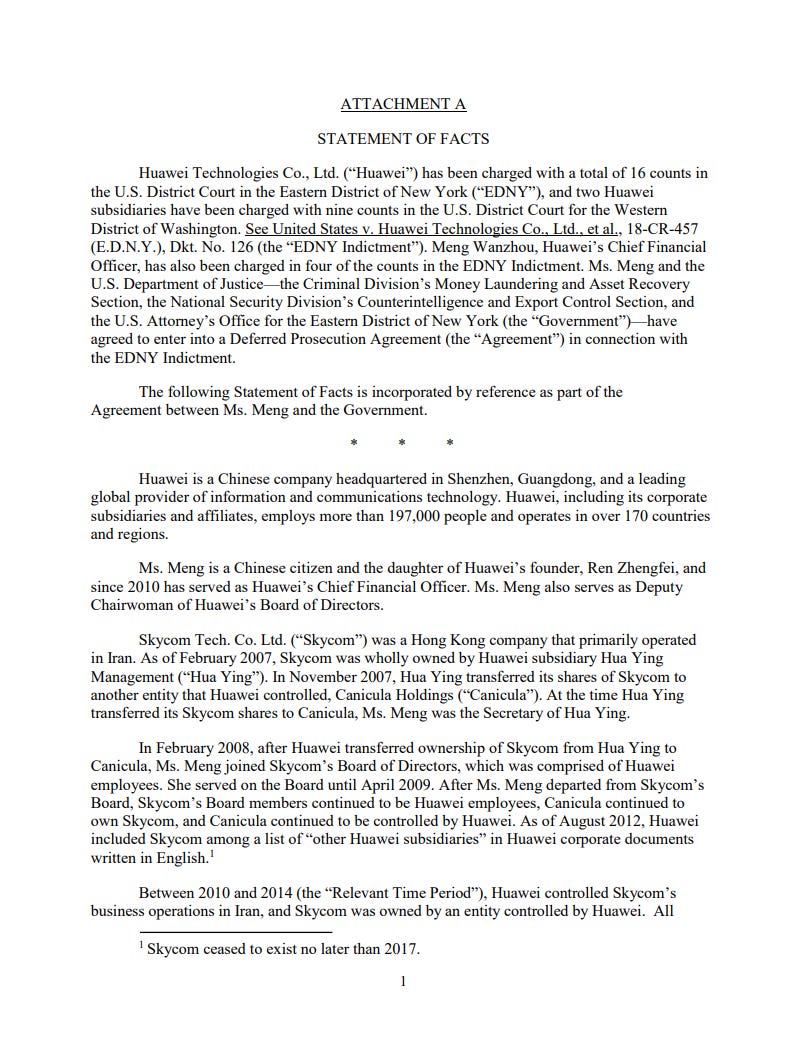
Other exhibits Solomon introduces trace transactions among Skycom; Hua Ying Management, a Huawei affiliate in Hong Kong; Canicula Holdings, a Mauritius-registered company allegedly operated by Huawei as a front in Syria; and Huawei Technologies Investment, a wholly owned Huawei subsidiary performing financial functions for the group.
Moon says Huawei controlled Hua Ying and Canicula, and that Meng served as a director. One document identifies a Canicula bank account in Dubai; another records transfers between Hua Ying and Canicula.
A 2009 exhibit shows Huawei Technologies Investment transferring approximately €13.8 million through Canicula to Hua Ying.
December 2010 records show Skycom paying Canicula roughly €7 million, followed by a same-day onward payment.
Solomon asks whether a discrepancy of approximately $312,000 prevents transactions involving €14 million and €13.8 million from being considered circular.
“Insignificant,” Moon says.
Next come documents concerning Skycom’s shutdown in Iran between November 2016 and June 2017.
A May 1, 2017, purchase order from Huawei Technologies Services (Iran) covers digital hosting and marketing services through May 2018.
Solomon establishes that Skycom did not issue the purchase order. The apparent point? Huawei continued operating through another Iranian entity after winding down Skycom.
Moon then guides the jury through a flowchart involving Mobile Communications of Iran (MCI), Skycom, Huawei Technologies Investment, Futurewei—Huawei’s American research subsidiary in San Jose—and Paycom, a payroll company.
She identifies approximately $12 million moving from Skycom to Huawei Technologies Investment through a New York correspondent bank. On May 9, 2014, another $5 million moved from Huawei Technologies Investment to Futurewei through a U.S. bank.
Moon treats these accounts as pooled funds. Some payments bear the designation “A2,” which she identifies as Huawei’s internal code for its Iran office.
Banks appearing in the records include JPMorgan Chase, HSBC and Standard Chartered, whose executives testified earlier in the trial.
Other transfers include $10 million to Futurewei on August 18, 2013, and $2 million 11 days later, with funds passing through New York twice.
Moon also discusses the Clearing House Interbank Payments System (CHIPS) and a February 2017 payment of $3 million to Futurewei through Citibank.
Her analysis treats Skycom and Huawei group accounts as one large pool.
At 11:47 a.m., Donnelly calls a 15-minute recess, reminding the gallery:
“This is a chewing gum free zone. Those are the rules.”
During the break, Solomon and Bitkower exchange smiles and laughter. Solomon says Bitkower gets “one zinger a day,” referring to his lunch-break joke.
Diego remarks that there has been “a great deal of tracing and a great many Excel spreadsheets,” but says the trial is moving faster than prosecutors expected.
“They said they’d be done in about a week.”
I wonder whom he has been talking to.
Nearby, another attorney, Jackson, a sartorial outlier, wears white Reebok tennis shoes, a beige sweater, baggy trousers and short Adidas socks. Sporting wire-rimmed glasses and a five-o’clock shadow, he reads a paperback about the U.S. Open: “something light enough to pick up and put down” between stretches of testimony.
After recess, Donnelly asks Solomon how much longer he needs.
He has covered 22 of his 170 slides.
Donnelly tells Bitkower she cannot imagine they will finish today.
At 12:08 p.m., Solomon resumes.
An exhibit shows $44 million in payments from Skycom to Huawei Technologies, with none moving in the opposite direction.
Other charts summarize transactions through American correspondent banks. One puts Skycom’s 2009-10 dollar-clearing flows at approximately $170 million: $143 million outgoing and $30 million incoming.
Another identifies roughly $100 million across 61 transactions involving correspondent banks and CHIPS.
“A single transfer can pass through several banks,” Moon explains.
She identifies another $46 million cleared through HSBC and Standard Chartered in 2012-14.
Sanctions Evasion?
The government introduces a July 2013 Huawei PowerPoint presentation about U.S. sanctions against Iran, previously provided to HSBC and later obtained by FBI subpoena.
It discusses restrictions on oil exports, central-bank transactions, private banking and access to SWIFT, the international financial messaging network.
Customers listed include MCI and Irancell.
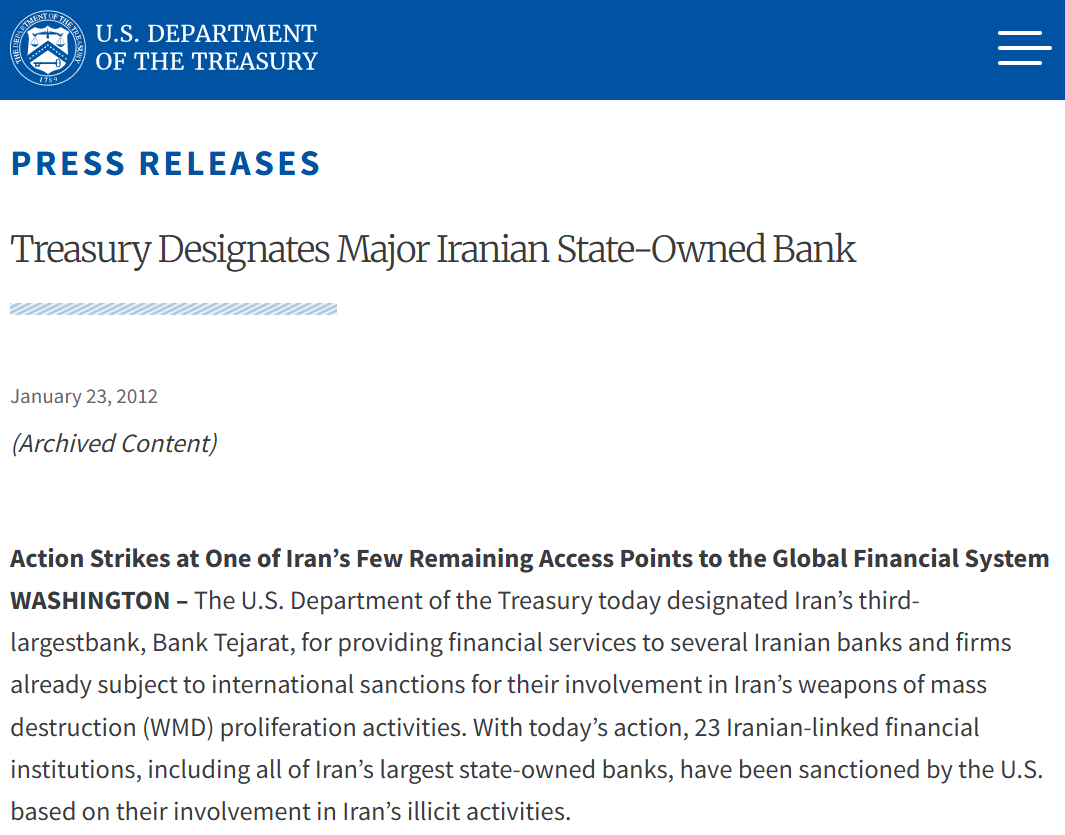
Moon identifies Bank Tejarat as one Iranian bank used by Skycom.
The presentation proposes ways around Iran’s currency restrictions, including letters of credit settled through Dubai under the “Irancell model.”
“There is currently no legal channel to exchange local currency,” one slide states.
Other proposals include selling Persian rugs into China and transferring as much as $20 million monthly to Chinese oil giant Sinopec.
Another slide warns that no fully reliable remittance route to China exists, describing letters of credit as the least risky option.
When Moon appears to interpret the document beyond her qualifications, Bitkower objects. After a sidebar, Donnelly sustains the objection.
Solomon returns to the MOU involving Panda, CMEC, Arya Hamrah and Skycom.
The document describes Iranian rial payments to Skycom, matched by dollars reaching Panda and CMEC in China through intermediaries.
An Arya Hamrah reconciliation statement and accompanying records identify Silsila General Trading LLC, a Dubai intermediary.
Moon connects the arrangement to Huawei’s earlier presentation about moving money through third countries. Her chart traces three USD payments from Silsila through a New York bank to CMEC in China.
Another intermediary identified is a UAE company called Lord Holding.
An Arya Hamrah email directs payment to Panda after an equivalent sum was paid to Skycom in rials.
Solomon asks whether this fits the pattern of local payments to Skycom followed by dollars passing through New York to China. Referring to invoice designation “A2,” Solomon calls it a “secret code.”
Bitkower objects. Donnelly sustains.
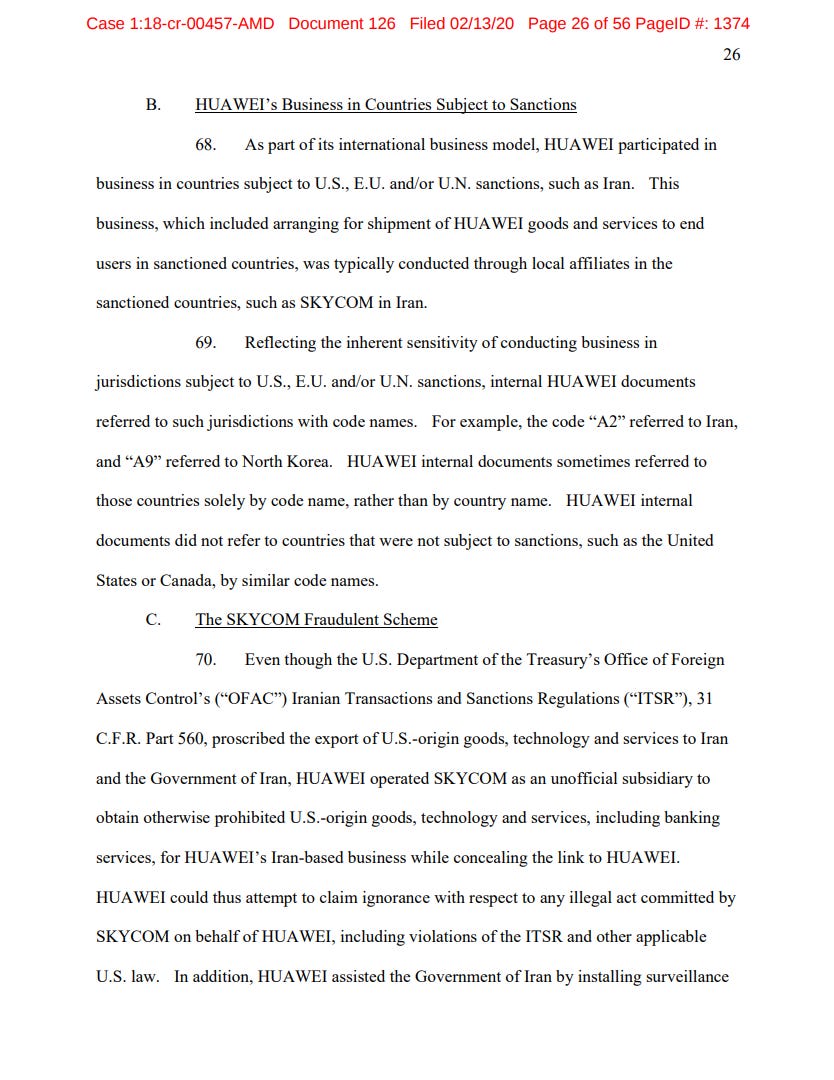
Other exhibits include packing lists bearing Huawei and Panda logos and a Huawei regulatory-compliance document obtained by subpoena.
A November 2012 document states that worsening conditions in Iran prompted Huawei to stop seeking new customers and reduce its presence.
At the end of my pew, an Asian man takes notes in Chinese in a black notebook, then lowers his head for a nap. An attorney? Someone from the consulate? I cannot tell.
Records from October 2012 show approximately $84,000 in Skycom payments to Networkers, a staffing company, routed through a New York bank.
In May 2013, Skycom paid Networkers another $54,000 through correspondent banks and CHIPS, involving JPMorgan Chase and HSBC.
At 1:04 p.m., Judge Donnelly announces a break for lunch until 2:30.
Outside the courthouse, a juror checks her phone in the sunshine before walking toward the Brooklyn Heights Promenade, where the neighborhood ends in a sweeping view across the East River to Manhattan’s Financial District, home to the banks she’s just heard so much about from the prosecutor.
