

This is the sixth in our series of blog entries with in-person coverage from the ongoing trial of Huawei Technologies (华为技术). Entry #1. Entry #2. Entry #3. Entry #4. Entry #5.
Trial Day 31: November 3, 2026
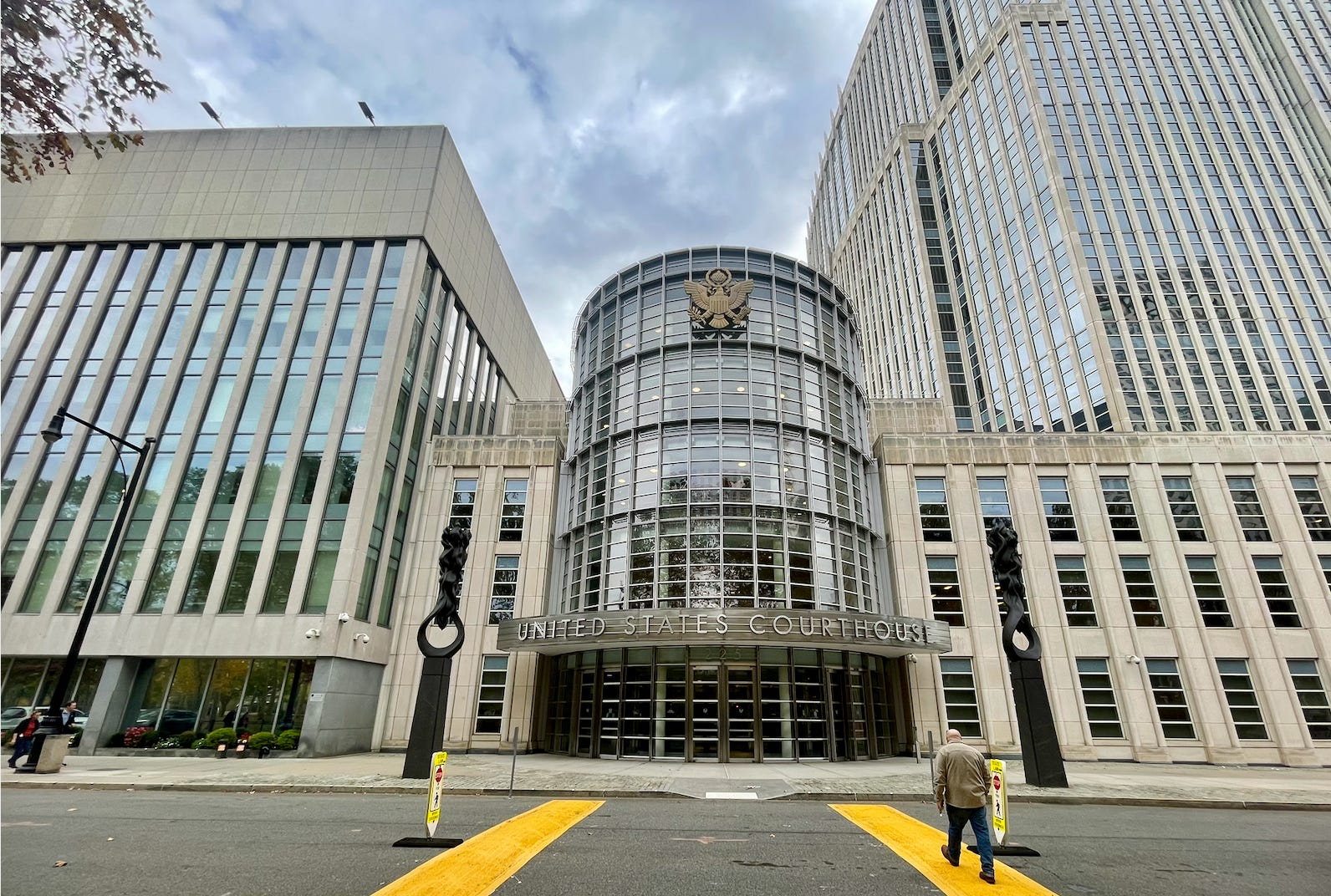
At 9:30 a.m. on Tuesday, November 3, U.S. mid-term Election Day, I arrive at the federal courthouse in downtown Brooklyn. Upon entering courtroom 6D South I am greeted by Jackson, a lawyer I have met before who is, as usual, sitting in the back row.
“It’s going to be a short day,” he says, adding that the defence may rest the week of November 9, with perhaps a day of government rebuttal to follow. He thinks the trial could be wrapping up around Monday, November 16. That is Jackson’s prediction, not the court’s schedule.
Above the bench, the seal of the U.S. District Court for the Eastern District of New York depicts an eagle with an olive branch in one talon and a clutch of arrows in the other. Peace and force, rendered in silver: a fitting emblem for a courtroom where competing accounts of corporate conduct are being tested, one exhibit at a time.
Shortly before 10 a.m., we all stand for Judge Ann M. Donnelly’s arrival.
Two Chinese women in dark suits speaking Mandarin sitting in front of me in the gallery are not, it turns out, the lawyers I thought they might be, but a duo of court interpreters who accompany the morning’s witness to the stand. He is retired Huawei employee Han Shitao [spelling unconfirmed], a short, bespectacled Chinese man wearing a dark gray sports jacket, white shirt and dark trousers. No tie.
A mailbox open to 150,000 employees
At 10:01 a.m. the jury enters and Assistant U.S. Attorney Matthew Skurnik resumes the government’s cross-examination. Skurnik takes Han back to the summer of 2013 and a Huawei Device memorandum, Government Exhibit 16336, promoting a campaign to incentivise Huawei employees in the collection of competitive intelligence [see Huawei on Trial #3].
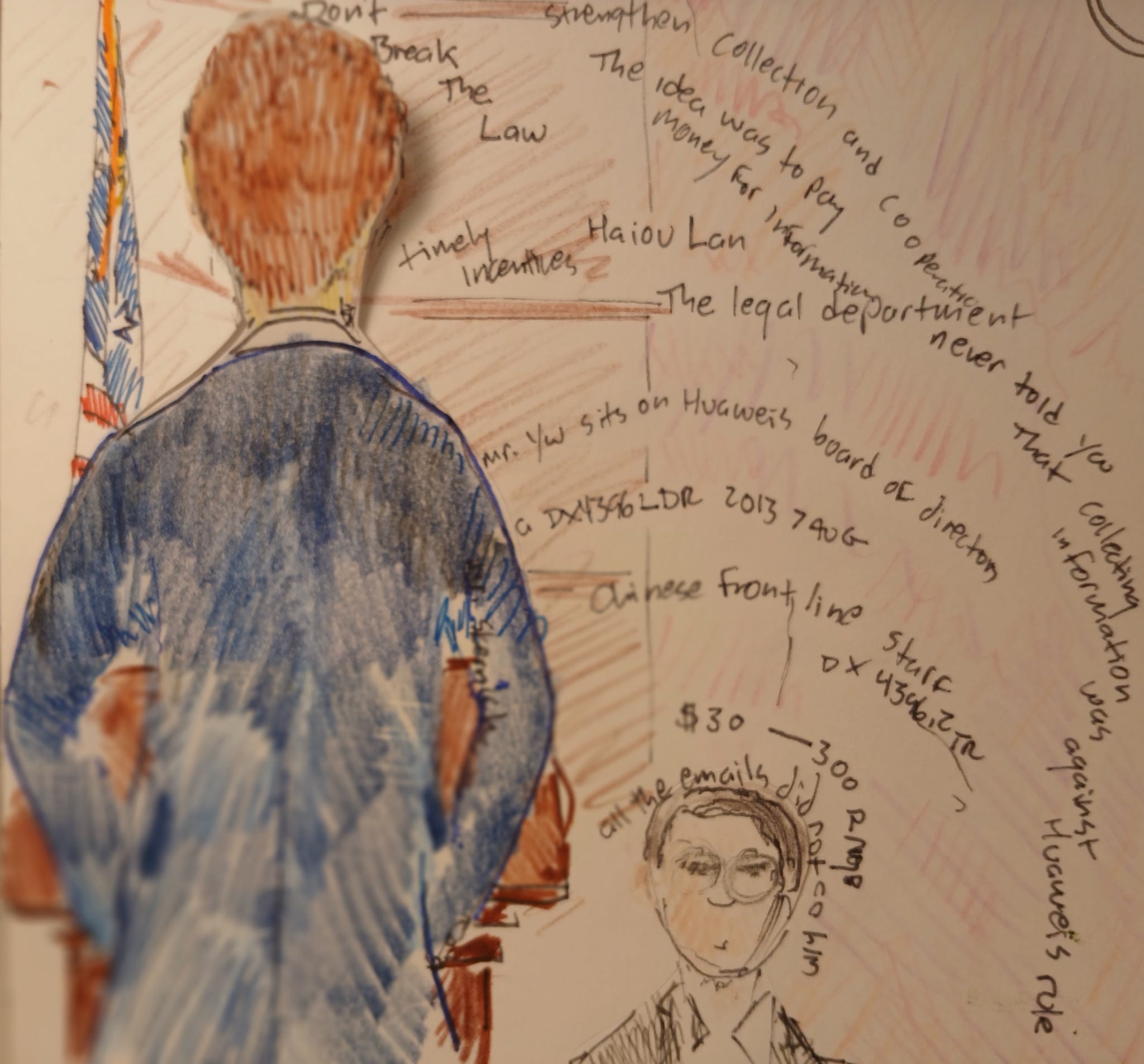
Han explains that Huawei had established a regional sales organization when its international business was still relatively small. The company also operated a “device competition community” on its intranet, with a special mailbox for submissions about competitors.
Questioning Han, Skurnik establishes for the jury that the community had no access restrictions. Huawei had roughly 150,000 employees in 2013, Han says, and, in principle, any of them could view the material or send information to the mailbox. Han was not an administrator. He does not know who created the mailbox, though he believes it predated the 2013 campaign.
The original memorandum offered rewards for competitive intelligence, ranked in four tiers. The awards ranged from 200 to 2,000 yuan, with higher-value submissions eligible for greater rewards. Han says the money would come from departmental office expenses. He oversaw a sales team of about 10 people and regarded the scheme as a modest, spur-of-the-moment way to encourage work his salespeople should already have been doing: visiting retail stores and learning about rivals’ products.
Han says he cleared the expense with his supervisor, Liu Jianfeng [spelling unconfirmed], who raised no objection. Neither man, Han insists, intended to encourage unlawful conduct. Even now, he says, he believes encouraging sales staff to gather legitimate commercial intelligence is a good idea.
Competitive Intelligence
Huawei’s competitive intelligence campaign emerged amid Beijing’s push for technological self-reliance. At the Communist Party’s 18th Congress in November 2012, outgoing leader Hu Jintao urged Chinese companies to accelerate indigenous innovation (自主创新), overcome technological bottlenecks and strengthen their global competitiveness. Eight months later, by which time XI Jinping had fully replaced Hu, both as General Secretary of the CCP and President of the People’s Republic, Huawei launched a program rewarding employees for collecting competitors’ product roadmaps, pricing and confidential business information—a practice known as competitive intelligence (竞争情报). Whether the campaign reflected Beijing’s industrial policy, Huawei’s commercial ambitions or both remains unclear. No public evidence establishes that the Party specifically ordered it.
The words that caused the trouble
The prosecutor’s questions narrow to the language of the July 10 memorandum, drafted by Huawei executive Kevin Gu. Some rewards appeared to depend on the value and confidentiality of the information supplied. Han acknowledges that he skimmed the document rather than reviewing it word for word.
“Had I drafted it myself, I would not have chosen that language,” Han says through one of the court interpreters, calling himself “careless” as the wording was easily misunderstood.
Supervisor Liu also received the memorandum and did not request changes, Han confirms. It circulated to Huawei personnel internationally. Complaints followed almost immediately, including warnings about legal risk. A July 12 email, introduced as a defence exhibit, bluntly criticized the problems the memo’s wording had created.
Han says he was astonished: he had thought he was simply asking colleagues to do their jobs.
Huawei withdrew the memorandum and instructed recipients to disregard and delete it. Han acknowledges the possibility of disciplinary consequences but distinguishes the warnings from what actually happened. He says no one was fired or demoted, no pay was docked and no formal disciplinary penalty was imposed on him. He was, however, sharply criticized. Gu, who wrote the memo, was not fired.
The government produces an email in which Liu writes that he bears “management liability” for the matter. Han disputes the implication of the English translation. In Chinese, the expression conveyed an apology rather than an admission of sole responsibility, Han says.
All three men—Han, Gu and Liu—shared responsibility, Han says, and Liu was trying to protect him.
“Mr. Han, are you familiar with the term ‘fall guy’?” Skurnik asks.
Han says he knows its meaning but rejects it as irrelevant in this situation: the campaign had not been intended to do anything wrong.
Withdrawn, rewritten—and sent again
What happened after the original memo encouraging competitive intelligence gathering was withdrawn soon becomes the central question. Government Exhibit 13689-T concerns a July 15, 2013 email in which Han withdraws the original memorandum and acknowledges the legal risks it posed.
By July 18, he and Gu were working with Huawei’s legal department on another draft. One version, described in court as “version 3.0,” retained much of the original scheme.
The new text explicitly instructed staff to comply with local law and Huawei’s Business Conduct Guidelines, or BCG, and forbade illegal methods of obtaining information. It also warned that employees who violated those rules would be acting for themselves, not the company. But the draft still described four rankings, monthly rewards, annual regional reviews and the special competitive-intelligence mailbox. Higher-ranked information was still to be encrypted when submitted.
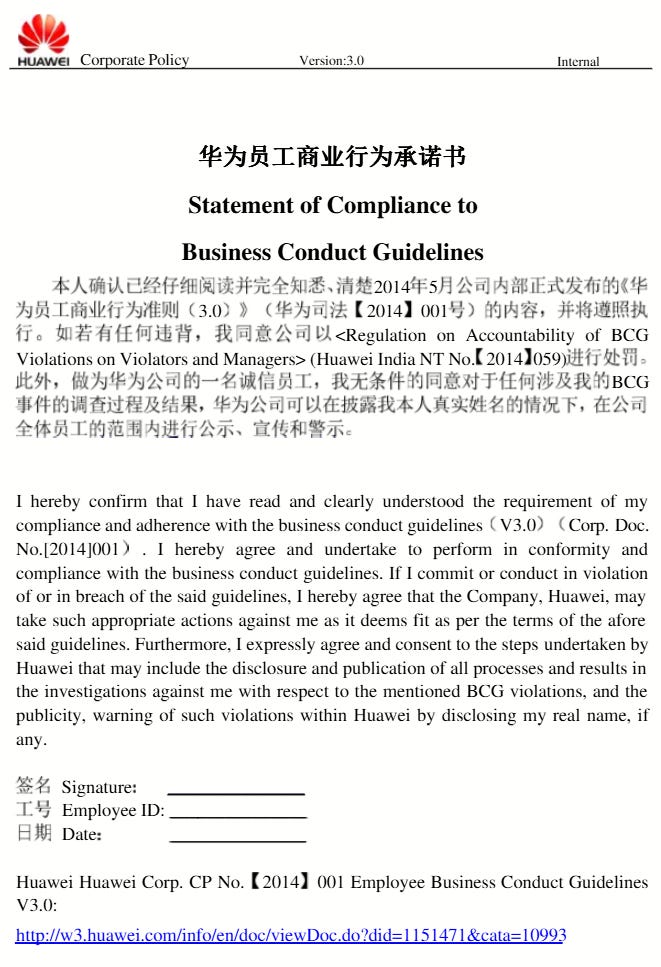
Skurnik presses the point: legal compliance language had been added, but the underlying solicitation of competitive intelligence survived. Han agrees that legal staff did not halt the initiative. His understanding was that gathering information from ordinary, lawful sources was consistent with the BCG. He says the particular 3.0 draft shown in court was never used.
What’s more, Skurnik notes, the name of senior executive Richard Yu, who now sits on Huawei’s board, appeared on the memo’s distribution template. Han says that does not mean Yu knew about the campaign. He does not know whether Liu discussed it with Yu and believes Yu was never briefed.
The prosecutor then turns to an August 7 email from Gu and the final revised memorandum, Defence Exhibit 4396.2-TR. It went to Chinese frontline staff about a month after the original had been circulated and withdrawn. The revised text kept the same memorandum number, 2013-42, and still encouraged employees to submit competitive intelligence information. A separate incentive chart was contemplated, but Han says he abandoned it.
“The personal criticism I received was enough. I did not want to continue the rewards programme. I just wanted it to be over,” Han says.
To his knowledge, the incentive chart was never relaunched.
The defence: a culture of compliance
At 11:06 a.m., Judge Donnelly calls a twenty-minute break. When proceedings resume, Skurnik finishes his cross-examination and soon Huawei defence attorney Julia Gatto of the law firm Steptoe takes up the redirect. Her questions return repeatedly to the company’s Business Conduct Guidelines. Were they taken seriously?
Han says employees treated the BCG as a kind of “Constitution”—or “Bible.”
Gatto emphasizes that staff themselves raised concerns about the original wording, that management ordered the memo withdrawn and that the replacement added explicit safeguards. Han says the campaign was meant for his department, and that he had initially seen no need to spell out the BCG. Once complaints arrived, he saw the need to include new language. No one, he says, had applied for an award before the original programme was stopped.
The defence also revisits reprimanding emails, including Government Exhibit 16385. Han regards the criticism from superiors as punishment, even if it was not formal discipline. Several of Gatto’s questions draw objections from the government, and Judge Donnelly cautions her against leading the witness. The exchanges underscore the competing interpretations: prosecutors portray a broad incentive scheme that survived legal warnings; Huawei portrays an ill-worded local initiative caught and corrected by its own compliance system.
The Bible, the Constitution and a final question
On recross, Skurnik returns to Han’s description of the BCG as Huawei’s “Bible” or “Constitution.” If it is that important, he asks, does it apply from the lowest-ranking employee to the most senior executive?
“Correct,” Han says.
The prosecutor directs him to Defence Exhibit 503-BCG, section 4.2, which instructs employees conducting external business not to make misrepresentations and to correct mistakes promptly.
“It instructs employees not to lie, right?” Skurnik asks.
“Correct,” Han says.
Han leaves the stand at 12:04 p.m., accompanied by the interpreters.
White noise fills the courtroom during a sidebar. Judge Donnelly then tells jurors that five government exhibits associated with the testimony of FBI forensic accountant Jennifer Moon [See Huawei on Trial #4] are being demoted from evidence to “demonstratives.” They are GX-20503, 20504, 20505, 20559 and 20564.
Judge Donnelly declines to predict exactly what will happen next.
“The case is moving much faster than expected,” she says, noting some jurors’ facial expressions of disappointment. “I hope you’re not mad!”
“Stay healthy, enjoy the weekend,” Judge Donnelly tells the jury, dismissing them at 12:09 p.m.
The lawyers remain.
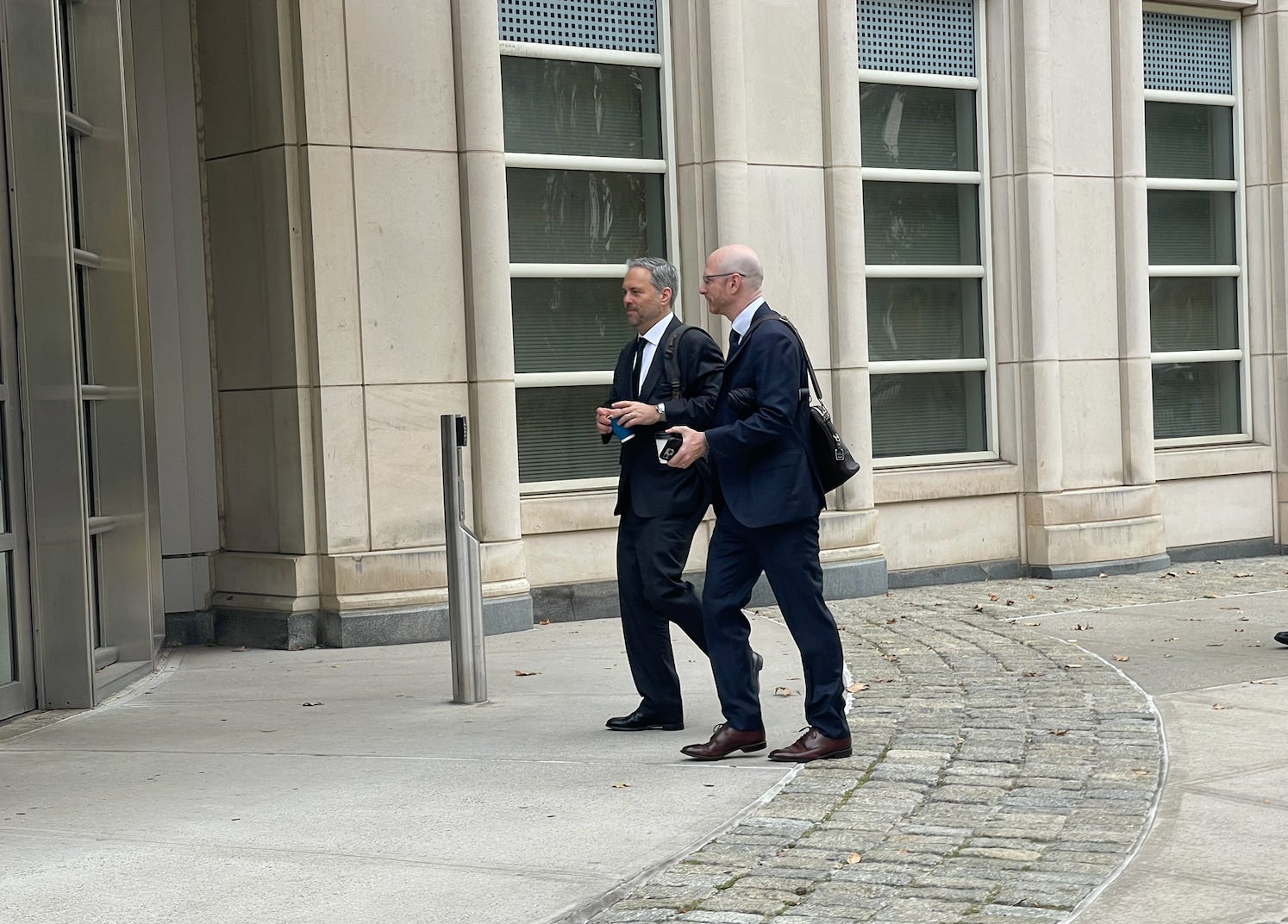
Lead prosecutor Alexander Solomon says the government is going to object to Chinese bank records Huawei has just received from China that they claim are relevant to the testimony of FBI agent Moon.
Solomon says the government is asking for complete records rather than the narrow selection Huawei defence lawyer David Bitkower of Jenner & Block wants to introduce. Judge Donnelly questions their relevance and materiality and reminds counsel that she will instruct the jury that “an indictment is not proof of a crime.”
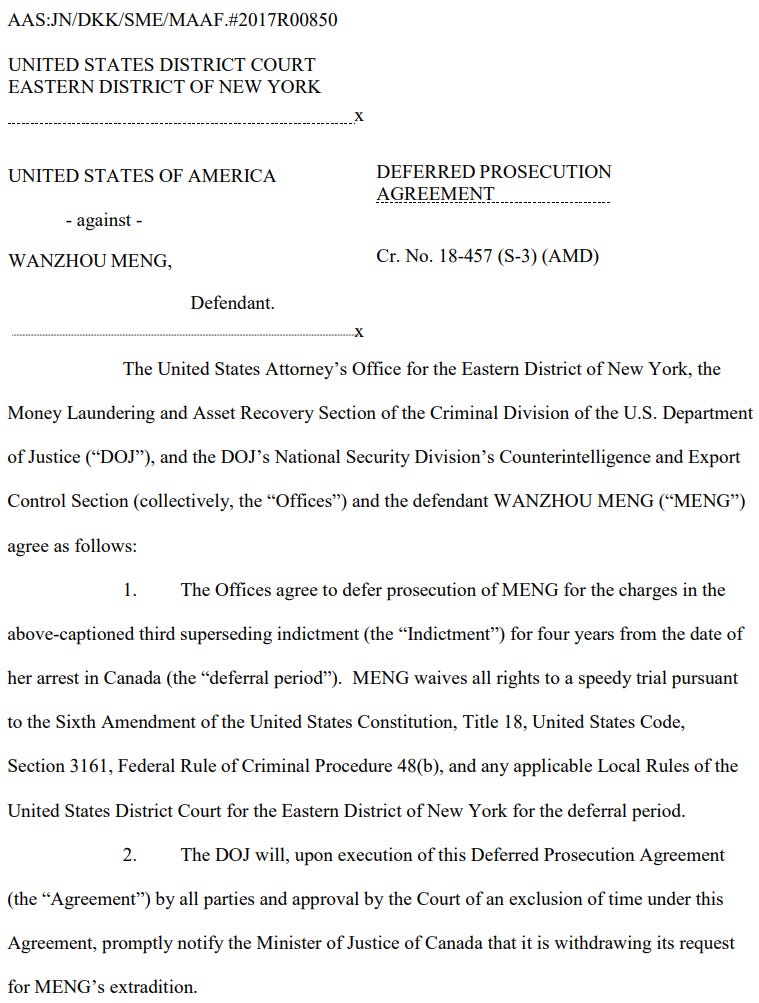
Judge Donnelly also briefly says she will not admit discussion of the circumstances around the admission of Huawei CFO Meng Wanzhou’s 2021 Deferred Prosecution Agreement (DPA).
The Crawford Waiver
Under the U.S. Supreme Court’s 2004 Crawford v Washington ruling, criminal defendants have the right to confront and cross-examine witnesses whose testimony is used against them.
This is an issue in Huawei’s trial because prosecutors have introduced admissions made by Huawei CFO Meng Wanzhou in her 2021 deferred prosecution agreement, which allowed her to return to China without pleading guilty.
Huawei argues that using Meng’s statements without allowing the company — the company her father founded — to cross-examine her violated its constitutional rights.
In June 2026, Judge Donnelly ruled that the statements Meng made in the DPA were admissible, allowing prosecutors to use Meng’s admissions about Huawei’s dealings with Iran without calling her to testify.
As the lawyers prepare to leave for the weekend, Solomon teases Huawei lawyer Douglas Axel of Sidley Austin.
“Are you done, Doug?” Solomon asks. “You look like you have the smile of a man who’s done.”
“We’ll see,” Axel says with a shrug and a smile.
“He’s not giving away anything,” a Solomon colleague says.
For now, the answer remains the same as it was at the start of the morning: the end may be near, but nobody is ready to say exactly when.
AUTHOR’S NOTE
The court bars recording devices and does not make transcripts available immediately. Quotes are based on my notes.
RESOURCES
“The world’s largest telecoms firm is on trial and the outcome has global implications,” NPR’s “All Things Considered,” Rob Schmitz interviews Michael Kovrig on the Huawei case, November 8, 2026
“Catch Us If You Can,” Noah Berman, The Wire China, November 1, 2026
“The story behind the Huawei story—it’s not a politically-orchestrated car accident in slow motion,” Strand Consult, December 14, 2018
This is the fifth in our series of blog entries with in-person coverage from the ongoing trial of Huawei Technologies (华为技术). Entry #1. Entry #2. Entry #3. Entry #4. Entry #5.
