

This is the seventh installment of Strategic Narratives’ in-person coverage of the federal criminal trial of Huawei Technologies (华为技术) in Brooklyn. Previous coverage: Huawei on Trial #1, #2, #3, #4, #5, #6.
As Huawei’s sprawling U.S. criminal trial neared closing arguments in Brooklyn, the defence portrayed the Shenzhen-based chip-maker and telecommunications giant as a company that developed its own technology, respected intellectual property and dealt openly with its bankers.
Prosecutors challenged that account, questioning what the banks knew, whether employees followed company rules, and what happened to a chip that came loose from an American circuit board entrusted to a Chinese researcher working for Huawei.
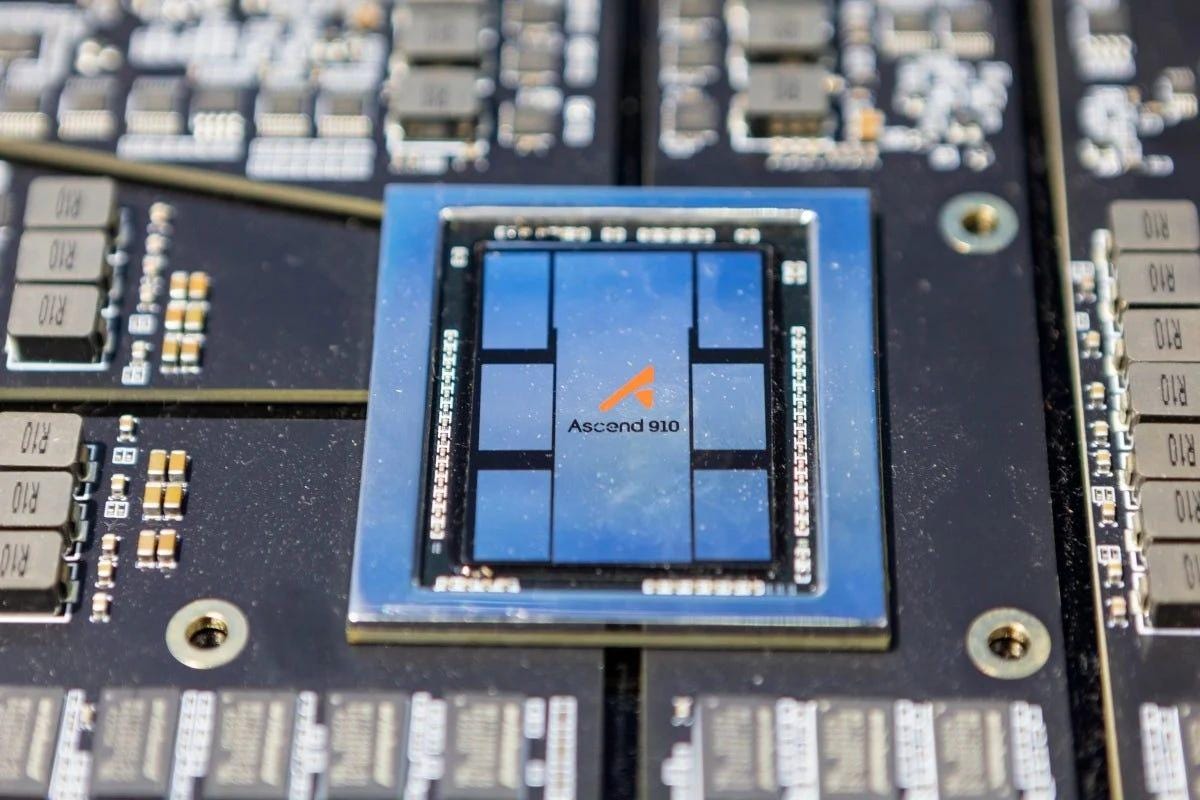
The stakes extend far beyond Brooklyn. As Washington grapples with controversy over embattled Nvidia’s advanced AI chips reaching China, Huawei is emerging as Beijing’s leading domestic challenger to the American semiconductor giant.
The dispute casts a geopolitical shadow over President Donald Trump’s planned APEC meeting with Xi Jinping in Shenzhen on Thursday, Nov. 19, bringing the competition for AI supremacy into sharper focus.
Huawei faces felony charges including racketeering, trade-secret theft, bank fraud and sanctions-related offences. Read the full indictment here.
Trial Day 35: November 10, 2026
What did the banks know?
On Tuesday November 10, in federal court in Brooklyn, Huawei’s defence returned to a simple question: What did its bankers know about Skycom, the company at the centre of allegations that Huawei concealed business in Iran?
The answer—Huawei’s lawyers suggested through emails, account applications and telegraphic transfer instructions—was quite a lot.
Before the jurors entered her courtroom Judge Ann Donnelly settled a dispute between the government and Huawei over Chinese bank records that Huawei received in late October but did not supply to prosecutors until November 5.
Donnelly expressed disappointment over the delay but found no violation sufficient to exclude the material. Defence attorney David Bitkower of Jenner & Block apologised and accepted responsibility.
The courtroom had the familiar atmosphere of a long-running trial. A whiteboard beside the jury box held photographs of HSBC employees. It had served its purpose and was wheeled out. The public gallery was busy with lawyers and observers. A courtroom sketch artist worked in the front row, pastels at hand and binoculars around her neck for studying faces across the room.
Once assembled, the jury heard from Stefan Brown, a Nardello & Co. data analyst . Assistant U.S. Attorney Matthew Skurnik questioned him about charts based on Huawei payroll records, which the defence used to show departures and new hires at Huawei Technologies USA and Huawei Device USA during 2017 and 2018.
Brown’s analysis had limitations. He treated gaps exceeding six months in payroll data as evidence of termination but had not consulted human-resources staff or reviewed transfer records. A payroll departure, he conceded, did not necessarily mean an employee had left the country. His assignment was to analyse spreadsheets, not investigate employees’ movements or motives.
Next came David Williams, global head of business investigations at FTI Consulting and a former IRS trial attorney and investigator. Huawei retained him to review selected records involving HSBC, Standard Chartered and Huawei.
Dozens of exhibits followed, many predating the December 2013 controversy over Huawei’s relationship with Skycom.
An HSBC record dated May 7, 2009, concerned a €10 million transfer from Skycom to Huawei Technology Investment. Another described a €200,000 transfer in the opposite direction, intended for subsequent remittance to Iran.
Other records showed Skycom sending funds to Tehran. A June 25, 2009, transfer request involved €300,000 to Bank Tejarat in Tehran. Williams described roughly 40 such applications. Another documented a €1.5 million transfer from Skycom Hong Kong to Skycom Iran.
The paper trail was extensive — and, crucially for Huawei’s argument, ran through the international banks’ U.S. operations.
In a June–July 2009 exchange, HSBC banker Helen Wong asked Huawei employee Dickens Zhang to explain Skycom’s business and interests in Iran.
Zhang replied that Skycom was incorporated in Hong Kong, operated as a contractor in Iran and supplied technical services for telecommunications infrastructure projects. He described payments for staff, bonuses, visas and market research. More than 90 percent of Skycom’s business was in Iran, he said, where it maintained a Tehran representative office.
The defence then turned to corporate structure.
In September 2011, HSBC banker Suki Tang requested information about Skycom’s relationship with Huawei. Zhang supplied a Hong Kong companies registry document showing Skycom’s shares held by Mauritius-based Canikula Holdings rather than Huawei.
An internal HSBC email drew a distinction: Huawei did not own Skycom but had handled its management all along.
That distinction lies at the heart of the competing narratives. Huawei argues the banks knew of the companies’ connections. Prosecutors allege Huawei misled financial institutions about the true nature and risks of its Iranian operations.
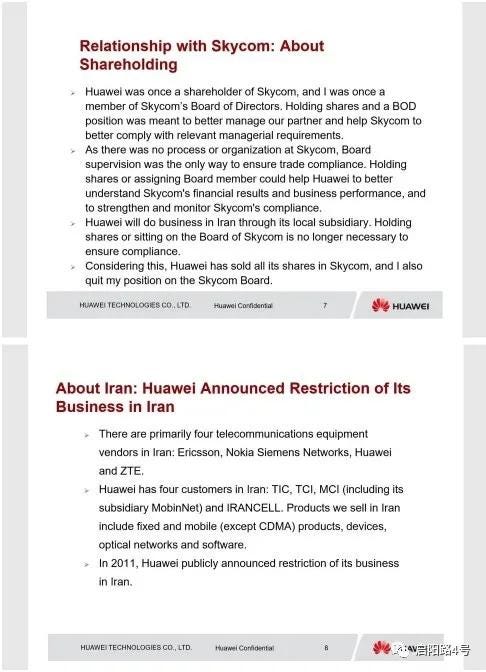
The documents continued through Canikula, linked to accounts in the United Arab Emirates. One application identified Tiger Nominees as Canikula’s owner and Huawei as “the introducer.”
Huawei regional treasury manager Yu Haiyong, also identified as Kevin Yu, appeared in account materials. Other correspondence placed Huawei employees in repeated contact with HSBC over Skycom and Canikula accounts.
A 2007 Skycom board record indicated Huawei approval was required for account signatories. An October 2012 email referred to Skycom as part of the “Huawei Group.” Williams also discussed a February 2013 request to close a Skycom account and transfer its balance to Huawei Technology Investment.
These were hardly records of companies that never crossed paths.
But Williams’s review had limits. He examined approximately 325 emails, 40 attachments and correspondence involving roughly 40 HSBC email addresses. The material, selected by Huawei’s lawyers, did not include every communication by key relationship bankers, including Alan Thomas.
Williams’ testimony could not establish what every banker knew or understood.
After the jury was dismissed for lunch, Judge Donnelly and the lawyers discussed remaining witnesses and anticipated testimony concerning Iranian telecommunications companies MCI and MobinNet, including disputed characterisations of their ties to the Iranian state.
In the gallery, the lawyer Jackson and I discussed Huawei’s strategy.
Much of the evidence connecting Huawei, Skycom and Canikula might initially have appeared useful to prosecutors. Yet Huawei was introducing it itself.
Perhaps the company hoped to demonstrate transparency, Jackson said. If bankers routinely received transfers, ownership documents and account instructions linking these companies, how hidden could their relationship have been?
That was the question the defence wanted jurors to ask.
Whether it answers the government’s allegations of deception is another matter. Jurors must decide not merely whether bankers saw the companies’ names together, but what they were told, what they understood and what was withheld.
Trial Day 37: November 12, 2026
A company that says it played by the rules
Two days later, on Thursday, November 12, Huawei shifted from banking records to another central allegation by the U.S. government: that the Chinese telecommunications giant systematically sought competitors’ intellectual property.
Huawei’s witnesses described a company that invested heavily in research, trained employees to respect intellectual-property rights and prohibited the misuse of competitors’ confidential information.
Veteran research executive Miguel Antonio Dajer joined Huawei’s Futurewei operation in New Jersey after a career at AT&T, Bell Labs, Lucent and Alcatel-Lucent.
He described American engineers developing wireless technologies for Futurewei two generations ahead of the market, funded by Huawei in China but developed locally. Futurewei’s intellectual property, he acknowledged, belonged to Huawei.
Dajer said his superiors never instructed him to obtain competitors’ confidential information. He described export-control training, nondisclosure agreements and hiring practices designed to prevent recruits from revealing proprietary information belonging to former employers.
Dajer’s testimony supported a straightforward defence narrative: Huawei recruited experienced researchers to innovate, not steal.
Prosecutors challenged the limits of his knowledge and his credibility. Dajer could not attend every job interview or know every question asked of potential recruits, could he? No. Hadn’t he testified for Huawei previously and met repeatedly with its lawyers? Yes. Wasn’t his testimony part of his work for the company? Yes. Wasn’t his annual bonus tied to his work performance? Yes. Dajer maintained he would have stopped improper IP disclosures during the hiring process he oversaw.
Huawei next called Vivian Kang Wei, a longtime intellectual-property executive who joined the company in 2001.
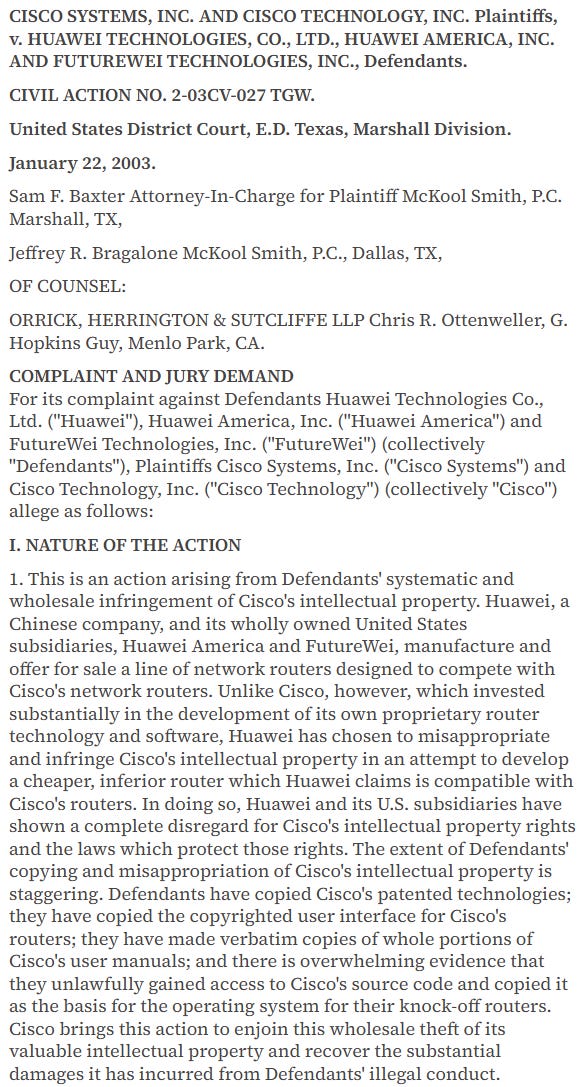
Through a team of two Mandarin language court interpreters, Kang described changes following Huawei’s dispute with Cisco, including measures attributed to founder Ren Zhengfei requiring respect for third-party intellectual property. A November 2004 directive, she testified, covered copyrights, patents, trademarks and trade secrets, with disciplinary measures extending to termination.
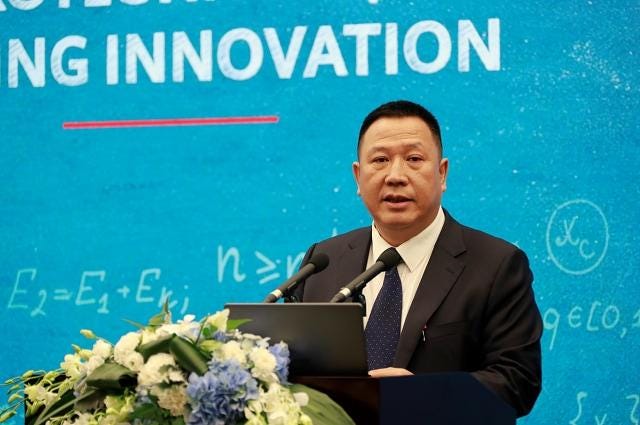
Kang sought to establish that intellectual-property compliance was directed from the top — by Ren and Song Liuping, who headed Huawei’s intellectual-property department before becoming chief legal officer.
The defence’s broader strategy was coming into focus.
Just as Huawei used bank correspondence to argue that its Iranian business relationships were not concealed, it now presented company policies as evidence that stealing technology was neither encouraged nor tolerated.
But the existence of rules did not necessarily establish that employees always followed them.
And the government still had a physical piece of evidence to put before the jury.
Trial Day 38: November 13, 2026
The broken board
On Friday, November 13, the government called engineer Ian Justice, who previously worked as an expert for the San Jose-based semiconductor company CNEX and received approximately $150,000 for that work.
Justice, an Englishman who had previously worked for the UK government in telecoms, faced close questioning from Huawei’s lawyers about his independence and technical conclusions.
The dispute concerned research by Bo Mao, a professor associated with Xiamen University, who used a borrowed CNEX open-channel solid-state-drive development circuit board while conducting research commissioned by Huawei.
Huawei sought to distinguish software testing on a “simulator” from physical measurements of the board.
Justice rejected defence attorney Doug Axel’s comparisons, which he considered technically misleading. Software commands known as “gets” and “puts,” which retrieve and store data in a simulated environment, were not equivalent to measuring the speed and efficiency of actual hardware “reads” and “writes.” “It’s apples and oranges,” he said.
Axel suggested that a chip might simply have come loose when the board was inserted into or removed from a computer.
A physical board was brought to the witness stand. Justice demonstrated how it fitted into a PCIe slot.
On redirect, prosecutor Alexander Solomon focused on the board’s JTAG connection, an interface allowing engineers to test and debug electronic components.
Justice described a 20-pin component reattached with glue and additional green wires. These alterations, he testified, were not ordinary wear from software experiments.
An active JTAG connection could permit engineers to examine a chip’s capabilities — information useful to someone designing a competing chip.
The government’s implication was that somebody had tampered with the board to gain access to its chip while the equipment was in the possession of a professor working on Huawei-commissioned research.
Justice’s testimony did not establish who made the alterations. But it challenged the defence’s effort to portray the episode as routine academic research involving borrowed equipment.
The jury heard Huawei executives describe rules against stealing intellectual property. Now it heard an engineer explain how a piece of hardware might have been altered to expose precisely the kind of proprietary technology those rules were supposed to protect.
The instructions that may decide the case
After the jury was released on Friday, the lawyers returned for a charging conference—the process of deciding how Judge Donnelly would instruct jurors before they deliberate.
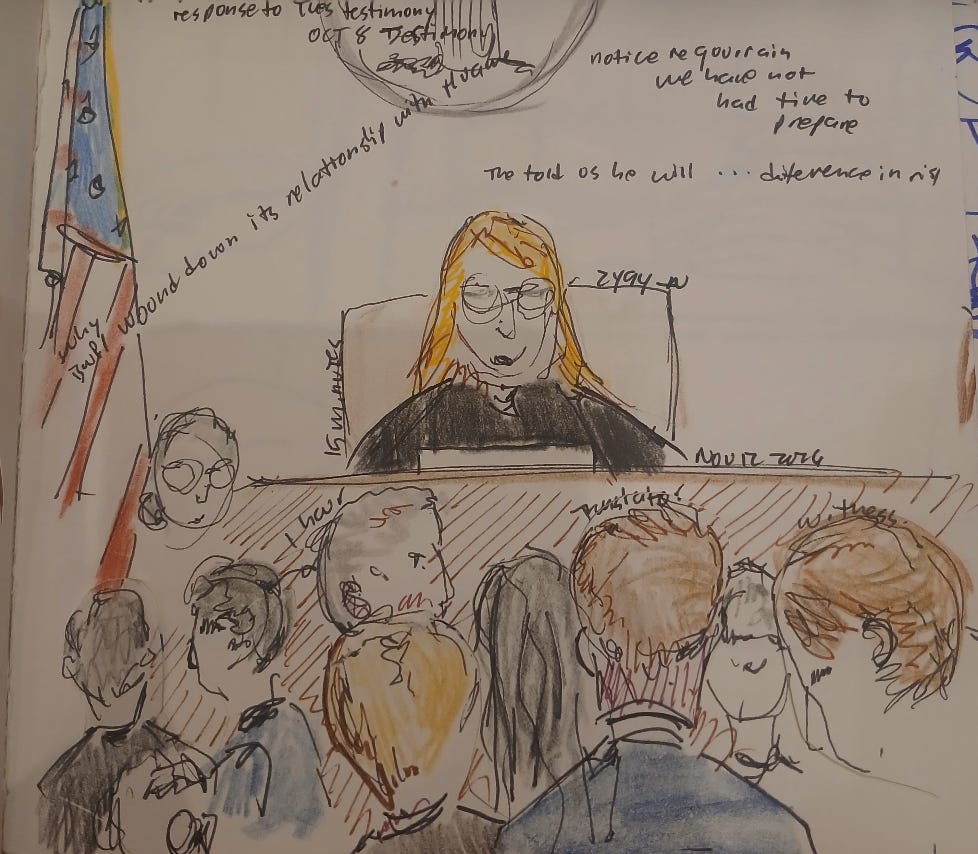
Huawei objected to an expansive theory of corporate responsibility under the racketeering and conspiracy allegations.
Its lawyers argued that prosecutors should not be permitted to assemble corporate knowledge and intent from the separate acts and states of mind of multiple employees. Judge Donnelly signalled skepticism about the defence’s proposed language.
The parties also disputed export controls and sanctions-related theories and a proposed “missing witness” instruction concerning Meng Wanzhou, Huawei’s chief financial officer.
Prosecutors said they had attempted to subpoena Meng, founder Ren Zhengfei’s daughter, through her personal lawyers at Zuckerman Spaeder.
Bitkower argued that Meng, who lives in China, was not within Huawei’s control and that inviting jurors to draw conclusions from her absence would be unfair. He also said there was no evidence that government prosecutors had tried to get to Meng through Chinese government channels.
Judge Donnelly agreed that this was not a conventional missing-witness situation and said she would not give the jury the instruction to consider Meng a “missing witness.”
By the end of Friday, she was discussing the remaining two defence witnesses, closing arguments and jury instructions. Judge Donnelly’s impatience with unnecessary length was unmistakable.
“Nobody ever leaves these wishing that speeches had been longer,” she said.
After months of testimony and a mountain of exhibits, the battle was shifting from what jurors had heard to what, precisely, they would be asked to decide.
The defence was offering a portrait of Huawei as a company whose bankers knew about its Iranian dealings, whose executives issued instructions to respect intellectual property and whose engineers developed their own technologies.
Prosecutors were challenging the completeness of that picture, questioning what the bankers actually understood, how consistently corporate rules were enforced and what happened to a borrowed circuit board.
The question now is whether Huawei’s evidence of corporate compliance and transparency can overcome the government’s allegations of deception and theft, and whether the jury will see a collection of disputed incidents — or a pattern of corporate conduct.
AUTHOR’S NOTE
The court bars recording devices and does not make transcripts available immediately. Quotes are based on my courtroom notes.
RESOURCES
“The world’s largest telecoms firm is on trial and the outcome has global implications” — NPR’s All Things Considered, Rob Schmitz interviews Michael Kovrig, November 8, 2026.
“Catch Us If You Can” — Noah Berman, The Wire China, November 1, 2026.
“The story behind the Huawei story—it’s not a politically-orchestrated car accident in slow motion” — Strand Consult, December 14, 2018.
PREVIOUS COVERAGE
