

This is the ninth instalment of Strategic Narratives’ in-person coverage of the federal criminal trial of Huawei Technologies (华为技术) in Brooklyn. Earlier entries: #1, #2, #3, #4, #5, #6, #7, #8.
The jury returns its verdict
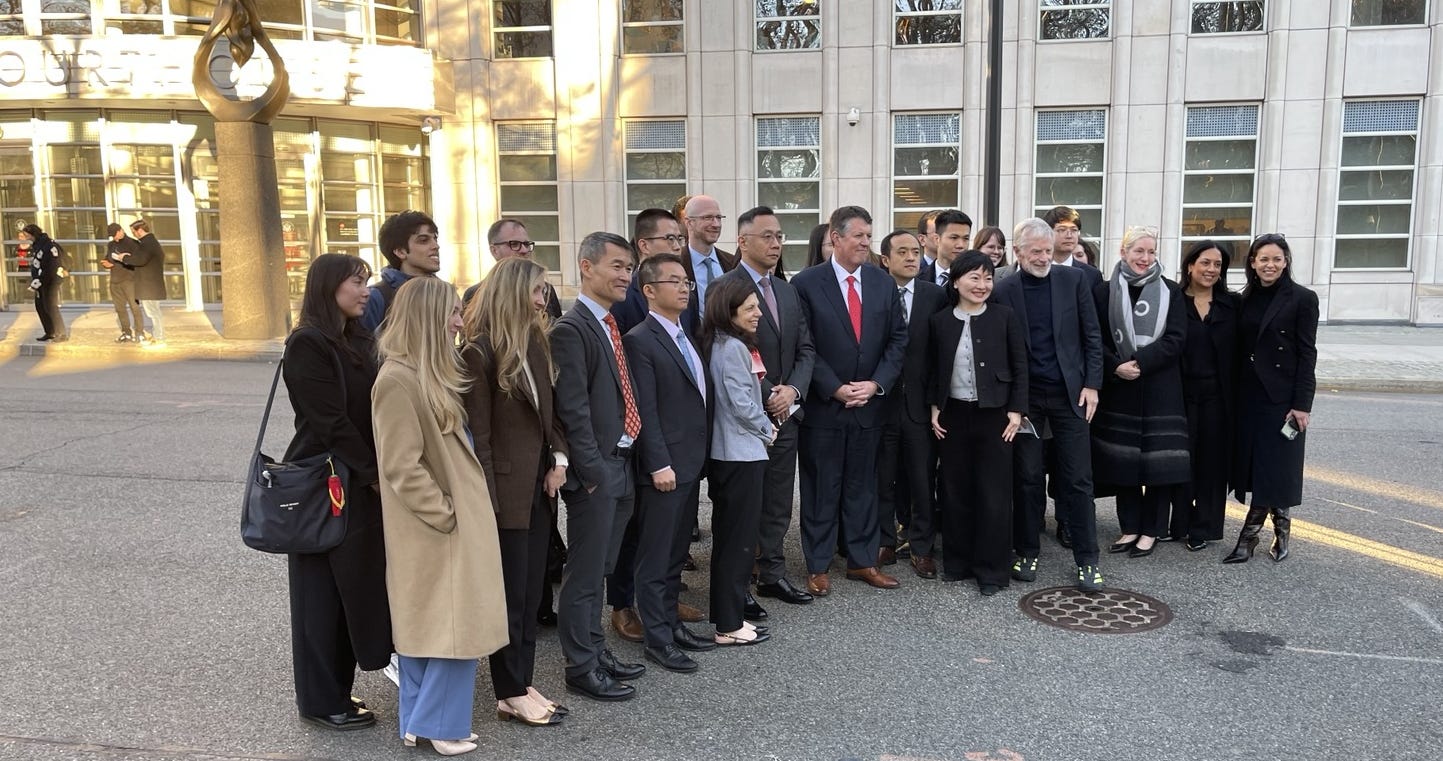
A federal jury in Brooklyn found Huawei Technologies guilty on 10 of 12 criminal counts on Tuesday, including bank fraud, wire fraud, conspiracy to steal trade secrets and conspiracy to violate U.S. sanctions.
Jurors acquitted Huawei of racketeering conspiracy, the most serious charge, and of conspiracy to obstruct justice. The racketeering count brought together allegations that Huawei and its affiliates operated as a criminal enterprise. The jury rejected that charge while convicting Huawei on counts relating to two central strands of the prosecution’s case, which began in 2018: Huawei’s efforts to obtain competitors’ technology and its dealings with banks over its business in Iran.
Jurors were presented with mountains of evidence and listened to testimony from more than 75 witnesses. In closing arguments, prosecutors said Huawei misled banks about its relationship with the Tehran-based company Skycom.
Among the documents the jurors reviewed was a 2021 deferred prosecution agreement (DPA) between the U.S. Department of Justice and Meng Wanzhou, Huawei’s CFO and daughter of the company founder Ren Zhengfei. The agreement was signed by Meng and lead prosecutor Assistant U.S. Attorney Alexander Solomon, who also led the case against Huawei. In the DPA Meng acknowledged, without pleading guilty, that she had made false statements to a bank executive at HSBC about Huawei’s relationship with Skycom and its business in Iran.
In her closing statement, Solomon’s colleague, Assistant U.S. Attorney Meredith Arfa said, “Meng committed crimes on Huawei’s behalf, and then Huawei put her in charge. That’s not a company that prohibits criminal conduct. That is a company that encourages it, demands it, rewards it.”
U.S. Attorney for the Eastern District of New York, Joseph Nocella Jr., said in an official statement, “Today’s verdict is a step towards accountability for Huawei’s criminal activities.”
The defence argued that the banks knew about Huawei’s business in Iran and challenged whether prosecutors had established the U.S. connection and intent required for the sanctions charges.
Outside the U.S. Courthouse at Cadman Plaza, an unidentified Huawei representative—a Chinese man in a grey suit, blue shirt, purple tie and spectacles—who had sat with the defence team for all 11 weeks of the trial, stood next to lead defence attorney Brian Heberlig of Steptoe LLP and thanked the Huawei trial team for nearly eight years of work. “I think it’s not a bad one,” he said of the verdict. “We will continue to fight.”
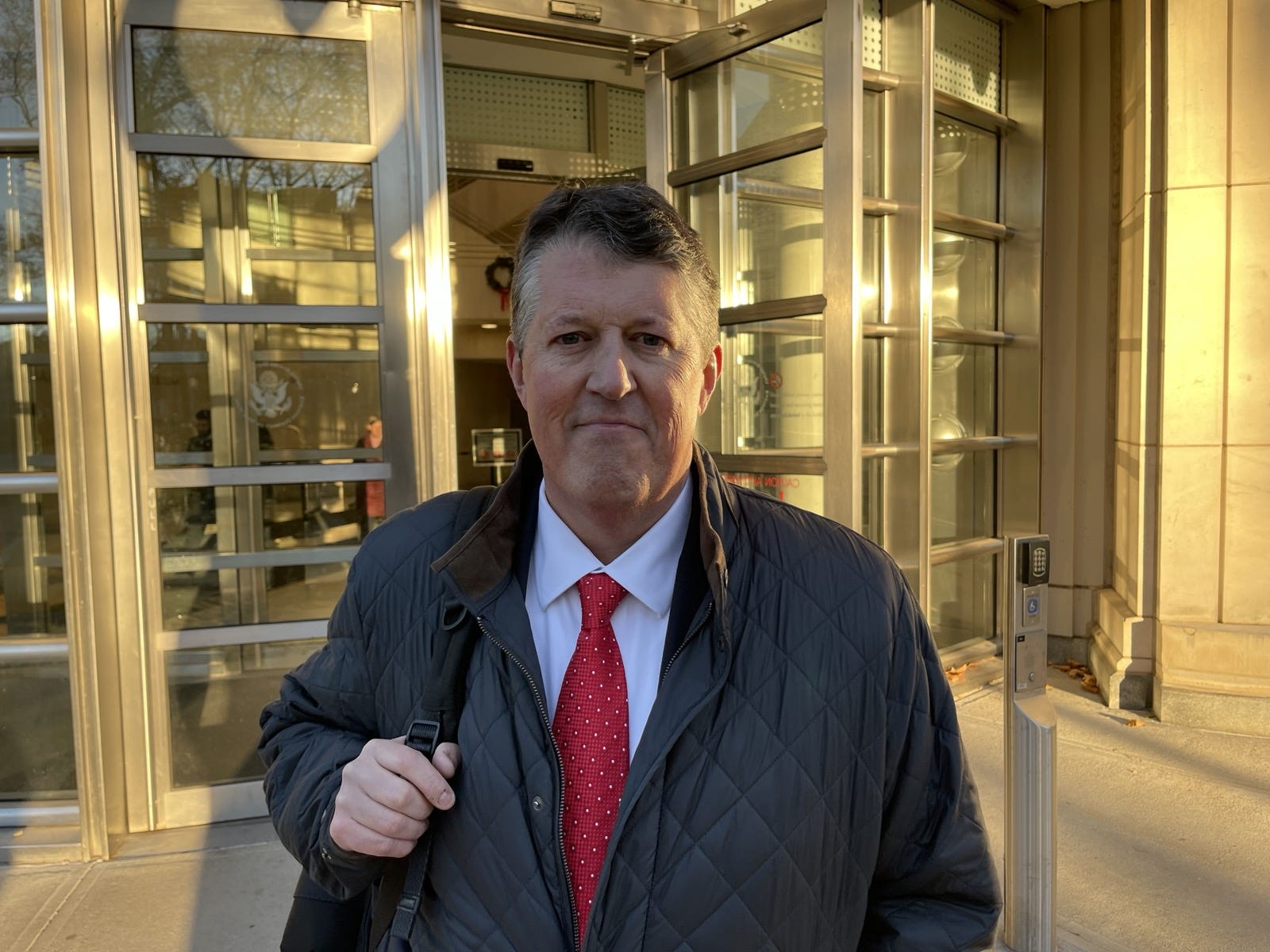
Heberlig said he felt “very mixed,” about the verdict. “We obviously wanted and believe we deserved to be acquitted on all charges.” He said the jury’s rejection of the racketeering conspiracy charge was of paramount importance to Huawei. Asked whether it had been a stretch for prosecutors to bring the allegations together under the Racketeer Influenced and Corrupt Organizations Act (RICO), he replied, “Yeah, I think it was.”
In a separate statement reported by Reuters, Huawei said the charges on which it was convicted lacked legal merit.
What comes next
“There will be an appeal,” Heberlig said, adding that Huawei had yet to file one and would go through sentencing first.
U.S. District Judge Ann M. Donnelly set sentencing for September 14, 2027.
The Huawei jury began deliberating in Brooklyn on November 18, and the next day, President Donald Trump met PRC General Secretary Xi Jinping in Shenzhen, near Huawei’s headquarters. Neither side publicly said whether the trial came up. In Washington, lawmakers from both parties cited the scandal surrounding U.S. chip giant Nvidia when calling for tighter controls on advanced chip exports to China.
U.S. export controls on advanced AI chips have helped Huawei and other Chinese chipmakers gain ground in China, where Nvidia’s share of the data-center AI chip market fell to 34 percent in the first half of 2026, Reuters reported.
On November 23, Nvidia announced that its board had voted unanimously to reinstate Jensen Huang as chief executive following his stepping down after the revelation of an extramarital affair with a woman thought by U.S. intelligence officials to be linked to China’s Ministry of State Security. The company said the board had received input from senior U.SR officials. Trump reportedly spoke directly with the board and offered assurances about the national security concerns surrounding Huang’s return.
The Huawei verdict came as the Trump administration’s war with Iran remained unresolved and Qatar was working to revive stalled talks. U.S. sanctions generally prohibit sending American equipment to Iran without authorization, including through a third country.
Commerce Department rules require a licence to export most items on the department’s export-control list.
During Trump’s first term, another Shenzhen telecom giant, ZTE, pleaded guilty in 2017 to conspiring to violate U.S. sanctions by shipping U.S.-origin items to Iran, obstructing justice and making a false statement. It agreed to pay $892 million in combined criminal and civil penalties, with an additional $300 million penalty suspended.
In April 2018, after ZTE made false statements about disciplining employees involved in the violations, the Commerce Department activated a seven-year ban that cut the company off from U.S. suppliers. Commerce lifted the ban that July after ZTE paid a further $1 billion and put $400 million in escrow under a settlement that imposed a ten-year probation period.
Editor’s note: Huawei’s trial has shed light on specific aspects of Huawei’s operations and now-confirmed criminality, but many questions about the company remain unanswered. The sentence and results of any appeals process are still to be determined. It was beyond the scope of the trial to address deeper dimensions of Western concerns about Huawei, including its potential role in enabling PRC cyber-espionage and cyber-attacks; why Xi Jinping resorted to hostage-taking and blackmail in an effort to prevent Meng from being extradited to the U.S. and her refusal to appear at the trial; the company’s relationship with the Chinese Communist Party; and its role in China’s complex political economy and national drive to dominate the commanding heights of technology and industry.
Thanks for reading and watch this space for more!
Resources
The story behind the Huawei story—it’s not a politically-orchestrated car accident in slow motion — Strand Consult, December 14, 2018
Inside the Secret Prisoner Swap That Splintered the U.S. and China — Drew Hinshaw, Joe Parkinson and Aruna Viswanatha, The Wall Street Journal, October 27, 2022
‘Huawei lobbyists’ held in Belgium raids over EU corruption — Hafsa Khalil, BBC News, March 13, 2025
Catch Us If You Can — Noah Berman, The Wire China, November 1, 2026
The world’s largest telecoms firm is on trial and the outcome has global implications,” Michael Levitt, Rob Schmitz, and Henry Larson, NPR, November 8, 2026
Chinese Tech Giant Huawei and Subsidiaries Convicted of Sanctions Violations, Fraud, Conspiracy to Steal Trade Secrets, and Money Laundering — Press Release, U.S. Department of Justice, November 24, 2026
Previous coverage
